Virginia · Department of Motor Vehicles

Virginia DMV practice test: 40 questions in 2 parts

Virginia’s knowledge test, given by the DMV, has 40 questions. The test has 2 parts: 10 road sign questions you must all get right, then 30 general knowledge questions where you need 24 right.

40

questions

34

right to pass

85%

passing score

Checked against the Virginia Driver’s Manual (April 27, 2026 edition) on October 25, 2026. How we check facts

Practice test

Take a 10-question Virginia DMV practice test

Pick an answer and check it. Every question comes with the reason behind the right answer and the sentence of an official document it rests on.

To pass here you need 9 of 10, since Virginia’s test asks for 85%.

  1. Question 1 of 10 · Traffic signals and arrows

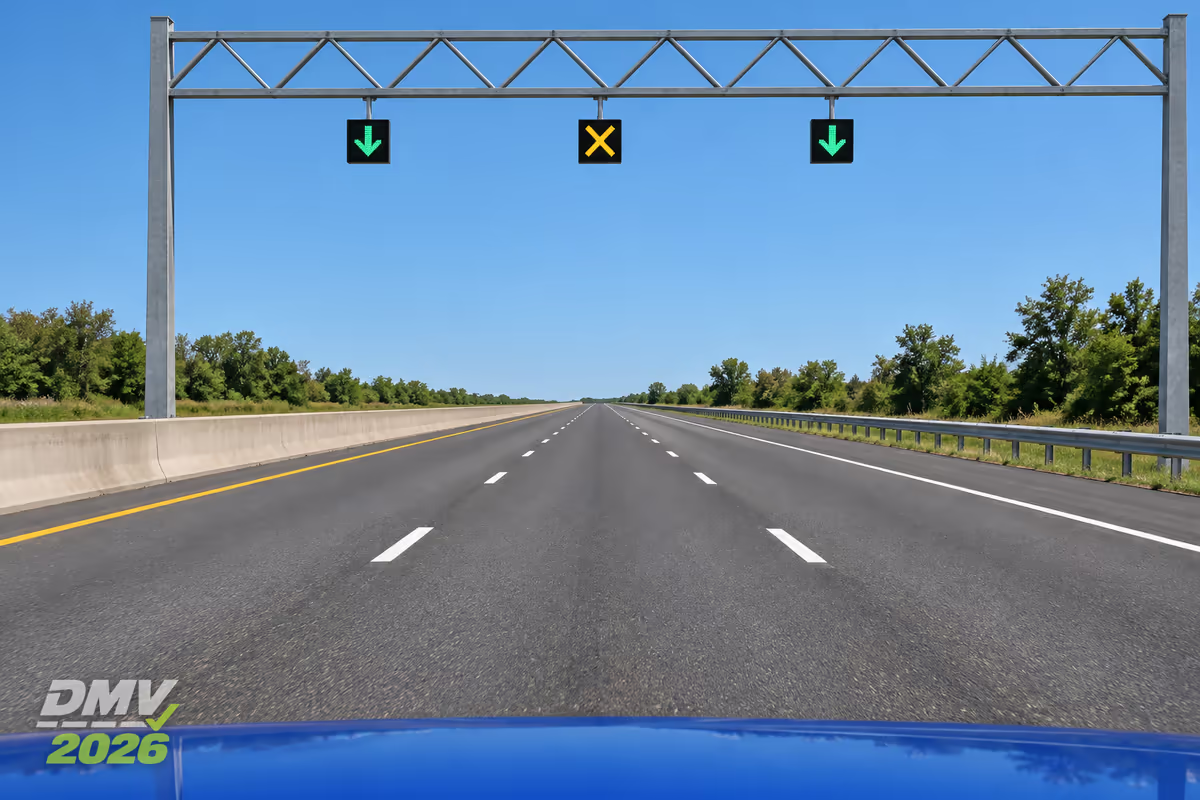
    Expressway seen from your car in the middle of three lanes, with a gantry over the road ahead. The square signal over your lane shows a steady yellow X, and the signals over the other two lanes show green arrows pointing straight down
    The signal over your lane shows this. It means the lane
    Show the answer

    The answer is B: is about to close.

    A steady yellow X means the lane you are in is about to be closed, and a red X will follow. Move into a lane with a green arrow while there is still room. It is the lane signal's version of a yellow light: a warning that red is next.

    “A steady YELLOW X signal indication shall mean that the lane which the Yellow X signal indication is located over is about to be closed to vehicle traffic in that direction and shall be followed by a steady RED X signal indication”

    MUTCD, 11th Edition, page 795
  2. Question 2 of 10 · Speed limits

    Everyone around you is driving faster than the sign allows. Your legal limit is ____.
    Show the answer

    The answer is C: the number on the sign

    The posted limit does not rise because the cars around you are speeding. Keeping up with traffic is good advice only up to the number on the sign. A line of fast cars is no defense when you are the one stopped. If the limit leaves you slower than the rest, stay in the right lane.

    “Speed Limit Signs—These black and white signs indicate the maximum legal speed allowed in ideal conditions.”

    AAMVA Model Driver’s License Manual, page 22
  3. Question 3 of 10 · Snow and ice

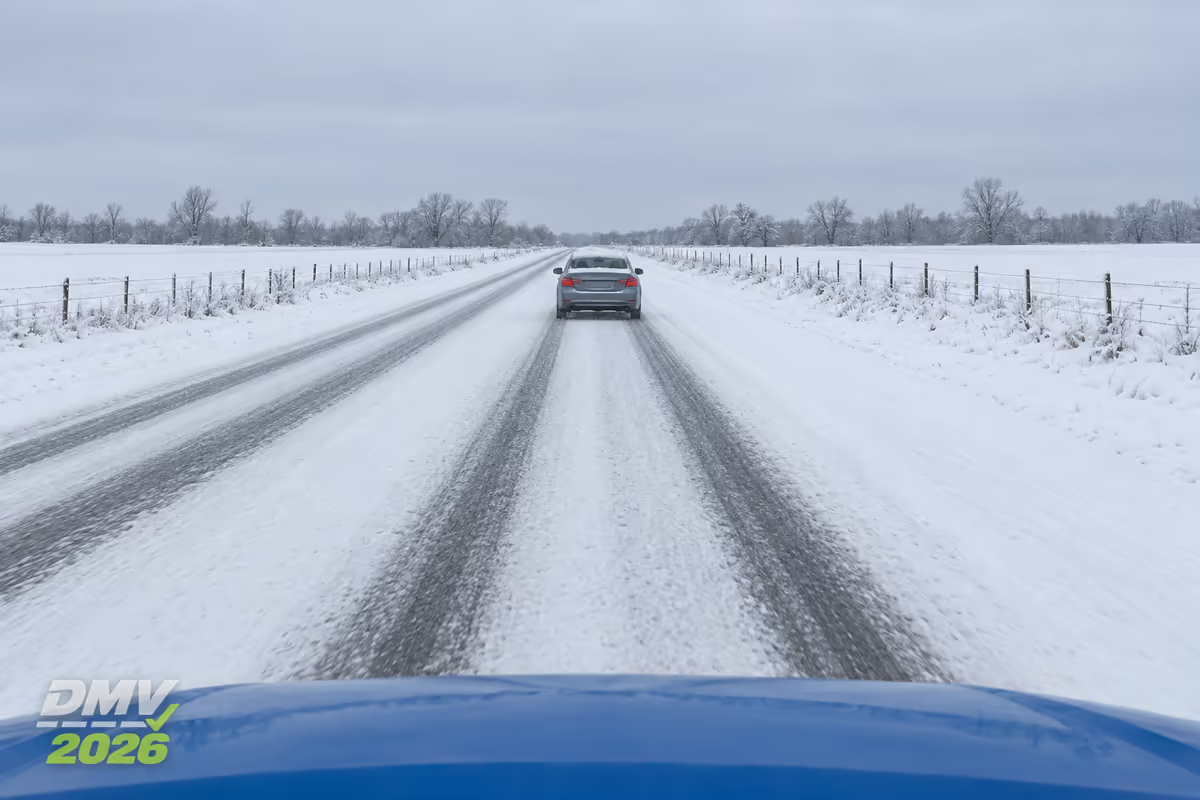
    View through the windshield of a straight two-lane highway under fresh snow, with tire tracks worn down each lane and white fields either side. A grey car drives ahead in your lane at an ordinary distance. Nothing is falling
    On snow, the gap to the car ahead should be ____ than on a dry road.
    Show the answer

    The answer is B: much bigger

    Stopping takes far longer on snow, and longer again on ice. Leave much more room than you would on a dry road, and more still where the road is icy. You cannot control how hard the driver ahead brakes. You can only control how much room you left.

    “When the roadway is slippery, your tires do not grip as well. It will take longer to stop, and it will be harder to turn without skidding. Always reduce your speed if the road is wet or covered with snow or ice.”

    AAMVA Model Driver’s License Manual, page 29
  4. Question 4 of 10 · Work zones and flaggers

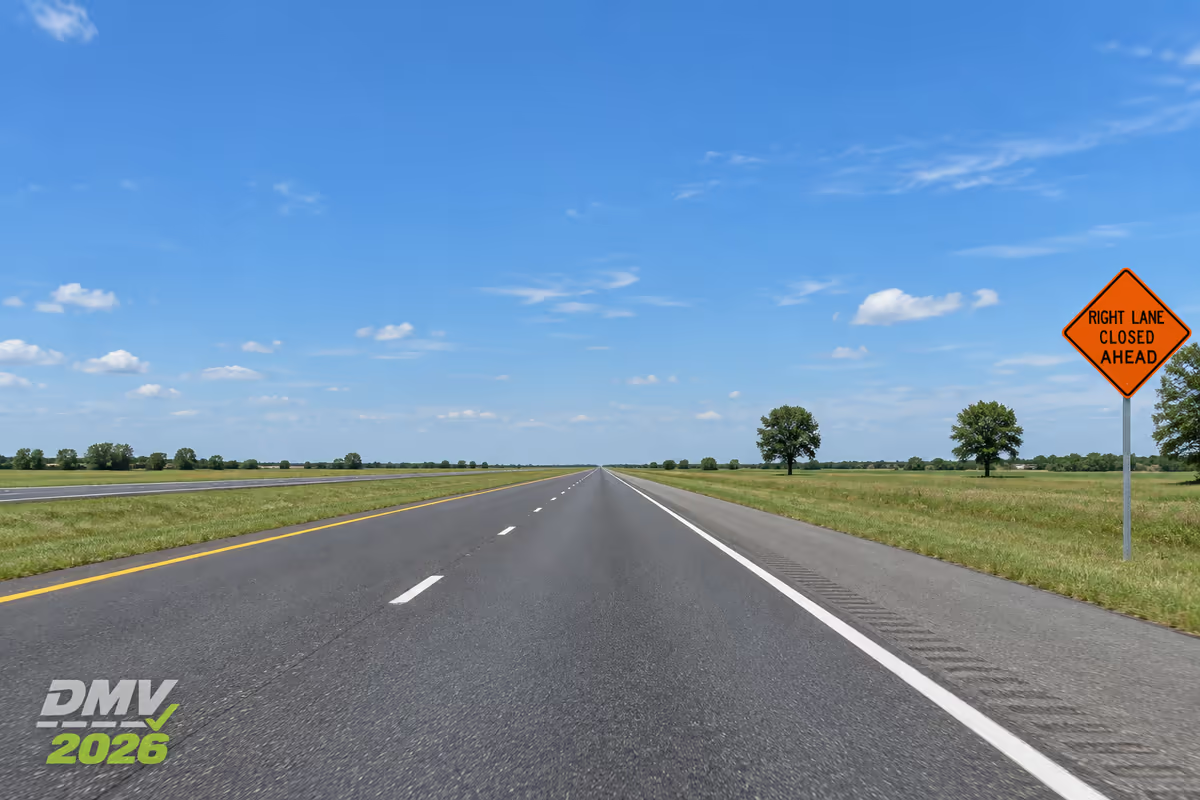
    Orange diamond sign with the words RIGHT LANE CLOSED AHEAD in black
    You are in the right lane when you see this sign. What should you do?
    Show the answer

    The answer is C: Move into the left lane before yours ends.

    The sign stands well before the closure so you have room to change lanes. Signal, check your mirror and blind spot, and take the first gap that opens. Where a sign tells you to stay in your lane up to a merge point, follow it instead.

    “The Lane(s) Closed sign (see Figure 6H-1) shall be used in advance of that point where one or more through lanes of a multi-lane roadway are closed.”

    MUTCD, 11th Edition, page 846
  5. Question 5 of 10 · Right-of-way

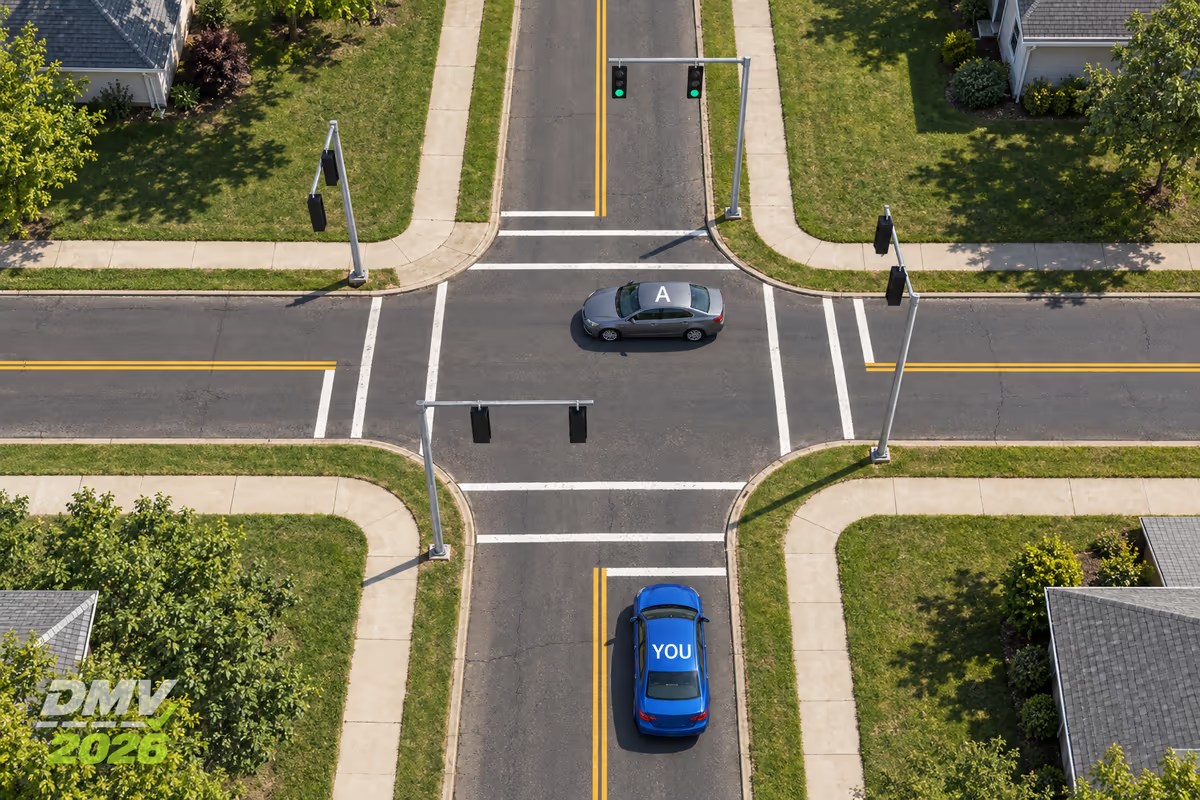
    Intersection seen from above. Your car has stopped at the line on the bottom approach, and the signal facing it shows green. Another car, marked A, is in the middle of the intersection, crossing from right to left in front of you and not yet out of your path
    Your light has just changed, but car A is still in the intersection. What do you do?
    Show the answer

    The answer is C: Wait until car A has cleared your path.

    Anyone still in the intersection goes first, whatever your light says. Car A may have entered on a yellow and run out of time. Wait until it is clear of your path, then go. Moving now would drive you into its side.

    “You should yield the right of way to”

    AAMVA Model Driver’s License Manual, page 19
  6. Question 6 of 10 · Pedestrians and bicyclists

    On the road, does a bicyclist have the same rights and duties as you?
    Show the answer

    The answer is B: Yes. A bicycle is a vehicle.

    On the road, a bicycle is a vehicle. The rider has the same rights and the same duties as you, and follows the same rules of the road. Share the road with them, and never force a rider off it.

    “Bicycles are considered vehicles when on roadways. Bicyclists are required and expected to follow the same rules of the road as motorized vehicles. As a motorist, you should know that a bicyclist has the same rights, privileges, and responsibilities as you.”

    AAMVA Model Driver’s License Manual, page 36
  7. Question 7 of 10 · Regulatory signs

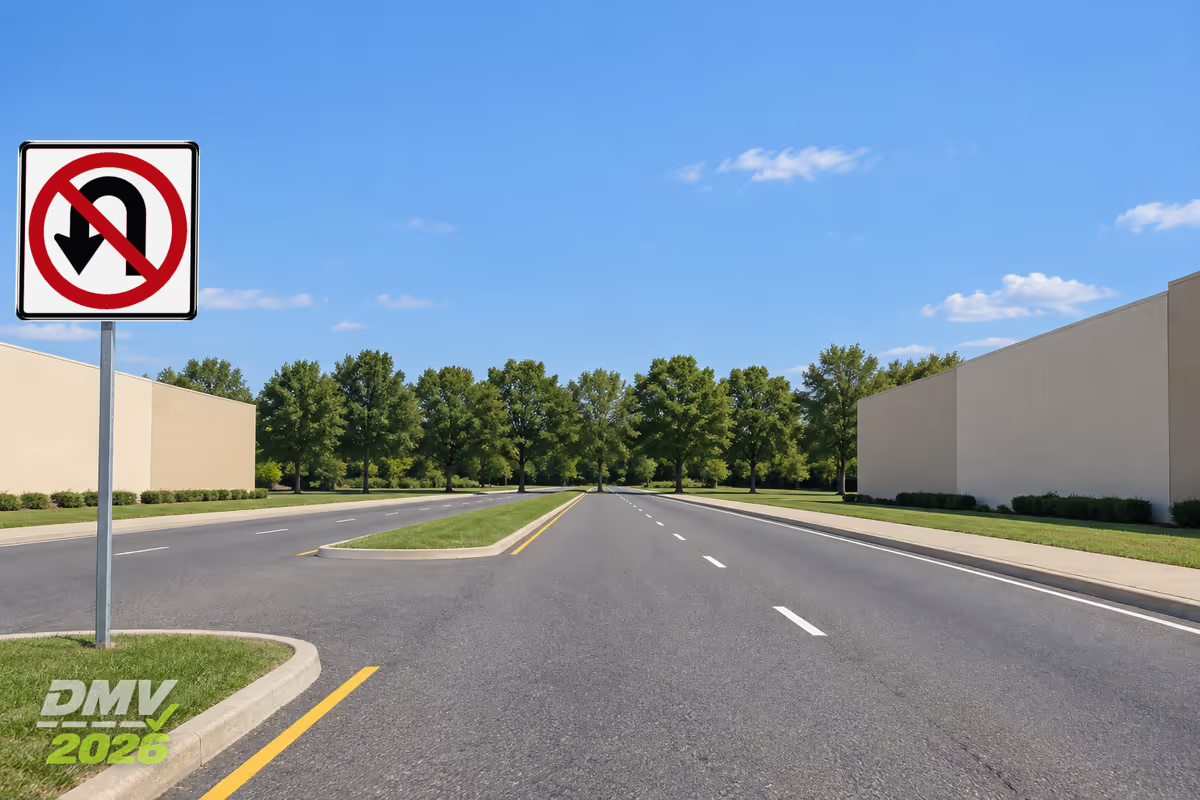
    Divided street seen from your car with a white square sign on a post on the median at the left, showing a black arrow that doubles back on itself inside a red circle with a slash through it. A gap in the median is ahead
    This sign forbids ____.
    Show the answer

    The answer is A: turning around to head back

    The U-shaped arrow in the red circle stands for a U-turn. That is the move where you swing around and drive back the way you came. It is banned here because the road is narrow, busy, or hides a turning car. A left turn is a different move and may still be allowed.

    “If a No U-Turn (R3-4) sign (see Figure 2B-4) or a combination No U or Left Turn (R3-18) sign (see Figure 2B-4) is used, at least one should be used at a location specified for a No Left Turn sign.”

    MUTCD, 11th Edition, page 130
  8. Question 8 of 10 · Distracted and aggressive driving

    When should you set the route and the music for a drive?
    Show the answer

    The answer is C: Before you start moving.

    Set the route, the music, your seat and your mirrors before you move. Anything you settle while parked is one thing you will not be doing at 50 mph. If the route has to change on the way, stop somewhere safe to change it.

    “You must pay attention to the driving task.”

    AAMVA Model Driver’s License Manual, page 10
  9. Question 9 of 10 · Curves and hills

    A car that enters a curve too fast runs wide because it
    Show the answer

    The answer is C: wants to keep going straight.

    A moving car wants to keep going straight. In a curve the tires have to pull it round, and at too high a speed they cannot. The car then slides toward the outside of the curve, off the road or into the other lane. Slowing down before the curve is the fix, not more steering.

    “This means if you are driving too fast on a curve, your vehicle is going to keep moving straight ahead instead of around the curve, no matter how much you try to steer it or slow it down to keep it in your lane. You will either run off of the road (on a left-bending curve) or go into the other lane of traffic (on a right-bending curve).”

    Pennsylvania Driver's Manual, page 55
  10. Question 10 of 10 · Passing

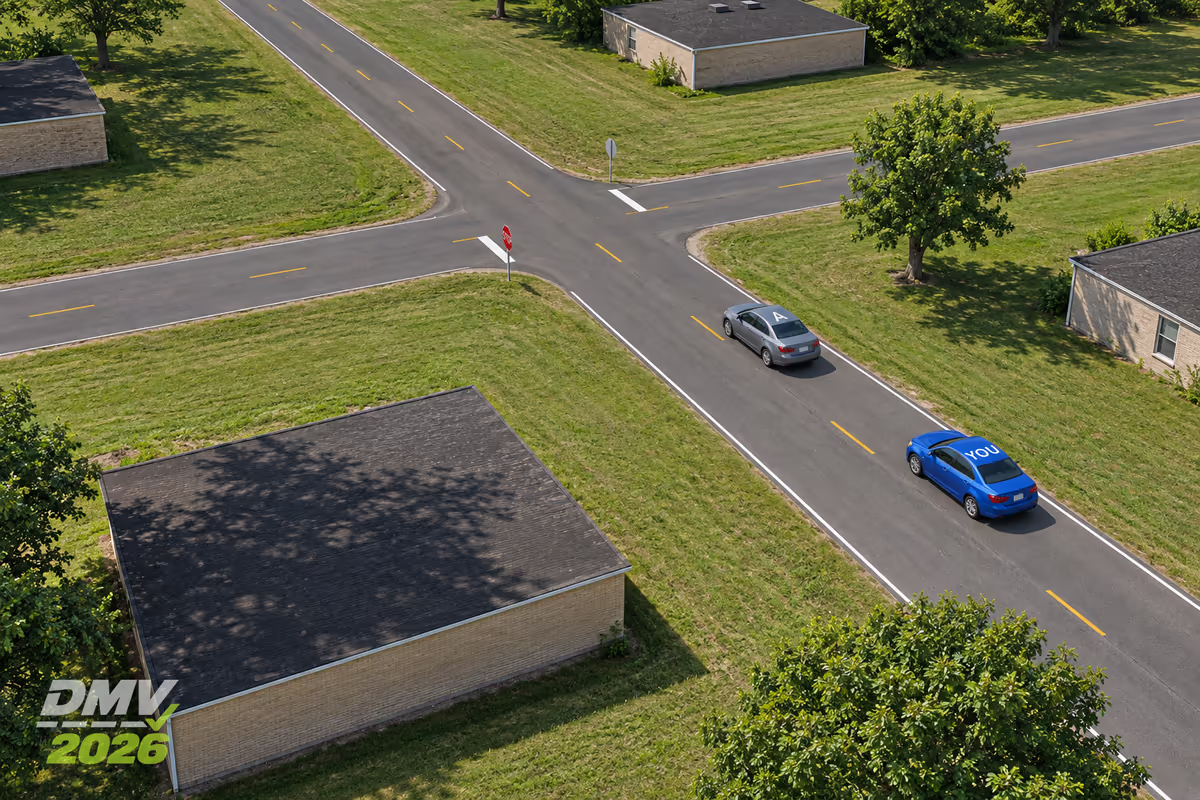
    Two-lane road seen from above with a broken yellow center line. Your car is in the right-hand lane behind a grey car marked A. A short way ahead of car A, a cross street with a stop sign on each side meets the road. The cross street and the oncoming lane are empty
    Car A is slow and the cross street is empty. May you pass it before the corner?
    Show the answer

    The answer is B: No. An intersection is ahead.

    Do not pass as you come up to an intersection. A driver pulling out of the cross street, or car A turning left, is not looking for you in the oncoming lane. An empty cross street can fill in a moment. Wait until you are through it.

    “Do not attempt to pass when an oncoming vehicle is approaching, your view is blocked by a curve or a hill, at intersections, or before a highway-railroad crossing or bridge.”

    AAMVA Model Driver’s License Manual, page 28

These 10 questions are from the DMV Champ app’s practice set, last updated October 23, 2026. Spot a mistake in a question? Email us.

How many questions can you miss on the Virginia permit test?

6

You need 34 of the 40 right.

The test has 2 parts: 10 road sign questions you must all get right, then 30 general knowledge questions where you need 24 right.

“The knowledge exam consists of two parts: Part one: 10 road sign questions All ten questions must be answered correctly Part two: 30 general knowledge questions You must correctly answer 24 questions to pass”

Virginia DMV, knowledge exam page

DMV Champ uses the same format for Idaho.

What happens if you fail the Virginia permit test?

If you’re under 18 and fail, you must wait a full 15 days before you try again.

“If you fail the exam and you are under age 18, by law you must wait a full 15 days before you can retake the exam.”

Virginia Driver’s Manual, page 5

You get 1 try per business day.

“The exam may be taken only once per business day.”

Virginia Driver’s Manual, page 5

After 3 failed tries, you must complete and pass the classroom part of driver education before a 4th try.

“If you fail the knowledge exam three times, you will not be able to take it a fourth time until you complete and pass the classroom component of driver education.”

Virginia Driver’s Manual, page 5

How do you take the Virginia permit test?

It’s given by the DMV, on a computer at DMV customer service centers or in classrooms at participating high schools.

“The exam is multiple choice and can be taken on a computer at DMV customer service centers or in classrooms at participating high schools.”

Virginia DMV, knowledge exam page

The manual calls it the knowledge exam.

“The two-part knowledge exam is given on a computer and tests your knowledge of traffic signs, motor vehicle laws, and safe driving.”

Virginia Driver’s Manual, page 5

You can book an appointment or walk in, and walk-ins must arrive by 4:30 p.m. on weekdays or 11:30 a.m. on Saturdays to test that day.

“Schedule an appointment for service Monday through Friday or stop by during office hours (no appointment). Walk-in applicants for the knowledge exam must be present by 4:30 p.m. Monday through Friday, and by 11:30 a.m. on Saturdays in order to test that day.”

Virginia DMV, knowledge exam page

The test comes in English, American Sign Language, Amharic, Arabic, Chinese (Mandarin, also in traditional script), Dari, Farsi, French, German, Haitian Creole, Italian, Japanese, Korean, Kurdish, Mongolian, Nepali, Pashto, Punjabi, Russian, Spanish, Thai, Twi, Turkish, Urdu and Vietnamese.

“With the exception of the CDL HAZMAT knowledge exam (available only in English), the Driver, CDL and Motorcycle knowledge exams are available in the following languages:”

Virginia DMV, knowledge exam page

You can ask for an oral test at any DMV customer service center.

“Oral exams are also available by request at all DMV customer service centers.”

Virginia DMV, knowledge exam page

Test simulator

Practice in the Virginia format

40 questions34 to pass

DMV Champ teaches every question with its explanation, then checks you with 5 simulated tests of 40 questions, graded against the 34-correct passing score. 35 topics in Virginia: the 34 every state tests, plus winter driving, because the Virginia handbook teaches it.

Download on the App Store