Idaho · County sheriff’s driver’s license offices

Idaho permit practice test: 40 questions, 85% to pass

Idaho’s knowledge test has 40 questions, and you need 34 right, or 85%, to pass.

40

questions

34

right to pass

85%

passing score

Checked against the Idaho Driver’s Handbook (July 2026 edition) on October 25, 2026. How we check facts

Practice test

Take a 10-question Idaho permit practice test

Pick an answer and check it. Every question comes with the reason behind the right answer and the sentence of an official document it rests on.

To pass here you need 9 of 10, since Idaho’s test asks for 85%.

  1. Question 1 of 10 · Traffic signals and arrows

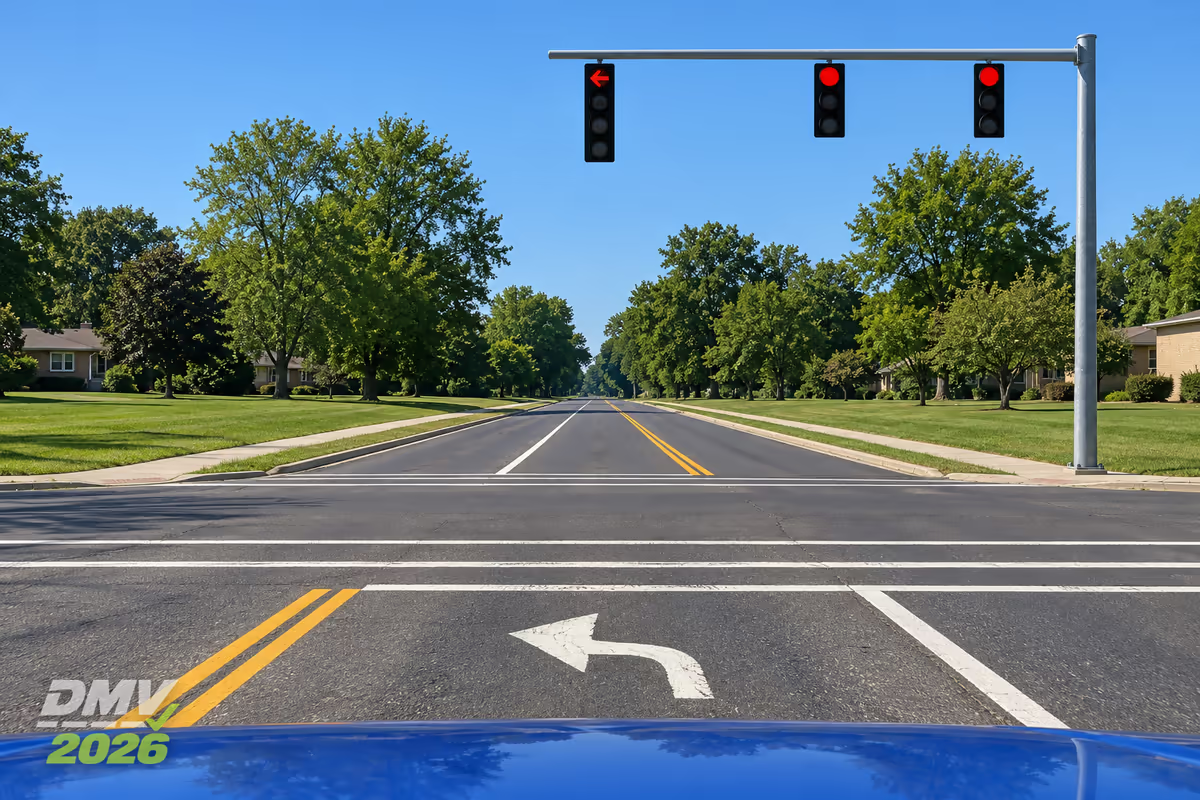
    Left-turn lane seen from your car, with a four-section signal over it whose sections are all arrows. The top section is lit as a red arrow pointing left and the other three are dark. The intersection ahead and the oncoming lanes are empty, and no car is ahead of you in the turn lane
    You are first in the turn lane. Nothing is coming. May you turn?
    Show the answer

    The answer is C: No. Wait for a green arrow or light.

    A red arrow means no turn in the direction it points. It is not a stop sign, and stopping does not earn you the turn. Wait until a green arrow or a green light comes on. The only exception is a sign at the corner that allows the turn after a stop. An empty road changes nothing.

    “Vehicular traffic facing a steady RED ARROW signal indication shall not enter the intersection to make the movement indicated by the arrow”

    MUTCD, 11th Edition, page 685
  2. Question 2 of 10 · Lane use and changing lanes

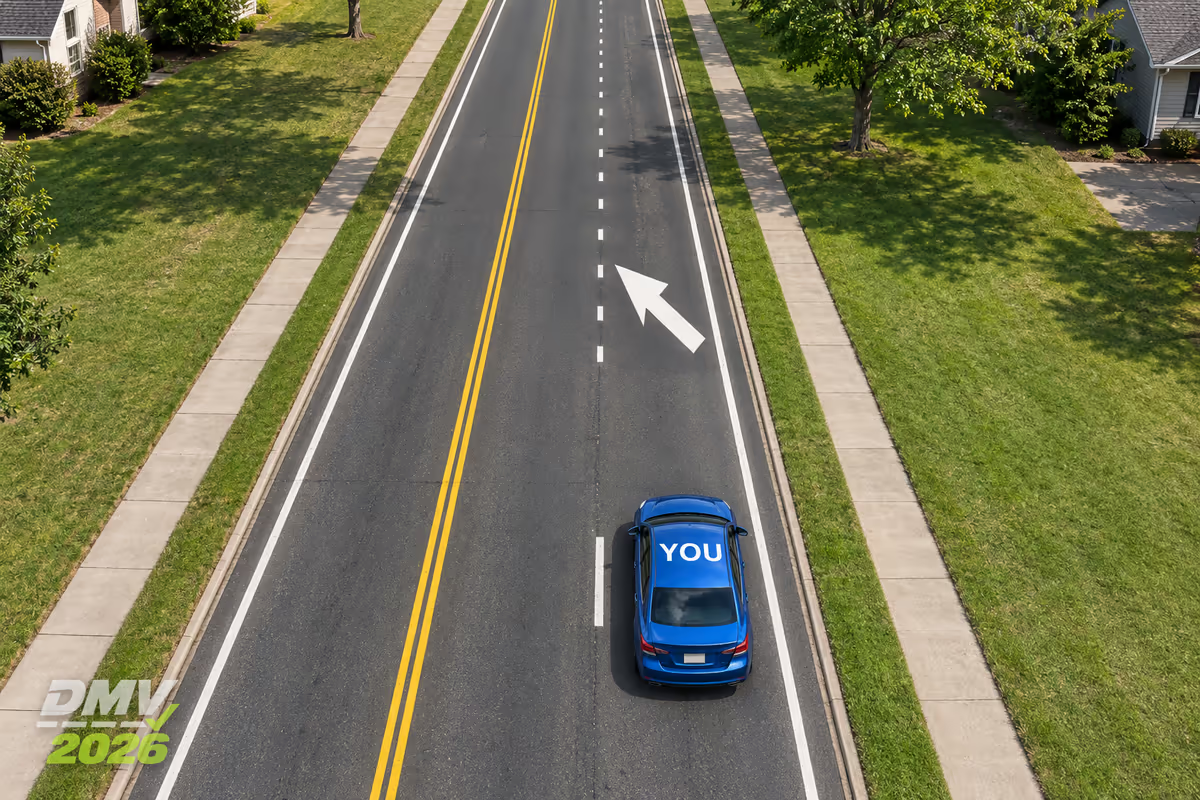
    Road seen from above with two lanes going your way. Your car is in the right lane, and a white arrow painted in that lane a short way ahead of you slants toward the left lane
    What does the arrow painted in your lane tell you?
    Show the answer

    The answer is C: Your lane is ending. Merge left.

    A slanted arrow painted in your lane means the lane is about to end. Traffic in it moves into the lane the arrow points to. Signal, check your mirror and your blind spot, and merge before the lane runs out, not at the last car length.

    “Lane Reduction—a gradual narrowing of the travel pavement (taper) through physical construction or pavement markings at which traffic in the lane being eliminated must merge into the adjacent through lane and continue in the same direction of travel.”

    MUTCD, 11th Edition, page 61
  3. Question 3 of 10 · Flooding and high water

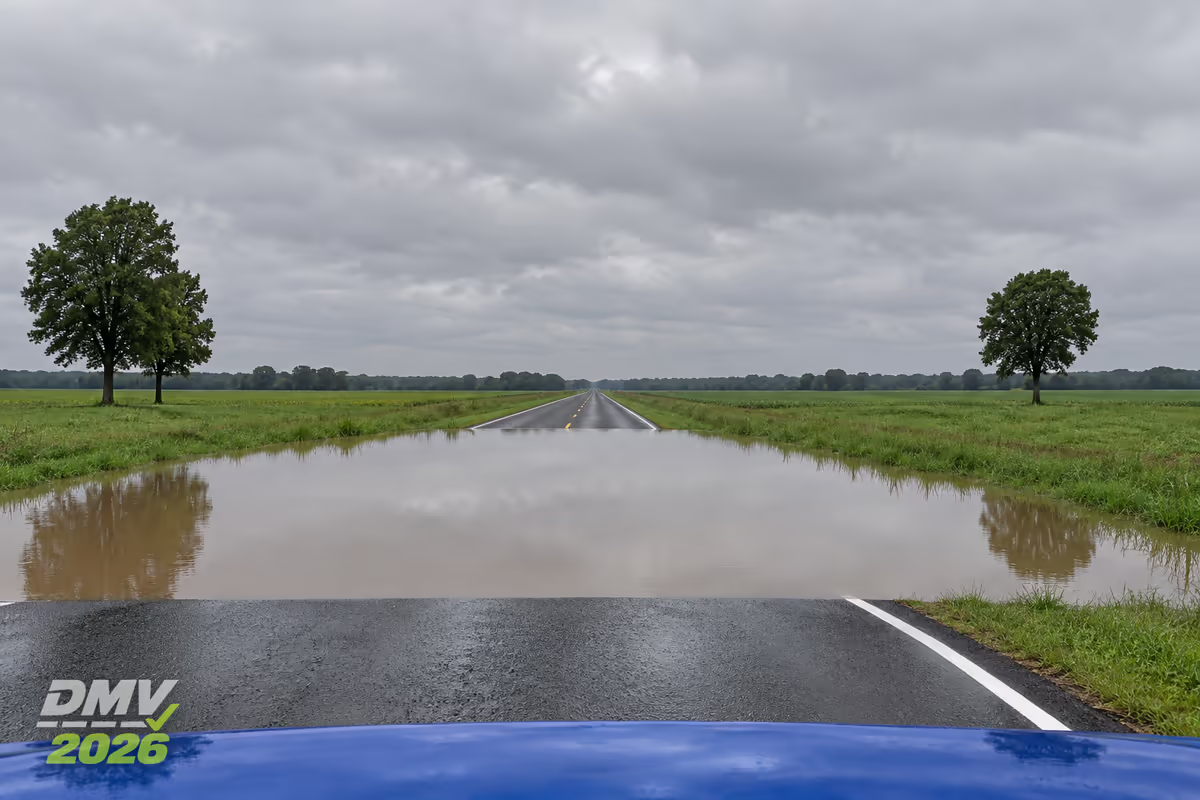
    View through the windshield of a straight two-lane road after rain. A short way ahead the road disappears under a flat sheet of brown water that fills it from edge to edge, and the road comes back out of the water in the distance. The water is still and nothing shows how deep it is
    Water is across the road ahead. What should you do?
    Show the answer

    The answer is B: Turn around and find another route.

    Water across the road means turn around and find another route. You cannot see how deep it is, or whether the road under it is still there. Even shallow water can stall the engine or lift the car. Going slowly does not make it safe.

    “Flooded roadways—Do not drive through large bodies of standing water on a road. If you see a flooded roadway, find another route to get to your destination.”

    AAMVA Model Driver’s License Manual, page 30
  4. Question 4 of 10 · Pavement markings

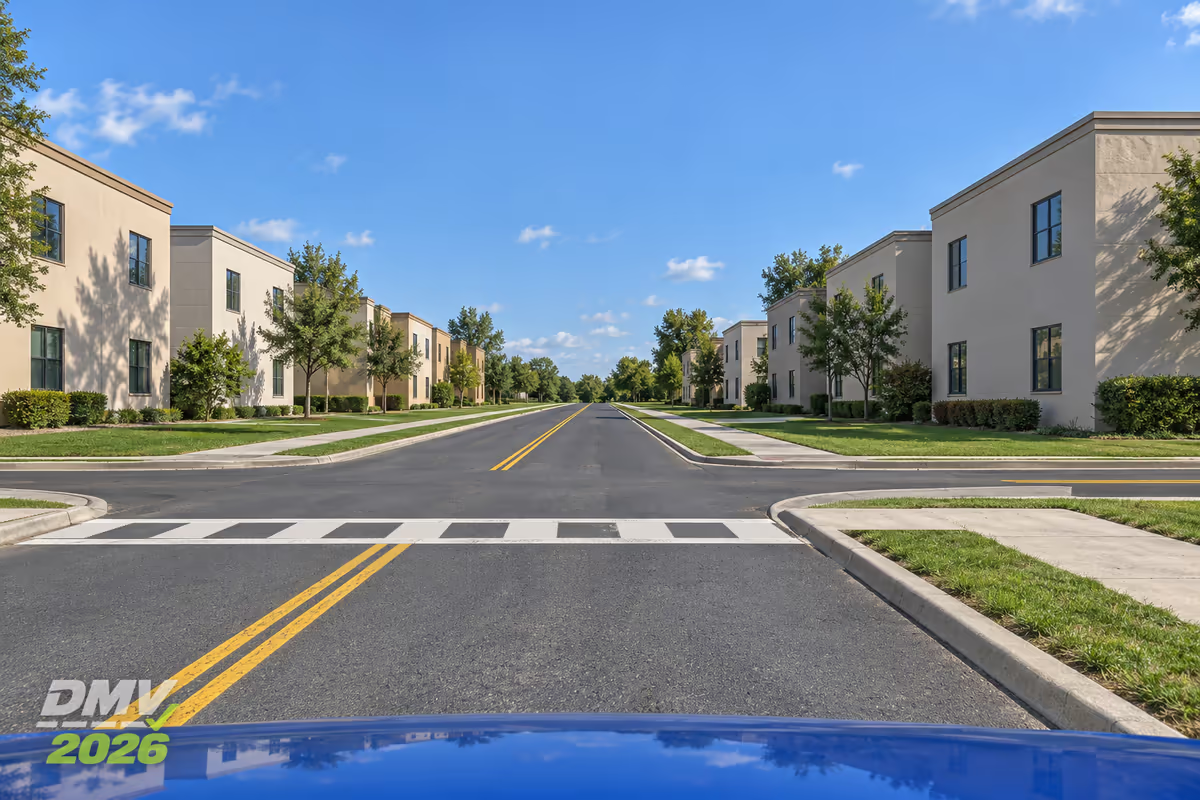
    Intersection from the driver's seat with wide white bars painted across the road from curb to curb between two white lines, like a ladder laid flat
    What does this marking across the road mean?
    Show the answer

    The answer is C: A crosswalk.

    Wide white stripes across the road are a crosswalk, the same as two plain lines. Both mark where people cross, so yield to anyone in it and never stop your car on it. The stripes are used where the crossing needs to stand out more.

    “Crosswalk markings are classified as either transverse line or high-visibility. Transverse crosswalk markings consist of two transverse lines. High-visibility markings consist of longitudinal lines parallel to traffic flow with or without transverse lines.”

    MUTCD, 11th Edition, page 631
  5. Question 5 of 10 · Emergency vehicles and the Move Over law

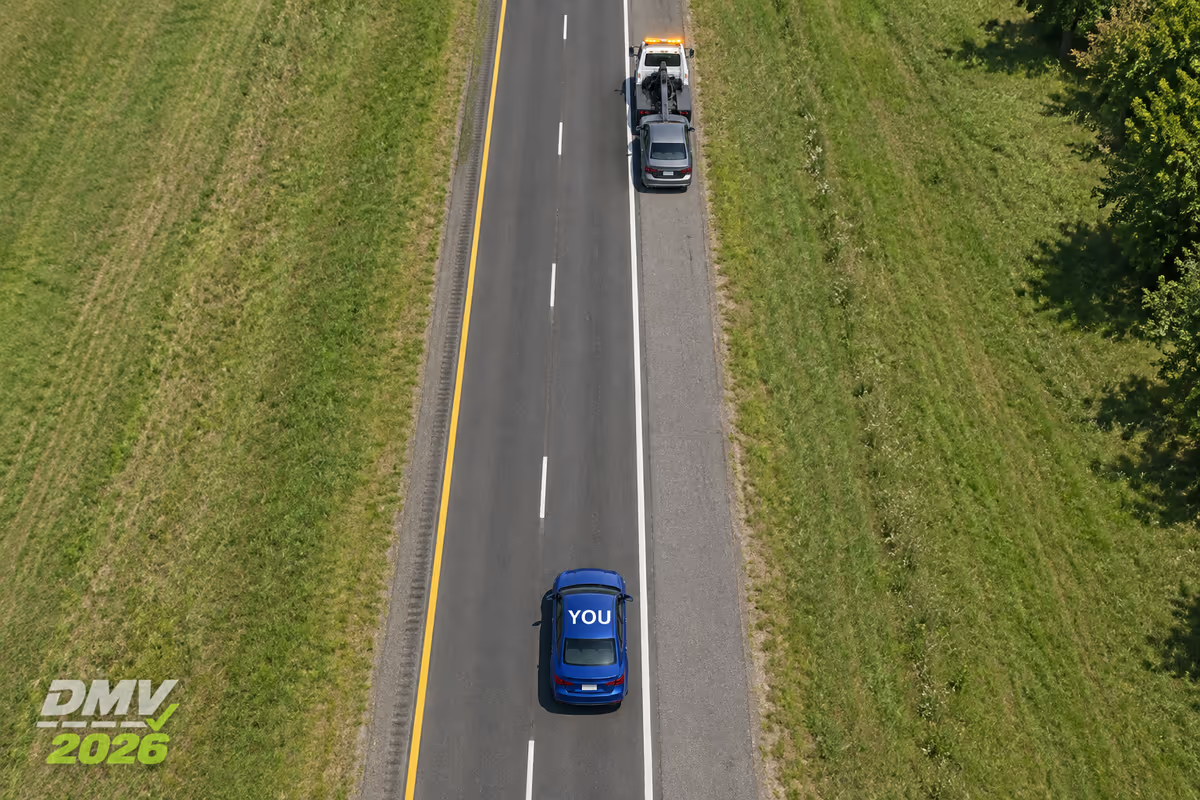
    Highway seen from above with two lanes in your direction. Your car is in the right lane. A tow truck with amber lights flashing is stopped on the right shoulder ahead, and the left lane is empty
    What does the Move Over law ask of you here?
    Show the answer

    The answer is B: Move over to the left lane.

    Move a lane away from a vehicle stopped on the shoulder with its lights flashing, whenever you can do it safely. That puts a whole lane between you and whoever is working there. Slowing down alone is for when no lane is open. In most states the law covers a tow truck like this one as well as police, fire and ambulance.

    “When approaching a stationary emergency vehicle with flashing emergency signal lights (hazard lights), move over and slow down.”

    California Driver's Handbook, page 51
  6. Question 6 of 10 · Stopping distance and braking

    Your car has no anti-lock brakes. You brake hard and a wheel locks up. What should you do?
    Show the answer

    The answer is C: Ease up, then press again.

    A locked wheel slides, and a sliding tire cannot steer or grip well. Without anti-lock brakes, ease up the moment a wheel locks, then press again, as often as it takes. Many handbooks call this pumping the brakes. Anti-lock brakes do it for you, which is why you press and hold there.

    “If your vehicle is not equipped with ABS, refer to your vehicle’s owner’s manual for proper braking procedure.”

    AAMVA Model Driver’s License Manual, page 33
  7. Question 7 of 10 · Regulatory signs

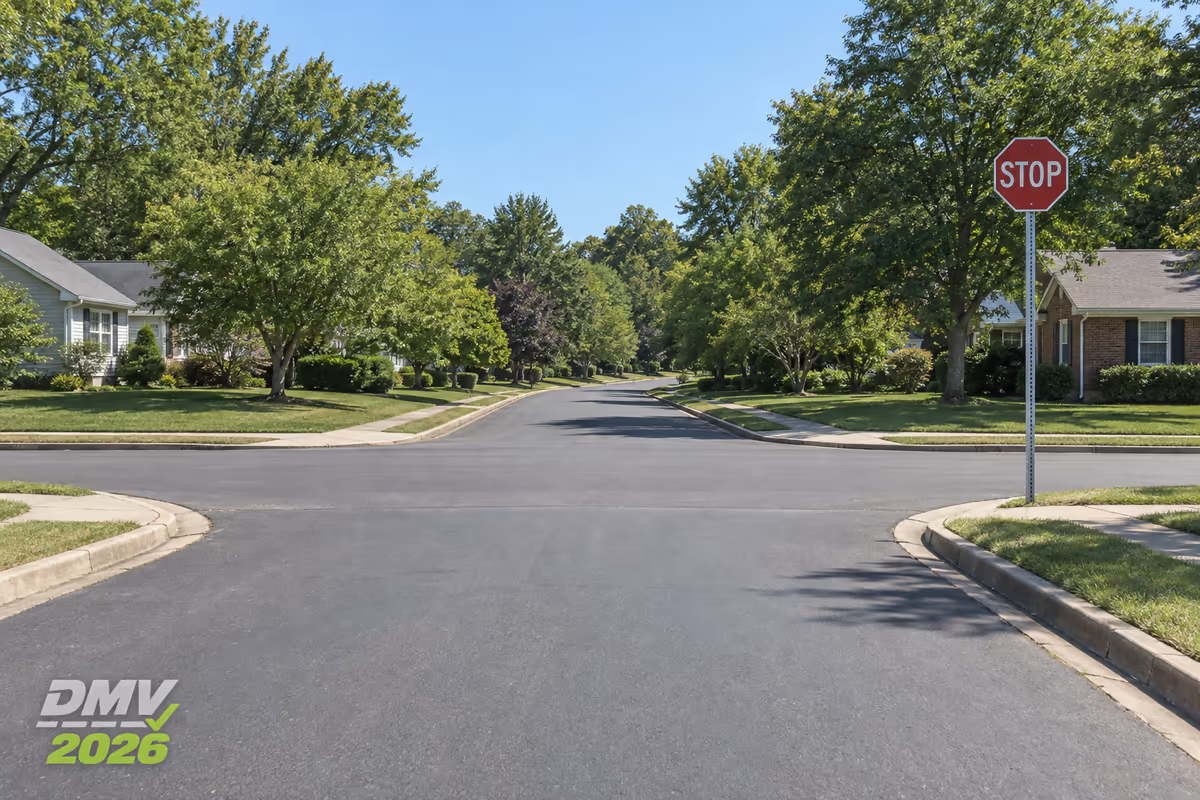
    Residential street seen from your car, with a red eight-sided sign reading STOP in white on a post at the near right corner. Nothing hangs under it, and no line or crosswalk is painted on the road at the corner. The cross street is empty
    What does this sign require?
    Show the answer

    The answer is B: A full stop, then go when the way is clear.

    A stop sign means a complete stop, every time, even on an empty road. Your wheels have to stop turning before you look both ways and go. Slowing to a crawl and rolling through is against the law, even when nothing is coming.

    “When it is determined that a full stop is always required on an approach to an intersection, a STOP (R1-1) sign (see Figure 2B-1) shall be used.”

    MUTCD, 11th Edition, page 115
  8. Question 8 of 10 · Alcohol, drugs and DUI

    What does the implied consent law mean for you?
    Show the answer

    The answer is A: You already agreed to a chemical test.

    By accepting your license, you agreed in advance to a chemical test if an officer has reason to think you are impaired. The test is of your breath, blood or urine, and the officer's lawful request is enough. The rule is the law of the state you are driving in, not the one that issued your license.

    “You are required to take a BAC test if asked by a police officer due to [State/Province/Territory] implied consent law. [State/ Province/ Territory] implied consent law is based on the principle that when you get your driver's license, you have implicitly consented to a lawfully requested test to determine the alcohol content of your blood, breath, urine, or other bodily substance if suspected of impaired driving.”

    AAMVA Model Driver’s License Manual, page 11
  9. Question 9 of 10 · Rain, fog and slick roads

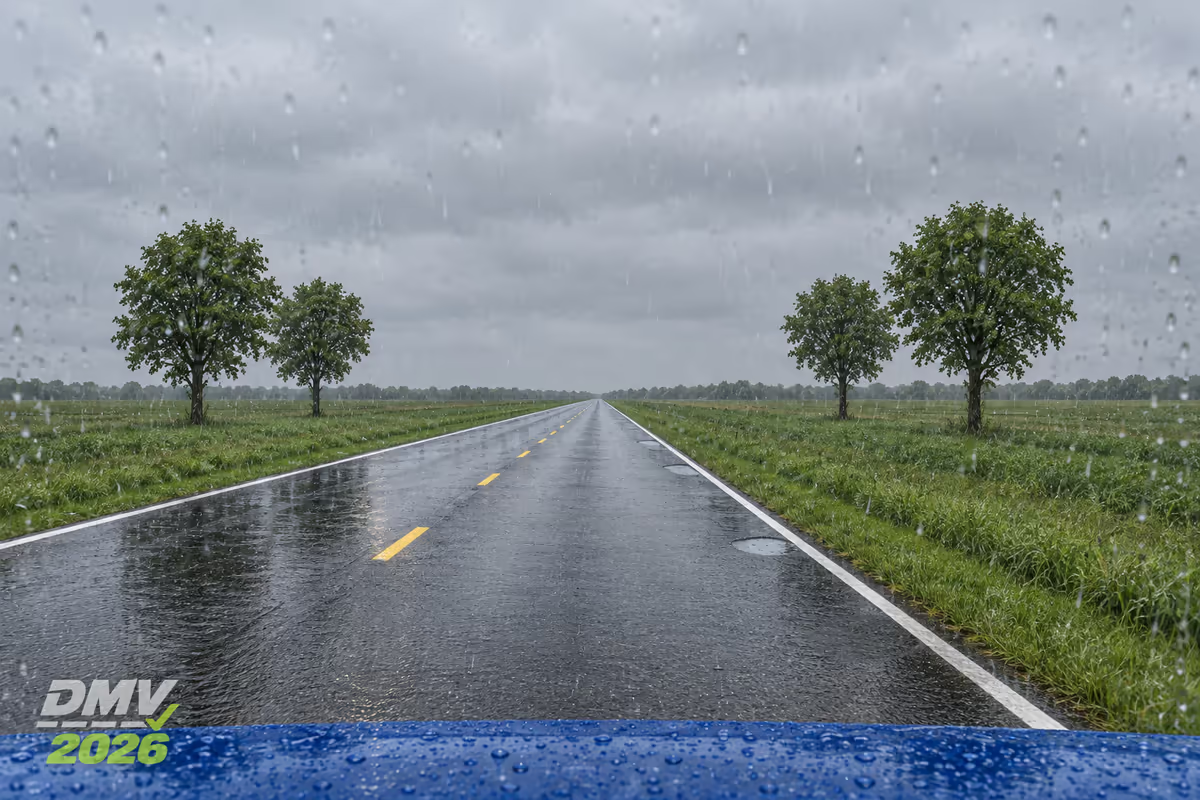
    View through the windshield of a straight two-lane road in steady rain. The pavement is dark and shiny, and raindrops cover the glass. The road ahead is empty
    Stopping takes longer on a road like this. Is turning harder too?
    Show the answer

    The answer is B: Yes. The tires can slide in a turn.

    A wet road gives your tires less grip, and they need grip to turn as well as to stop. A turn taken at dry-road speed can slide the car just as a hard stop can. Slow down before a curve, not in it.

    “Slippery roads—Reduce speed at the first sign of rain, snow, sleet, or ice. When the roadway is slippery, your tires do not grip as well. It will take longer to stop, and it will be harder to turn without skidding. Always reduce your speed if the road is wet or covered with snow or ice.”

    AAMVA Model Driver’s License Manual, page 29
  10. Question 10 of 10 · Right-of-way

    Turning left into a driveway, you yield to ____.
    Show the answer

    The answer is A: traffic coming toward you

    Any left turn crosses the oncoming lane, so you yield to traffic coming toward you, with or without an intersection. Wait for a gap big enough to clear the lane without making anyone brake. Check for anyone walking across the driveway before you turn in.

    “drivers in the opposing traffic lane when you are making a left turn;”

    AAMVA Model Driver’s License Manual, page 19

These 10 questions are from the DMV Champ app’s practice set, last updated October 23, 2026. Spot a mistake in a question? Email us.

How many questions can you miss on the Idaho permit test?

6

You need 34 of the 40 right.

The test has 40 questions, and you can miss up to 6 before you fail.

“The knowledge test consists of 40 questions; you can miss up to six (6) questions before failing the test.”

Idaho Driver’s Handbook, page 32

DMV Champ uses the same format for Virginia.

How old do you have to be to get a driver training permit in Idaho?

The youngest you can be is 14 and a half.

“Driver Training Permits (DT) allow anyone 14 1/2 and under 17 years of age to attend any public school or private driver training program.”

Idaho Driver’s Handbook, page 15

What happens if you fail the Idaho permit test?

If you fail, you wait 3 days before you can take the test again.

“IF YOU FAIL A KNOWLEDGE TEST, YOU MUST WAIT THREE (3) DAYS TO RETEST.”

Idaho Driver’s Handbook, page 32

How do you take the Idaho permit test?

Permits are issued through your county sheriff’s driver’s license office.

“Idaho driver’s licenses, ID cards, and instruction permits are issued through the county sheriff’s driver’s license offices.”

Idaho Driver’s Handbook, page 14

You can take the test in 11 languages, including English, Spanish, Arabic and Chinese, or in American Sign Language.

“The knowledge test is available in English, Arabic, Chinese, Farsi, French, Korean, Russian, Serbo-Croatian, Spanish, Swahili, Vietnamese, and American Sign Language (ASL).”

Idaho Driver’s Handbook, page 32

Test simulator

Practice in the Idaho format

40 questions34 to pass

DMV Champ teaches every question with its explanation, then checks you with 5 simulated tests of 40 questions, graded against the 34-correct passing score. 36 topics in Idaho: the 34 every state tests, plus winter driving and flooding, because the Idaho handbook teaches them.

Download on the App Store