California · Department of Motor Vehicles

California DMV practice test: 80% to pass

California’s knowledge test is given by the DMV, and you need 80% to pass. DMV Champ’s simulated tests use 46 questions.

46 (DMV Champ’s figure, not confirmed by an official source)

questions

37 (DMV Champ’s figure, not confirmed by an official source)

right to pass

80%

passing score

* The figures DMV Champ’s simulated tests use, not confirmed by an official source.

Checked against the California Driver’s Handbook (revised June 2025) on October 25, 2026. How we check facts

Practice test

Take a 10-question California DMV practice test

Pick an answer and check it. Every question comes with the reason behind the right answer and the sentence of an official document it rests on.

To pass here you need 9 of 10, since California’s test asks for 80%.

  1. Question 1 of 10 · Regulatory signs

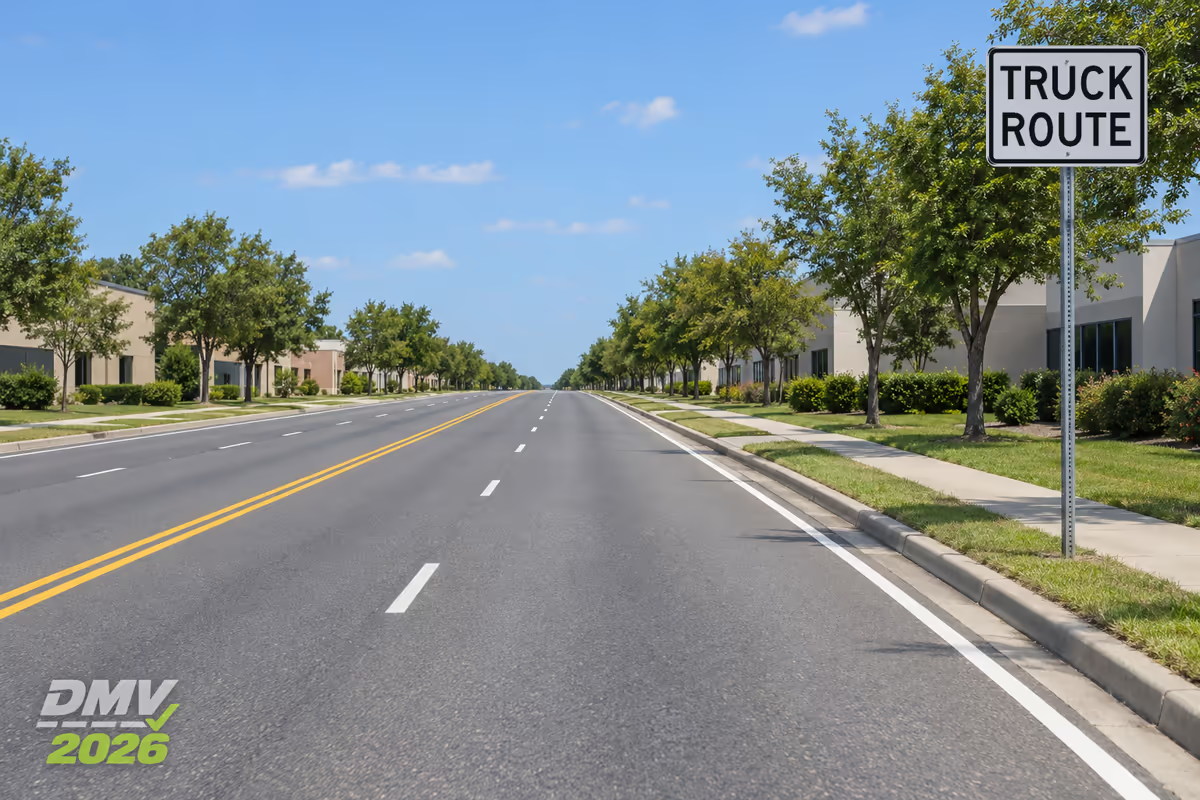
    Four-lane city street seen from your car with a white rectangular sign on a post at the right reading TRUCK ROUTE in black on two lines. The street is empty
    You are driving a car and see this sign. What does it mean for you?
    Show the answer

    The answer is B: Nothing. It marks a road trucks may use.

    A truck route sign marks a road set aside for trucks to use, often to keep them off narrow streets nearby. Cars may use it as well. The sign is there for truck drivers, so they know which roads are meant for them.

    “The TRUCK ROUTE (R14-1) sign (see Figure 2B-31) should be used to mark a route that has been designated to allow truck traffic.”

    MUTCD, 11th Edition, page 179
  2. Question 2 of 10 · Right-of-way

    A driver who should yield to you keeps coming. You should
    Show the answer

    The answer is C: slow down and let them go.

    No rule hands you the right of way. The rules say who has to yield, and nothing more. If another driver takes what should be yours, let them have it. Being in the right is no help after a crash.

    “Although yielding right-of-way rules provide a guide to determine who should yield the right of way, no one should assume he or she automatically has the right of way. The situation and circumstances at the intersection must always be considered.”

    AAMVA Model Driver’s License Manual, page 19
  3. Question 3 of 10 · Curves and hills

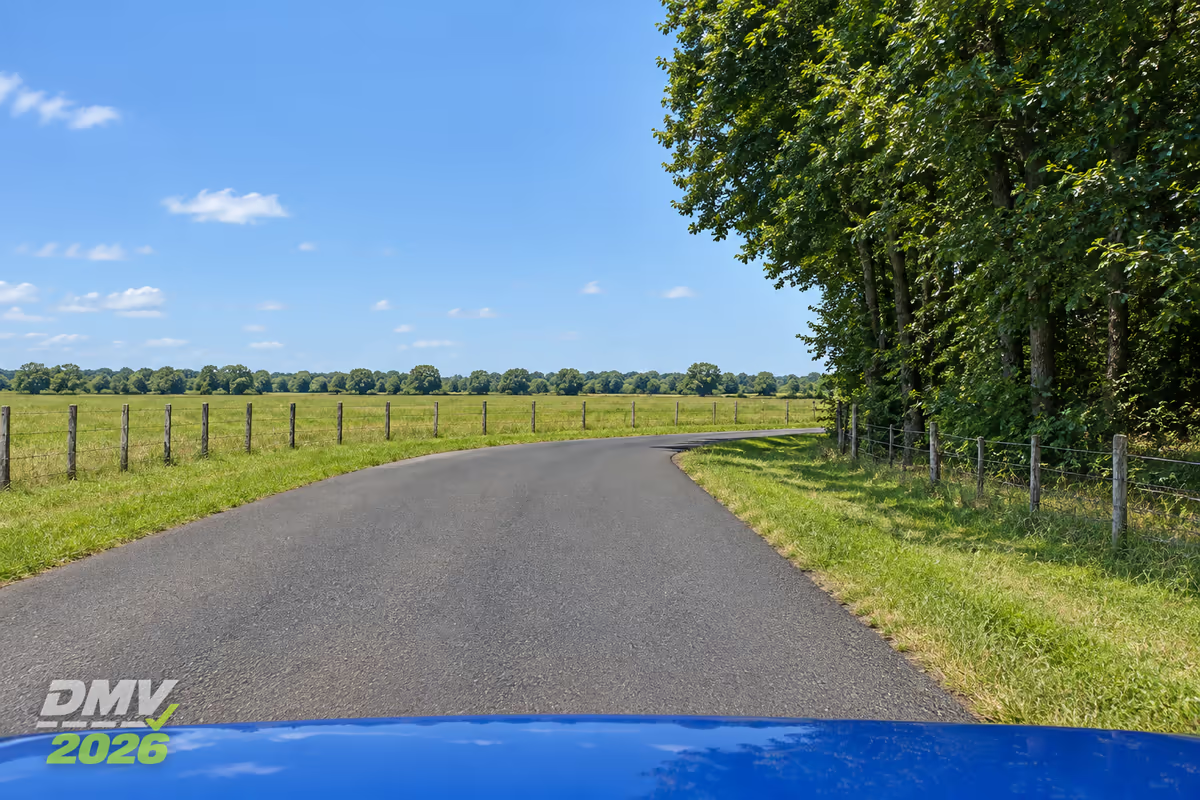
    Narrow two-lane country road seen from your car. It runs straight for a short way, then bends to the right and disappears behind a thick stand of trees on the inside of the bend. None of the road beyond the bend can be seen
    How should you take this curve?
    Show the answer

    The answer is A: More slowly than usual.

    When you cannot see the end of a curve, slow down more than usual. A stopped car or a slow vehicle may be just around the bend. You have to be able to stop in the road you can see. Slow down more again in rain or when you are following another car.

    “Reduce speed more when traction is poor, when following other vehicles, and when you cannot see the end of the curve.”

    AAMVA Model Driver’s License Manual, page 29
  4. Question 4 of 10 · Guide and service signs

    What kind of information is on a green highway sign?
    Show the answer

    The answer is A: Directions and distances.

    Green is the color of guide signs. They name the roads, towns and exits ahead and say how far each one is. Blue points to services and brown to parks, so the color sorts a sign before you can read a word.

    “G. Green—indicated movements or actions permitted and direction guidance”

    MUTCD, 11th Edition, page 74
  5. Question 5 of 10 · Highways, merging and exits

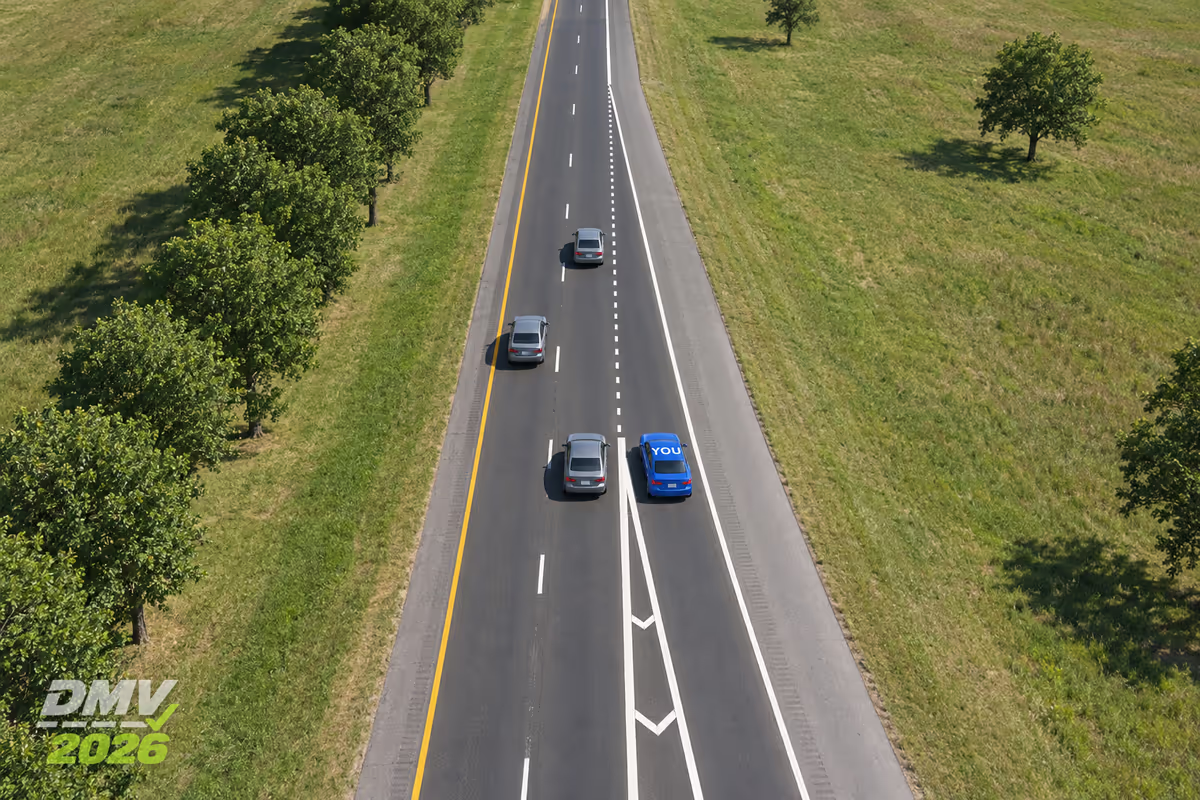
    Freeway seen from above. An entrance ramp comes in from the right and opens into a lane of its own that runs alongside the through lanes before it ends. A striped triangle marks the point where the ramp meets the road. Your car is on the ramp, and other cars are running in the through lanes
    Nobody on the highway moves over for you. Who has to yield?
    Show the answer

    The answer is A: You, the driver on the ramp.

    Traffic already on the highway has the right of way. You are the one joining, so you fit into a gap in their line. Many drivers will make room for you, but you cannot count on it. Match their speed, pick a gap, and move in.

    “Identify a gap in traffic and merge with the traffic flow.”

    AAMVA Model Driver’s License Manual, page 28
  6. Question 6 of 10 · Slow-moving and farm vehicles

    At 55 mph, you reach a 15 mph tractor 300 feet ahead in about ____.
    Show the answer

    The answer is B: 5 seconds

    You catch up to a slower vehicle at the difference between your speeds. Here that is 40 mph, or about 59 feet every second, so 300 feet is gone in about 5 seconds. From far back the tractor looks slow, not close, so start slowing as soon as you see the emblem.

    “Normal speeds for slow-moving vehicles range from 5-20 mph. When a vehicle traveling at normal highway speed approaches a slow-moving vehicle from the rear, the speed differential will dramatically shorten the time it takes to reach the slow-moving vehicle.”

    Illinois Rules of the Road 2026, page 49
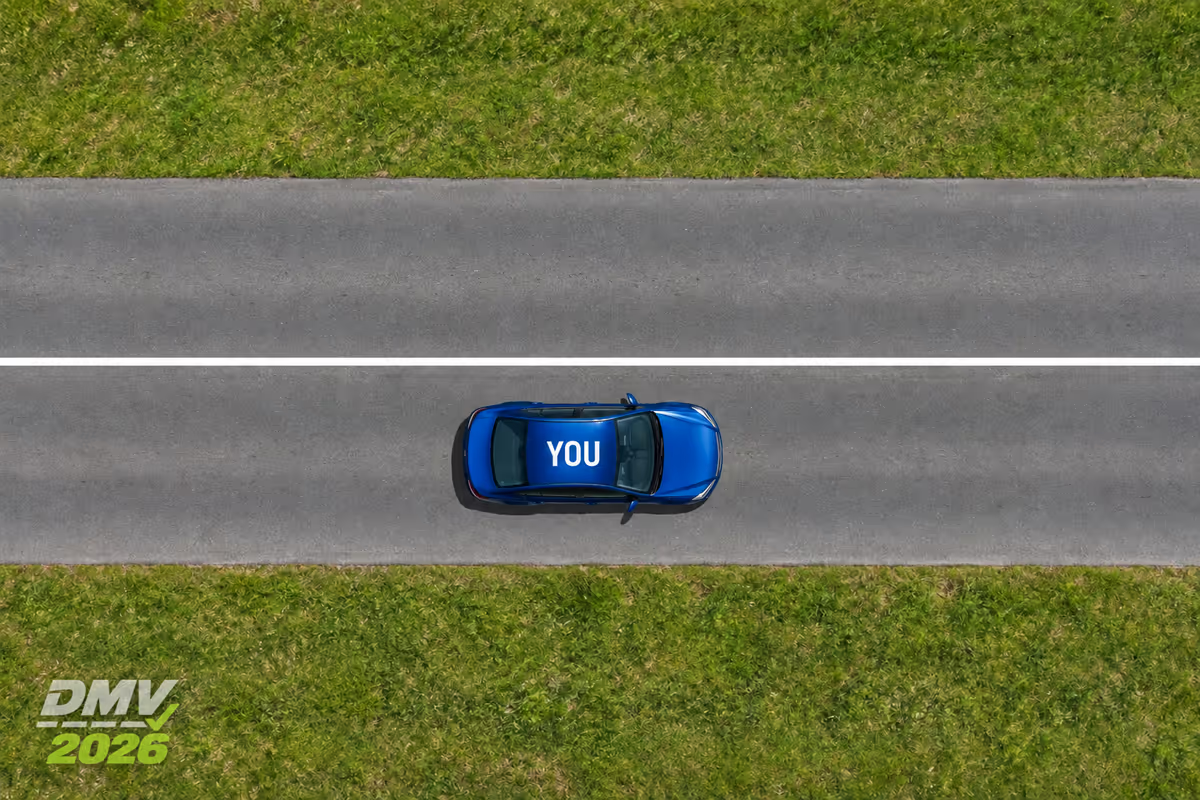
  7. Question 7 of 10 · Pavement markings

    Two lanes running the same way seen from above, separated by a single solid white line, your car in the lower lane and the other lane empty
    A single solid white line runs between your lane and the next. What does it mean?
    Show the answer

    The answer is C: You should stay in your lane.

    A solid white line between lanes going the same way tells you not to cross it. A broken white line is the one you may cross to change lanes. Solid means stay, broken means you may.

    “A single solid white line marks traffic lanes going in the same direction. This includes one-way streets.”

    California Driver’s Handbook, page 19
  8. Question 8 of 10 · Alcohol, drugs and DUI

    A friend who has been drinking picks up their car keys. What do you do?
    Show the answer

    The answer is A: Take the keys and find them a ride.

    Never let a friend drive after drinking. Someone who has been drinking is the worst judge of whether they can drive, because judgment goes first. A ride, a taxi, a bus or a couch for the night all work. Settle who drives before the first drink.

    “Never let a friend or relative drive if he or she has been drinking.”

    AAMVA Model Driver’s License Manual, page 10
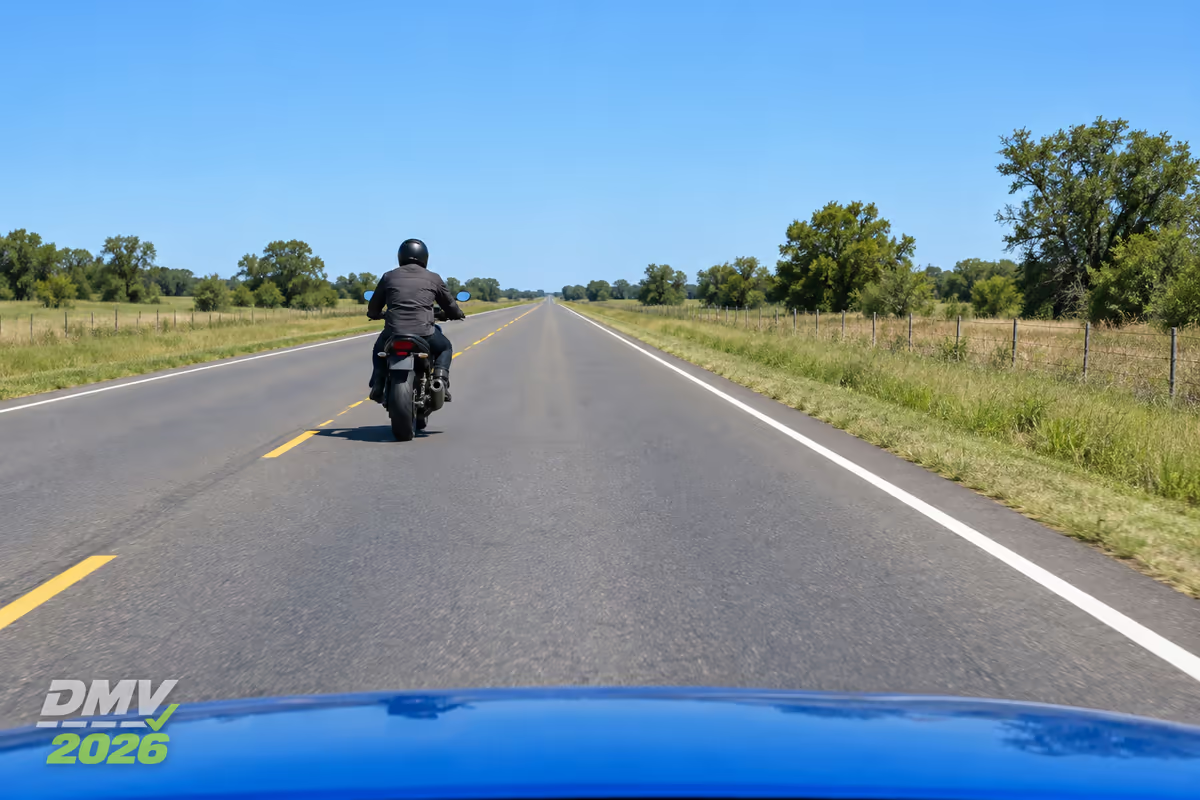
  9. Question 9 of 10 · Motorcycles, trucks and buses

    Motorcycle ahead of your car in the same lane, riding over toward the left-hand side of it, with the right-hand side of the lane beside it empty
    May you drive beside the motorcycle in this lane?
    Show the answer

    The answer is C: No. It has the whole lane.

    A motorcycle has the right to the full width of its lane, like any other vehicle. The rider needs that room to steer around a pothole, gravel or a slick patch. Pass it the way you would pass a car, in the next lane.

    “Never try to pass a motorcycle in the same lane as you.”

    California Driver’s Handbook, page 50
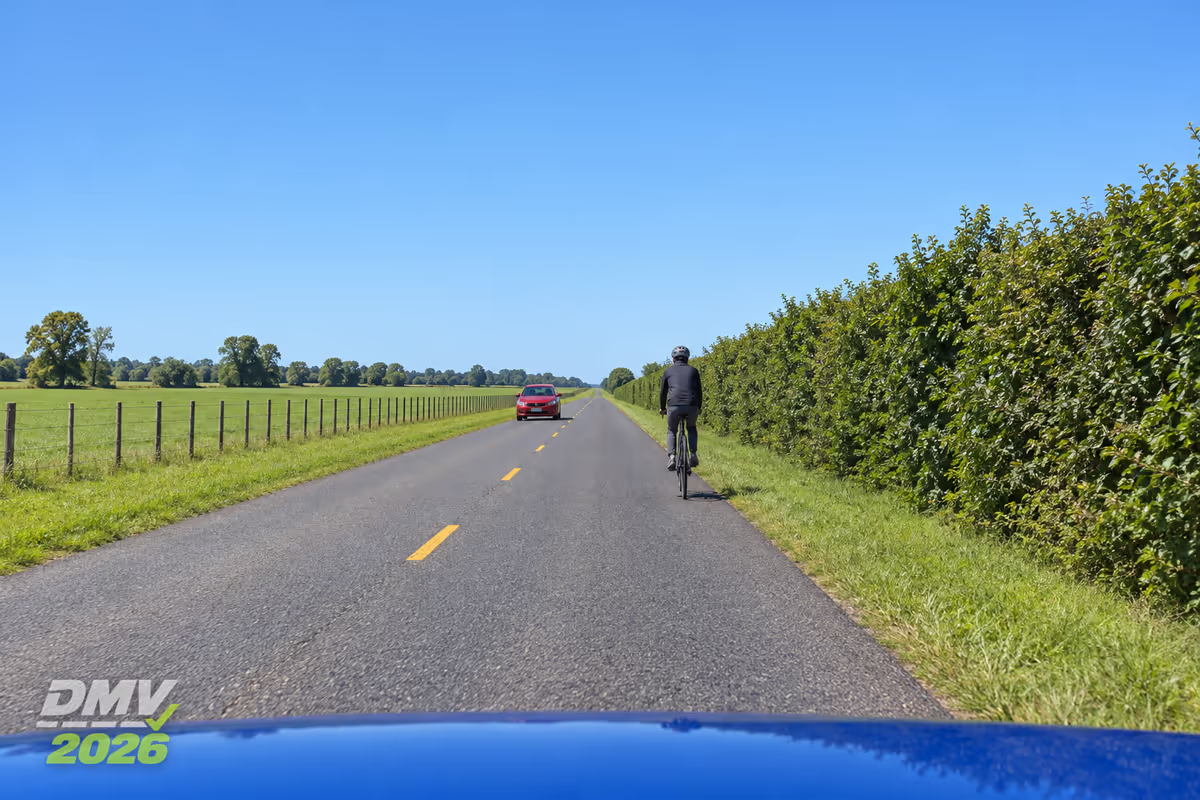
  10. Question 10 of 10 · Passing

    Narrow two-lane road seen from your car. A person on a bicycle is riding ahead of you at the right edge of your lane. A red car is coming toward you in the other lane. There is no shoulder and no bike lane
    There is no room to pass the rider inside your lane. What should you do?
    Show the answer

    The answer is C: Slow down and wait for room to pass wide.

    Slow down and stay behind the rider until the oncoming lane is clear, then pass wide. Give as much room as you can. Do not squeeze past inside your lane. Do not use your horn close to a rider either, since it can startle them into your path.

    “When passing a bicyclist, slow down and allow as much space as possible, and consider the bicyclist's speed when you pass.”

    AAMVA Model Driver’s License Manual, page 28

These 10 questions are from the DMV Champ app’s practice set, last updated October 23, 2026. Spot a mistake in a question? Email us.

How many questions can you miss on the California permit test?

20% of them, since you need 80%.

On DMV Champ’s 46-question simulated test, you can miss 9.

The number of questions isn’t confirmed by an official source.

The test is multiple choice, and you need a score of 80% to pass.

“There are multiple choice questions based on the California Driver’s Handbook, and a passing score is 80%.”

California DMV, instruction permits page

How old do you have to be to get an instruction permit in California?

The youngest you can be is 15 and a half.

“If you are under 18 years old, you will also need to: • Be at least 15½ years old.”

California Driver’s Handbook, page 9

The handbook calls it an instruction permit.

“To apply for a Class C instruction permit: 1. Complete a Driver’s License & ID Card Application.”

California Driver’s Handbook, page 8

What happens if you fail the California permit test?

You get 3 tries to pass before you have to apply again.

“You are allowed three attempts to pass before you must reapply.”

California Driver’s Handbook, page 11

If you’re under 18 and fail, you must wait 7 days to try again, not counting the day you failed.

“Minors must wait seven days to retake a failed knowledge test, not including the day of the failure.”

California Driver’s Handbook, page 11

How do you take the California permit test?

It’s given by the DMV.

“In-office knowledge tests can be completed during DMV business hours.”

California DMV, instruction permits page

You make an appointment at a DMV office and take the test there.

“Visit a DMV office (schedule an appointment), where you will:”

California DMV, instruction permits page

DMV offices don’t give tests after 4:30 p.m., so you have enough time to finish.

“To allow sufficient testing time, tests are not available at DMV offices after 4:30 p.m.”

California DMV, instruction permits page

You can’t use any aids during the test, such as the handbook or a cell phone.

“You are not allowed to use any testing aids during knowledge tests, such as a California Driver’s Handbook or cell phone.”

California Driver’s Handbook, page 11

Test simulator

Practice in the California format

46 questions37 to pass

DMV Champ teaches every question with its explanation, then checks you with 5 simulated tests of 46 questions, graded against the 37-correct passing score. 36 topics in California: the 34 every state tests, plus winter driving and flooding, because the California handbook teaches them.

Download on the App Store