Oregon · Driver and Motor Vehicle Services

Oregon DMV practice test: 35 questions, 80% to pass

Oregon’s knowledge test, given by the DMV, has 35 questions, and you need 28 right, or 80%, to pass.

35

questions

28

right to pass

80%

passing score

Checked against the Oregon Driver Manual (2026–2027 edition) on October 25, 2026. How we check facts

Practice test

Take a 10-question Oregon DMV practice test

Pick an answer and check it. Every question comes with the reason behind the right answer and the sentence of an official document it rests on.

To pass here you need 8 of 10, since Oregon’s test asks for 80%.

  1. Question 1 of 10 · Traffic signals and arrows

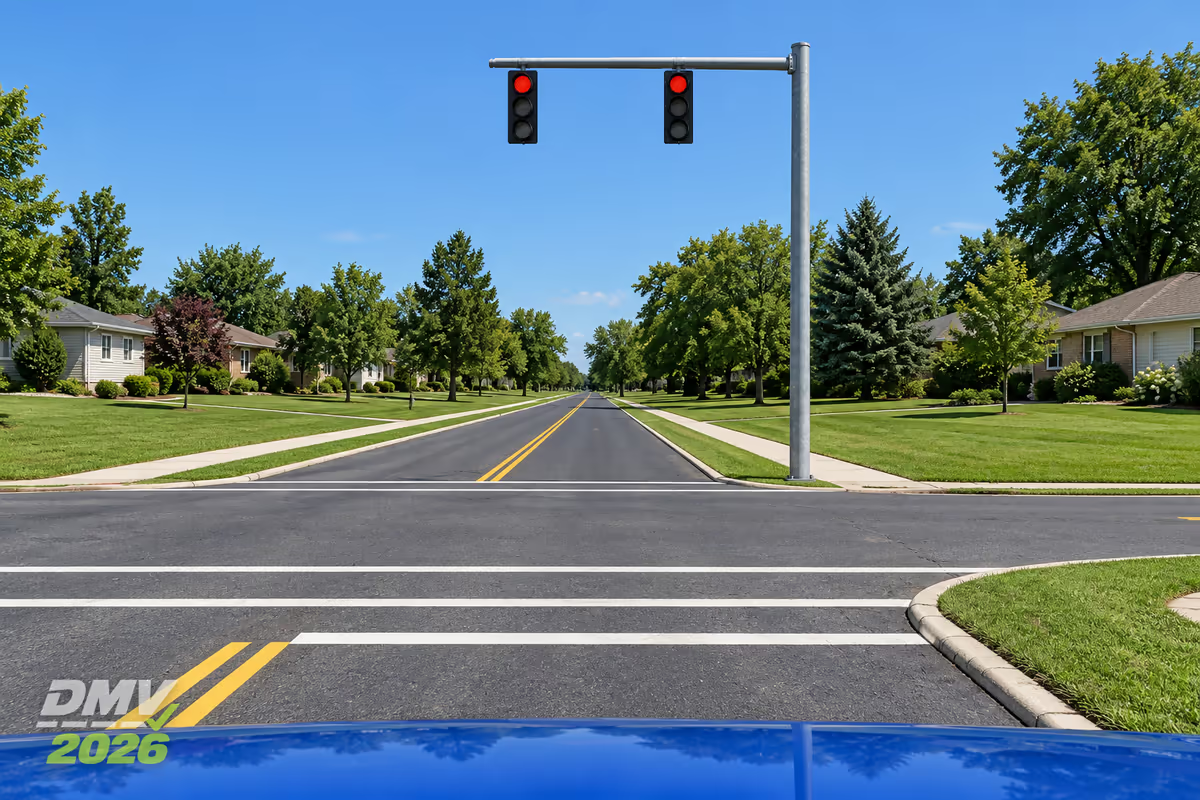
    Street seen from your car, with a traffic signal hanging over the intersection ahead. The signal has three round lenses one above the other, and the top one is lit red while the other two are dark. There is a stop line and a crosswalk across your lane, and no other cars
    You are stopped at this light to go straight. The road is empty. When may you go?
    Show the answer

    The answer is A: When your light turns green.

    A steady red light is not a stop sign. Stopping does not earn you the right to go, and an empty road makes no difference. Wait for your green light, or a green arrow for your direction. In most states one turn is allowed on a steady red. That is a right turn, after a full stop, where no sign forbids it.

    “and shall remain stopped until a signal indication to proceed is displayed, or as provided below.”

    MUTCD, 11th Edition, page 685
  2. Question 2 of 10 · Turn signals, horn and lights

    A left arm out of the window and bent up at the elbow means a ____.
    Show the answer

    The answer is C: right turn

    Left arm bent up at the elbow means a right turn. Every hand signal is given with the left arm out of the driver's window. So the arm points up for a right turn, not out to the right. Bicyclists may point the right arm straight out instead, so read a rider's arm the way it points.

    “Hand and arm signals — Should give the signal using the left arm. For a right turn, the hand and arm are extended straight up.”

    Illinois Rules of the Road 2026, page 33
  3. Question 3 of 10 · Night driving and headlights

    At night, the hardest thing to see on the road is a ____.
    Show the answer

    The answer is C: person in dark clothes

    A person in dark clothes gives back almost none of your light. Signs are made to reflect it, and a car with its lights on makes its own. Search well ahead of your headlights for dark shapes on the road or beside it.

    “Try to search well ahead of your headlight beams, looking for dark shapes on the roadway.”

    AAMVA Model Driver’s License Manual, page 42
  4. Question 4 of 10 · Regulatory signs

    A sign is shaped like a triangle standing on one point. What does it ask you to do?
    Show the answer

    The answer is A: Let the other traffic go first.

    The downward-pointing triangle is the yield sign, and no other sign has that shape. It stands where your road meets one that has the right of way. A yellow diamond is the sign that warns of a hazard ahead.

    “A yield sign is a red and white downward-pointing triangle with red letters. It means you must slow down and allow traffic that has the right of way to cross before entering.”

    AAMVA Model Driver’s License Manual, page 22
  5. Question 5 of 10 · Emergency vehicles and the Move Over law

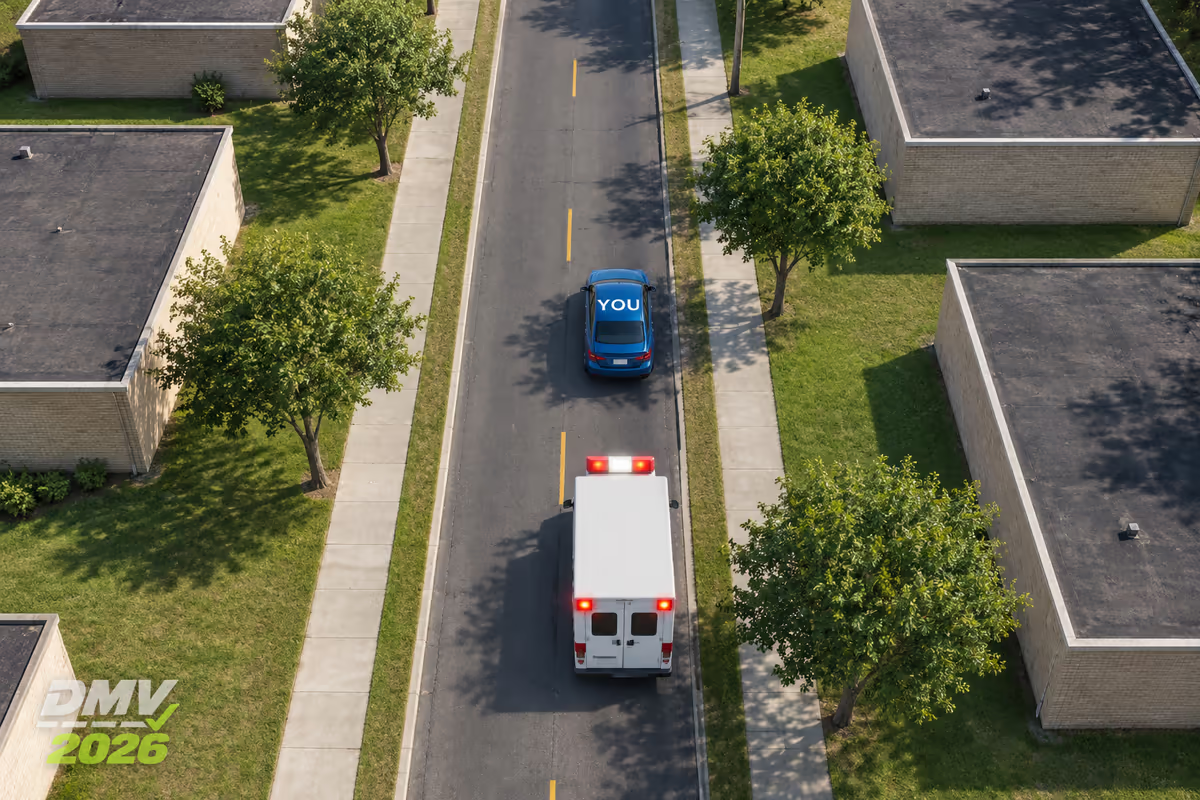
    Two-way street seen from above. Your car is driving in the right-hand lane, and an ambulance with its red lights flashing is close behind it in the same lane. The street is otherwise empty
    What should you do here?
    Show the answer

    The answer is D: Pull to the right edge and stop.

    Lights and a siren together mean the vehicle behind you needs the road. Pull to the right, as close to the edge as you can, and stop until it has passed. Stopping in your lane leaves it nowhere to go, and slowing down without pulling over keeps it stuck behind you.

    “You must yield right of way to an emergency vehicle when the flashing lights and siren are on by pulling over to the edge of the road so the emergency vehicle(s) may pass.”

    AAMVA Model Driver’s License Manual, page 40
  6. Question 6 of 10 · Before you drive

    You put a penny head first in the tread, and all of Lincoln's head shows. What does that mean?
    Show the answer

    The answer is C: The tire is worn out.

    Put the penny into the deepest-looking groove, head first. If you can see all of Lincoln's head, the tread is too shallow and the tire is too worn to drive on. Replace it. Worn tread grips the road less, most of all when the road is wet.

    “Can you see all of his head? If yes, your tires are too worn—don't drive on them, and make sure to get them replaced.”

    AAMVA Model Driver’s License Manual, page 13
  7. Question 7 of 10 · Warning signs

    The only pennant-shaped sign warns of a ____.
    Show the answer

    The answer is B: no-passing zone

    Shape is a shortcut. A pennant pointing right means a no-passing zone. A round sign means a railroad crossing ahead, and a five-sided sign means a school. Each shape belongs to one sign only, so you can read it from the outline before the words are close enough.

    “The NO PASSING ZONE (W14-3) sign (see Figure 2C-11) shall be a pennant-shaped isosceles triangle with its longer axis horizontal and pointing to the right.”

    MUTCD, 11th Edition, page 231
  8. Question 8 of 10 · Alcohol, drugs and DUI

    For a driver under 21, the alcohol rule is
    Show the answer

    The answer is B: far stricter, near zero.

    Every state holds a driver under 21 to a far lower alcohol level than an adult. In many states that level is zero. Drinking under 21 is against the law everywhere, with or without a car. A young driver can lose the license over a level that would not count against an adult.

    “All states have "zero tolerance" laws (no alcohol in the circulatory system) or similar laws for drivers under the age of 21.”

    AAMVA Model Driver’s License Manual, page 10
  9. Question 9 of 10 · Motorcycles, trucks and buses

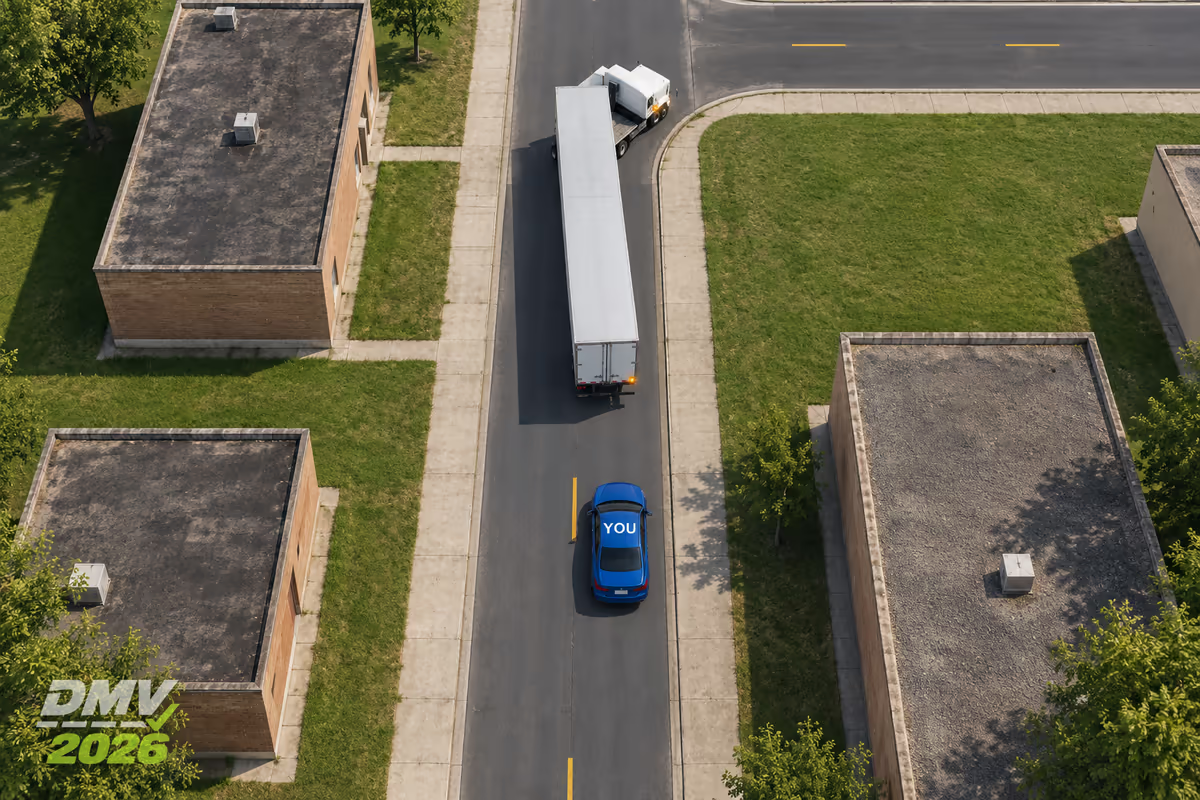
    Tractor-trailer turning right at a corner ahead of your car, its right turn signal on, its cab turned into the side street and its trailer swung out to the left, leaving a gap between the trailer and the curb on the right. Your car is behind it
    You want to turn right too. What should you do?
    Show the answer

    The answer is A: Wait until it has finished turning.

    A truck often swings wide to the left before it turns right. Its back wheels follow a shorter path than its front wheels, so it needs the room. The gap by the curb is where the trailer is about to go, and a car in it gets squeezed. The truck may use the next lane too. Stay back until it has finished its turn.

    “When a truck or bus needs to make a right turn, the driver will sometimes swing the vehicle wide to the left to safely turn right and clear the corner of a curb or other obstruction. Sometimes space from other lanes is used to clear corners.”

    AAMVA Model Driver’s License Manual, page 39
  10. Question 10 of 10 · Lane use and changing lanes

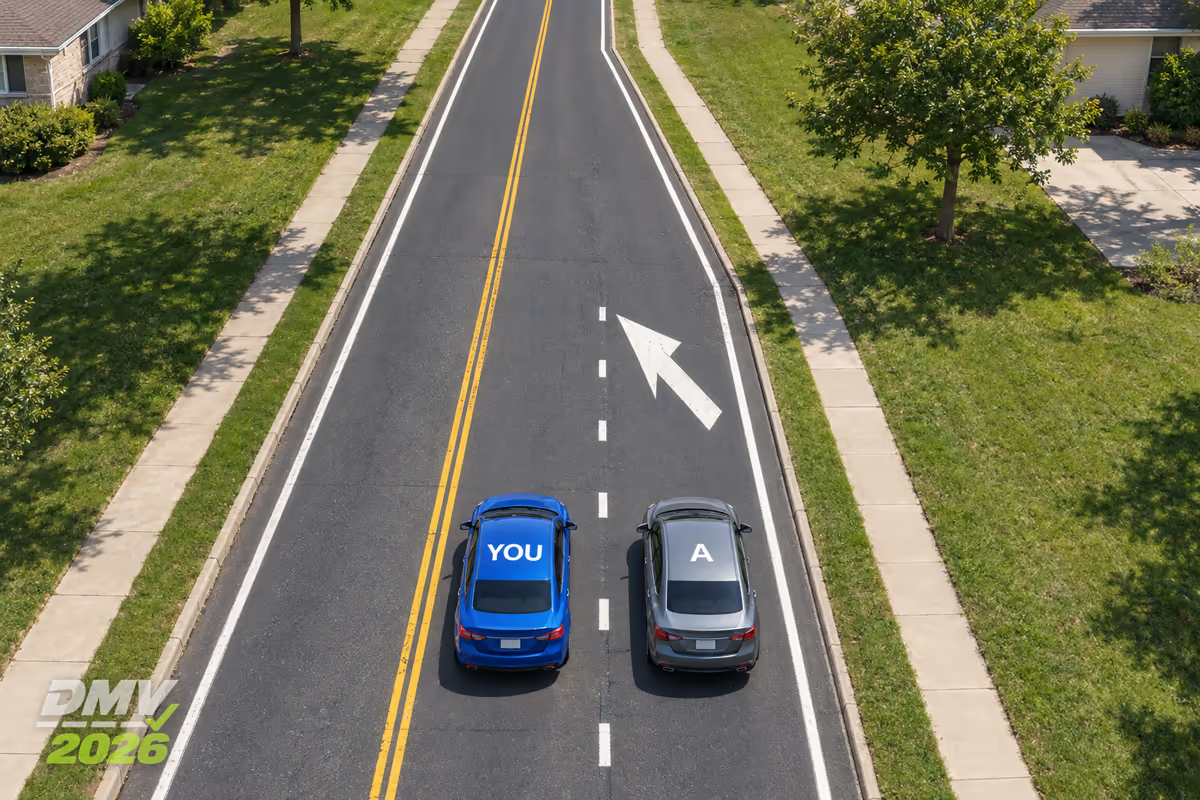
    The same road seen from above with two lanes going your way and the right lane ending ahead. Your car is in the left lane, and a car marked A is in the right lane level with you, where its lane is about to end
    Car A's lane ends ahead. What do you do?
    Show the answer

    The answer is A: Ease off and let it in.

    Where two lanes become one, the driver in the through lane makes room. Ease off the gas, or move over a lane if you can, so car A can slot in ahead of you. Close the gap and that driver is left braking hard at the end of a lane.

    “Make space for vehicles entering a multiple-lane or limited access roadway by moving over a lane or adjusting your speed.”

    AAMVA Model Driver’s License Manual, page 31

These 10 questions are from the DMV Champ app’s practice set, last updated October 23, 2026. Spot a mistake in a question? Email us.

How many questions can you miss on the Oregon permit test?

7

You need 28 of the 35 right.

The test has 35 multiple choice questions.

“It has 35 multiple-choice questions.”

Oregon DMV, online driver manual testing page

You need 28 correct answers to pass.

“You must answer 28 questions correctly to receive a passing score.”

Oregon Driver Manual, page 10

DMV Champ uses the same format for Illinois.

How old do you have to be to get an instruction permit in Oregon?

The youngest you can be is 15.

“Be at least 15 years of age to apply for an instruction permit.”

Oregon Driver Manual, page 97

What happens if you fail the Oregon permit test?

If you fail at a DMV office, you may be able to test again the same day if the office has room.

“If you fail a knowledge test, you may test again the same day, depending on the DMV office testing resource availability.”

Oregon Driver Manual, page 10

If you fail online, you can test up to 2 times in 24 hours.

“If you fail a knowledge test, you may test two times in a 24-hour period.”

Oregon Driver Manual, page 11

You can take the test online 4 times in all, and after that you must test at a DMV office.

“You may take the test online four times total. After four attempts you must test at a DMV office.”

Oregon Driver Manual, page 11

How do you take the Oregon permit test?

It’s given by the DMV.

“For an original driving privilege, DMV will test your vision, driving knowledge and driving skill.”

Oregon Driver Manual, page 9

You can take the test online at DMV2U at any time, or at a DMV office with or without an appointment.

“You have options to take the knowledge test! Online: Go to DMV2U.Oregon.gov, at any time; or at a DMV office, either standby service or with an appointment.”

Oregon Driver Manual, page 10

If you’re under 18 and test online, a proctor over age 21 must supervise you.

“If under 18 years of age, a Proctor over 21 years of age must supervise the test.”

Oregon Driver Manual, page 11

To test online, you need a desktop or laptop computer with a keyboard, mouse and webcam.

“You must use a desktop or laptop computer with a keyboard, mouse and webcam.”

Oregon Driver Manual, page 11

You can read and hear the test in English, Spanish, Arabic, Chinese (Simplified Mandarin), Japanese, Korean, Russian or Vietnamese.

“The test can be read and heard in the following languages:”

Oregon DMV, instruction permit page

Test simulator

Practice in the Oregon format

35 questions28 to pass

DMV Champ teaches every question with its explanation, then checks you with 5 simulated tests of 35 questions, graded against the 28-correct passing score. 36 topics in Oregon: the 34 every state tests, plus winter driving and flooding, because the Oregon handbook teaches them.

Download on the App Store