South Carolina · Department of Motor Vehicles

South Carolina DMV practice test

South Carolina’s knowledge test is given by the SCDMV. DMV Champ’s simulated tests use 30 questions, with 24 right to pass.

30 (DMV Champ’s figure, not confirmed by an official source)

questions

24 (DMV Champ’s figure, not confirmed by an official source)

right to pass

80% (DMV Champ’s figure, not confirmed by an official source)

passing score

* The figures DMV Champ’s simulated tests use, not confirmed by an official source.

Checked against the South Carolina Driver’s License Manual on October 25, 2026. How we check facts

Practice test

Take a 10-question South Carolina DMV practice test

Pick an answer and check it. Every question comes with the reason behind the right answer and the sentence of an official document it rests on.

To pass here you need 8 of 10, the 80% DMV Champ’s simulated tests use.

  1. Question 1 of 10 · Work zones and flaggers

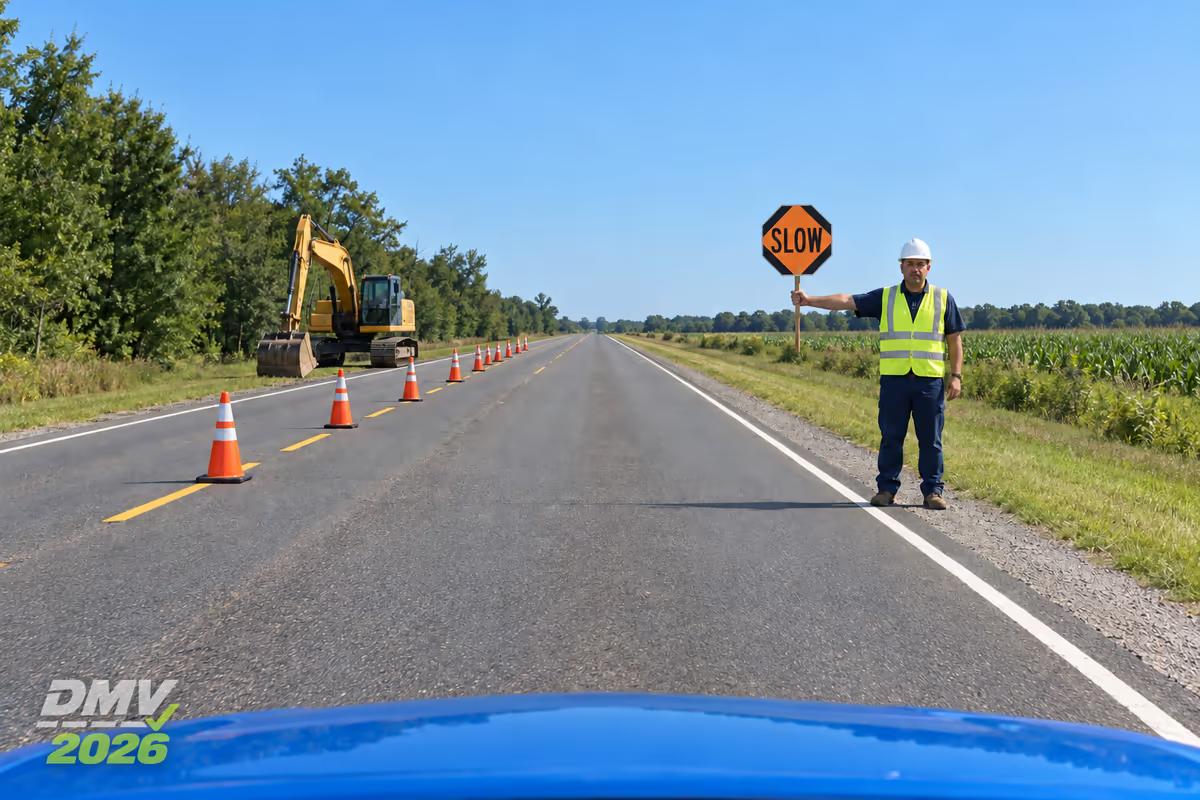
    Two-lane road seen from your car. A flagger in a bright vest stands on the right shoulder just ahead, facing you, holding up a paddle that reads SLOW in black on orange, with the other hand down at the side. Beyond the flagger the oncoming lane is closed off by orange cones around a work area, and your lane runs on past it, empty
    May you keep driving past this flagger?
    Show the answer

    The answer is B: Yes, slowly and ready to stop.

    The SLOW face means keep moving, slowly, and watch for people and machines. The flagger may add a wave of the free hand to send you on. It is not permission to hurry: traffic may be coming the other way through the one open lane.

    “To alert or slow traffic, the flagger shall face road users with the SLOW paddle face aimed toward road users in a stationary position with the arm extended horizontally away from the body.”

    MUTCD, 11th Edition, page 826
  2. Question 2 of 10 · Passing

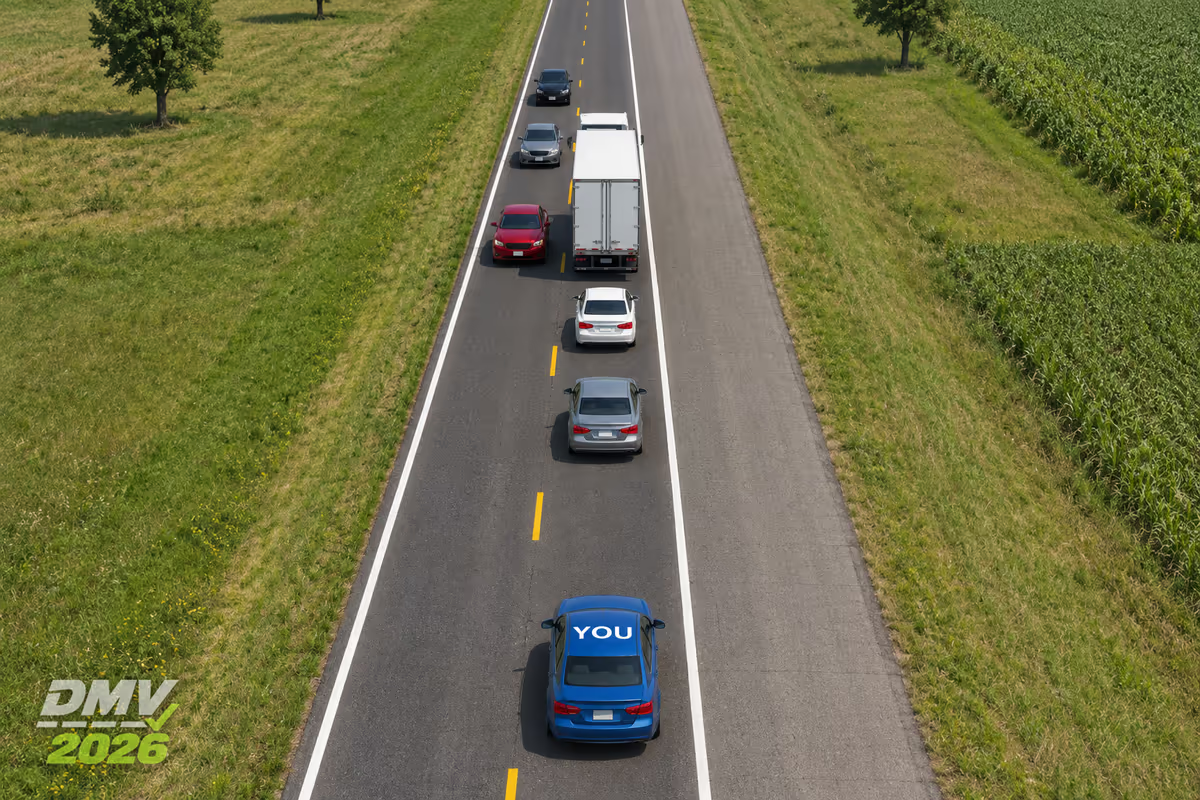
    Straight two-lane road seen from above and behind your car, marked YOU. Two cars and a truck are bunched ahead of you in your lane, and a line of cars is coming the other way. On your right, beyond the white edge line, a wide paved shoulder is empty
    May you use the shoulder to get past the truck?
    Show the answer

    The answer is A: No. It is not a passing lane.

    The shoulder is not a passing lane, paved or not. Other drivers do not expect a car there, and one pulling off the road may do it without looking. A stopped car or a cyclist can be just ahead as well. Stay in line and pass in a traffic lane where the road allows it.

    “Never pass on the shoulder, whether it is paved or not.”

    AAMVA Model Driver’s License Manual, page 28
  3. Question 3 of 10 · Following distance and space

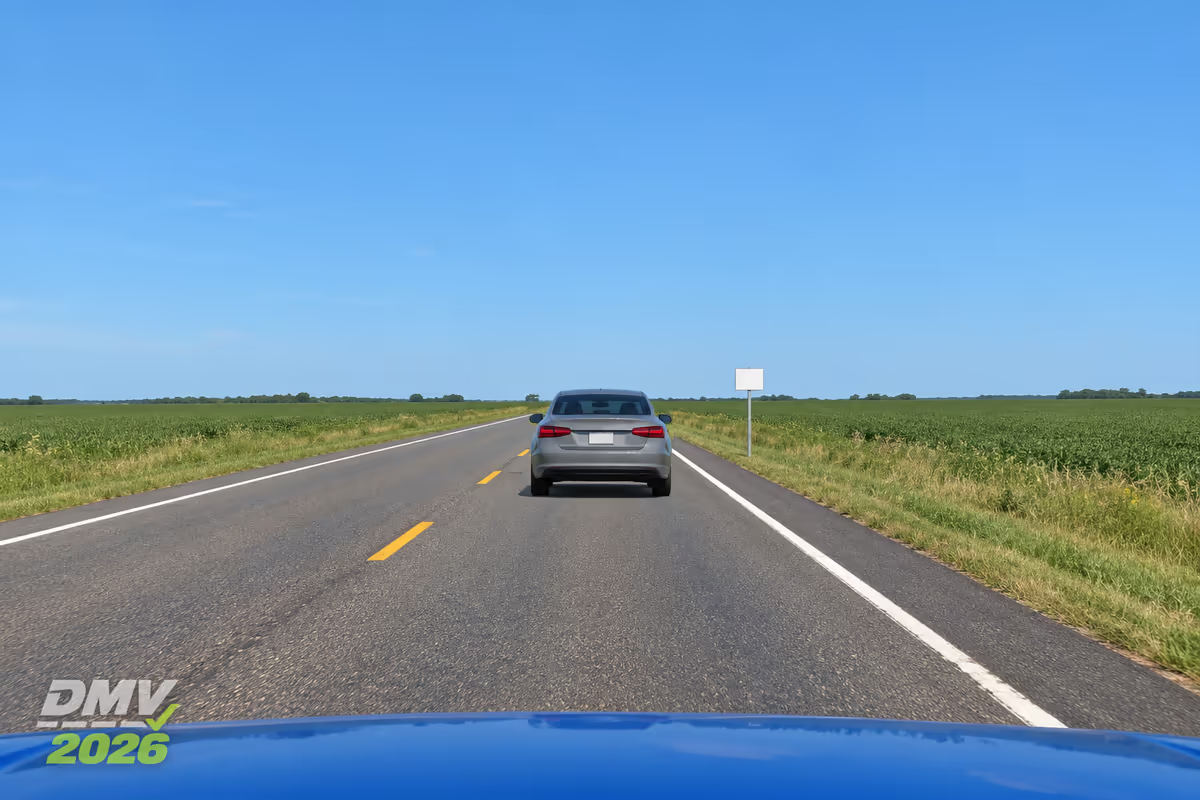
    View through your windshield of a straight dry road. A grey car is ahead in your lane, and a little way beyond it a small plain sign stands on a post at the right edge of the road. Your hood is at the bottom of the picture
    You are using this sign to check your gap. When do you start counting?
    Show the answer

    The answer is A: When the car ahead passes it.

    Start counting the moment the back of the car ahead passes the sign. Count one thousand one, one thousand two, until your own car reaches it. That count is the time between you and the car ahead, which is the time you would have to stop. Any fixed object works, like a pole or a tree.

    “Watch when the rear of the vehicle ahead passes a sign, pole, or any other stationary point.”

    AAMVA Model Driver’s License Manual, page 30
  4. Question 4 of 10 · Traffic signals and arrows

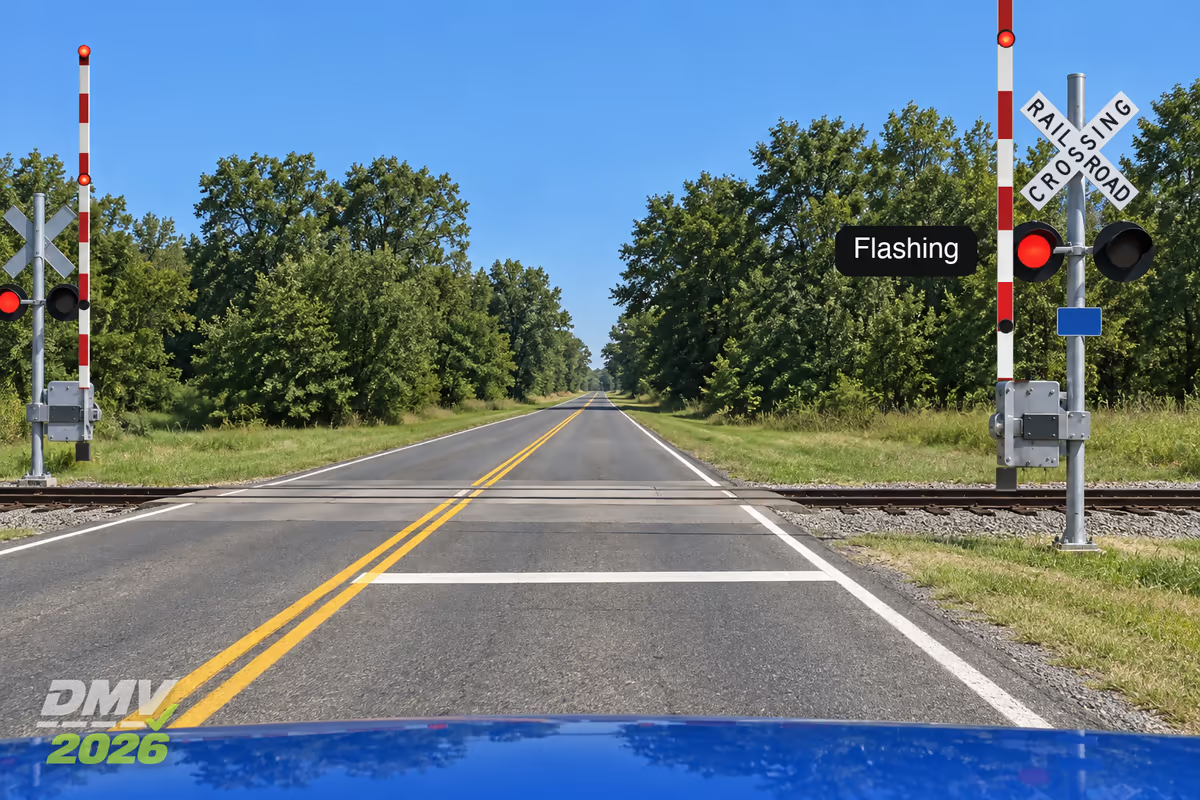
    Railroad crossing seen from your car, stopped short of the line. On the post at the right are a crossbuck and a pair of red lamps, the left one lit, with a small caption beside them reading Flashing. The gate arm stands fully raised and vertical. The track crosses the road ahead and no train is in view
    The gate is up, but the lights are still flashing. May you cross?
    Show the answer

    The answer is B: No. Wait until the lights stop.

    Flashing red lights at a crossing mean a train is coming or still near, whatever the gate is doing. Stay stopped until the lights stop flashing. A second train may be coming on another track, hidden by the first. The lights, not the gate, tell you when it is clear.

    “Flashing-Light Signals—a warning device consisting of two red signal indications arranged horizontally that are activated to flash alternately when rail traffic is approaching or present at a grade crossing.”

    MUTCD, 11th Edition, page 58
  5. Question 5 of 10 · Emergency vehicles and the Move Over law

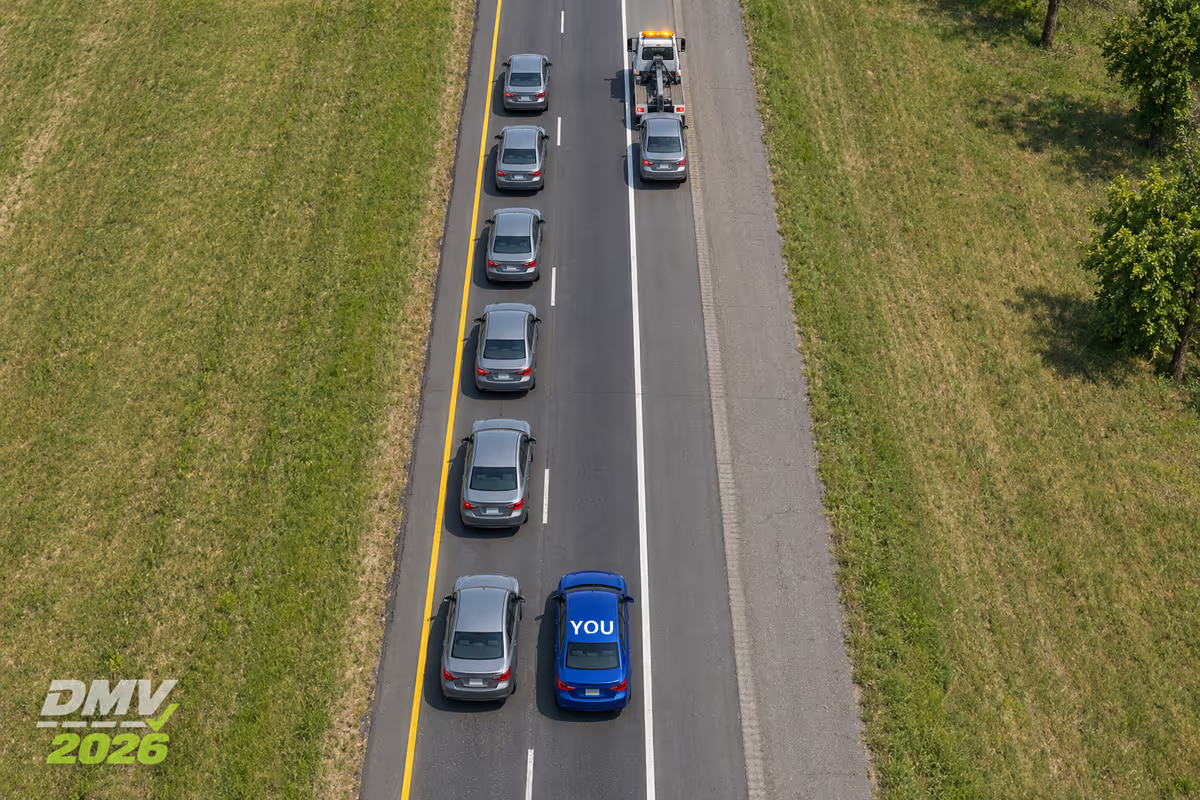
    Highway seen from above with two lanes in your direction. Your car is in the right lane. A tow truck with amber lights flashing is stopped on the right shoulder ahead, and the left lane is full of cars with no gap
    May you pass the tow truck at your current speed?
    Show the answer

    The answer is C: No. Slow down and go past with care.

    When you cannot change lanes, the law asks you to slow down and pass with care. How much to slow down varies by state, and some states name a figure. Go well under the speed of the traffic around you and be ready to stop. Stopping on the highway would create a new hazard.

    “If a lane change is not possible, reduce speed and proceed with caution.”

    Illinois Rules of the Road 2026, page 28
  6. Question 6 of 10 · Rain, fog and slick roads

    The best way to keep from hydroplaning is to
    Show the answer

    The answer is C: slow down.

    Slow down in the rain and wherever water pools on the road. At low speed the grooves in the tread push the water out from under the tire. The faster you go, the less water they can clear. A firm grip and a tap on the brakes clear no water at all.

    “The best way to avoid traction loss from hydroplaning is to slow down in the rain or when the road is wet with pooled water or water puddles.”

    AAMVA Model Driver’s License Manual, page 30
  7. Question 7 of 10 · Regulatory signs

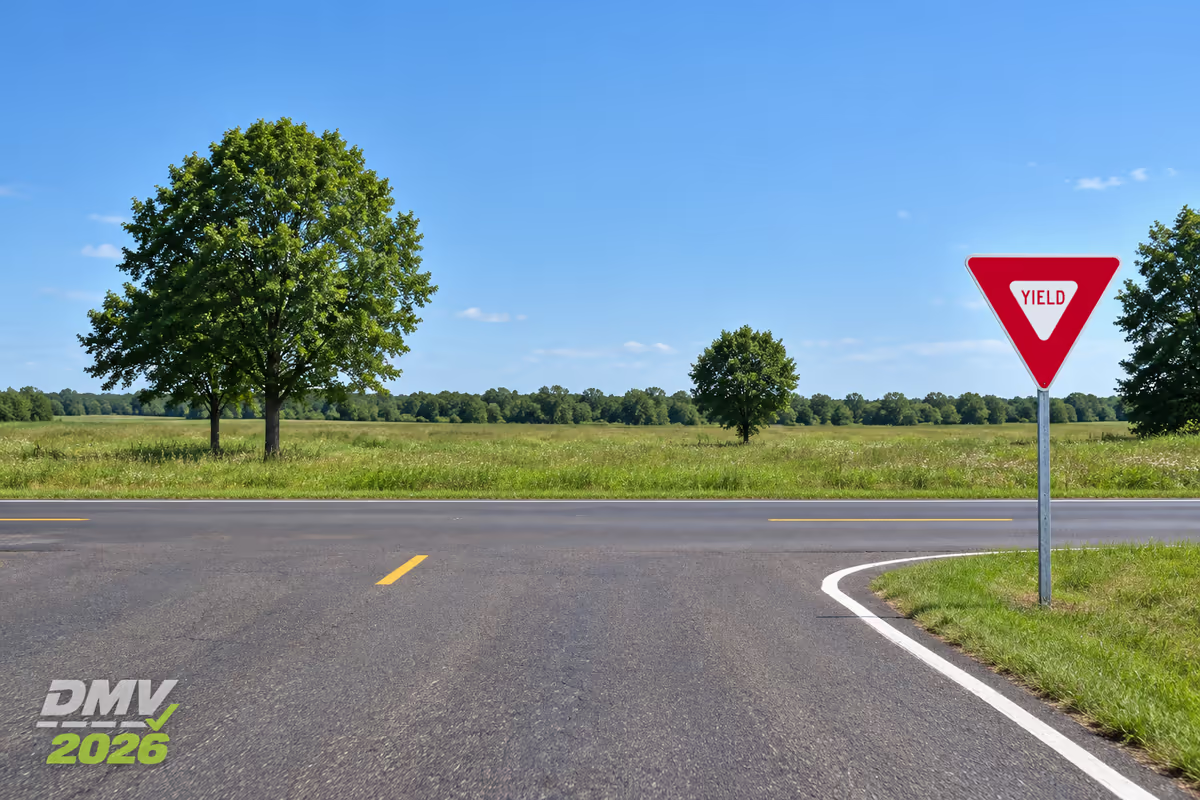
    Road seen from your car as it comes in to join a wider road ahead, with a downward-pointing triangle sign on a post at the right, red border, white center and the word YIELD in red. Both roads are empty
    The road you are joining is empty. Must you stop at this sign?
    Show the answer

    The answer is B: No. Slow down and go if it stays clear.

    A yield sign asks you to give up the right of way, not to stop for its own sake. If the road is clear, slow down, look, and go. A stop sign is the one that requires a full stop whether the road is empty or not.

    “Vehicles controlled by a YIELD sign need to slow down to a speed that is reasonable for the existing conditions or stop when necessary to avoid interfering with conflicting traffic.”

    MUTCD, 11th Edition, page 115
  8. Question 8 of 10 · Licensing, insurance and penalties

    Your license is suspended. May you drive to work and back?
    Show the answer

    The answer is B: No. That is a separate offense.

    A suspended license is not valid for any trip. Driving on it is a separate offense, on top of what got you suspended. It brings a fine, often jail, and usually a longer suspension. In many states the owner who lends a car to a suspended or unlicensed driver is punished too.

    “If your license or permit has been suspended or revoked for any reason, it is not valid. You are not allowed to drive in Massachusetts or anywhere else. Driving with a suspended or revoked license is a criminal motor vehicle violation. You may face a large fine and/or jail sentence, as well as additional penalties.”

    Massachusetts Driver's Manual, English, page 75
  9. Question 9 of 10 · Looking ahead, mirrors and backing up

    Your blind spot is the part of the road
    Show the answer

    The answer is A: your mirrors do not show.

    A blind spot is the area beside and just behind your car that no mirror shows. A car or a motorcycle can be there without showing in any mirror. The only way to check it is to turn your head and look over your shoulder on that side.

    “Check your "blind spots," or areas around your vehicle that cannot be seen by other vehicles, by turning your head and looking over your shoulder in the direction you plan to move.”

    AAMVA Model Driver’s License Manual, page 27
  10. Question 10 of 10 · Turns and U-turns

    Before a right turn, may you swing out to the left to make more room?
    Show the answer

    The answer is B: No. Keep to the right edge of your lane.

    Turn right from the right-most part of your lane and keep close to the curb. Swinging left first tells the driver behind that you are changing lanes or turning left. It also opens a gap on your right for a bicycle or a car. Set your position before the corner.

    “Avoid swinging wide to the left before making the turn.”

    AAMVA Model Driver’s License Manual, page 24

These 10 questions are from the DMV Champ app’s practice set, last updated October 23, 2026. Spot a mistake in a question? Email us.

How many questions can you miss on the South Carolina permit test?

On DMV Champ’s 30-question simulated test, you can miss 6.

Those figures aren’t confirmed by an official source.

How old do you have to be to get a beginner’s permit in South Carolina?

The youngest you can be is 15.

“If you have never had a driver’s license, you must start with a beginner’s permit. • You must be at least 15 years old.”

South Carolina Driver’s License Manual, page 8

The manual calls it a beginner’s permit.

“If you have never had a driver’s license, you must start with a beginner’s permit.”

South Carolina Driver’s License Manual, page 8

How do you take the South Carolina permit test?

It’s given by the SCDMV.

“You may take vision and knowledge tests at any SCDMV branch.”

South Carolina Driver’s License Manual, page 14

To take the test, go to an SCDMV branch before 4 p.m.

“If you're interested in getting a beginner's permit, study the appropriate manual and visit an SCDMV branch before 4 p.m. to take the knowledge test.”

SCDMV, beginner’s permit page

If you’re getting your first Class D beginner’s permit, you can also test with a third-party tester.

“There are also One Stop Driver Training and Testing Programs (also known as third-party testers) available if you are applying for a first-time regular (class D) beginner’s permit, driver’s license, or motorcycle (class M) license.”

South Carolina Driver’s License Manual, page 14

You can’t bring written material or any kind of electronic device into the test area.

“Written material or electronic devices of any kind are not allowed in the knowledge test area.”

South Carolina Driver’s License Manual, page 14

Test simulator

Practice in the South Carolina format

30 questions24 to pass

DMV Champ teaches every question with its explanation, then checks you with 5 simulated tests of 30 questions, graded against the 24-correct passing score. 36 topics in South Carolina: the 34 every state tests, plus winter driving and flooding, because the South Carolina handbook teaches them.

Download on the App Store