Rhode Island · Division of Motor Vehicles

Rhode Island DMV practice test: 40 questions, 70% to pass

Rhode Island’s knowledge test, given by the DMV, has 40 questions, and you need 28 right, or 70%, to pass.

40

questions

28

right to pass

70%

passing score

90 min

time limit

Checked against the Rhode Island Driver’s Manual (April 2024 edition) on October 26, 2026. How we check facts

Practice test

Take a 10-question Rhode Island DMV practice test

Pick an answer and check it. Every question comes with the reason behind the right answer and the sentence of an official document it rests on.

To pass here you need 7 of 10, since Rhode Island’s test asks for 70%.

  1. Question 1 of 10 · Guide and service signs

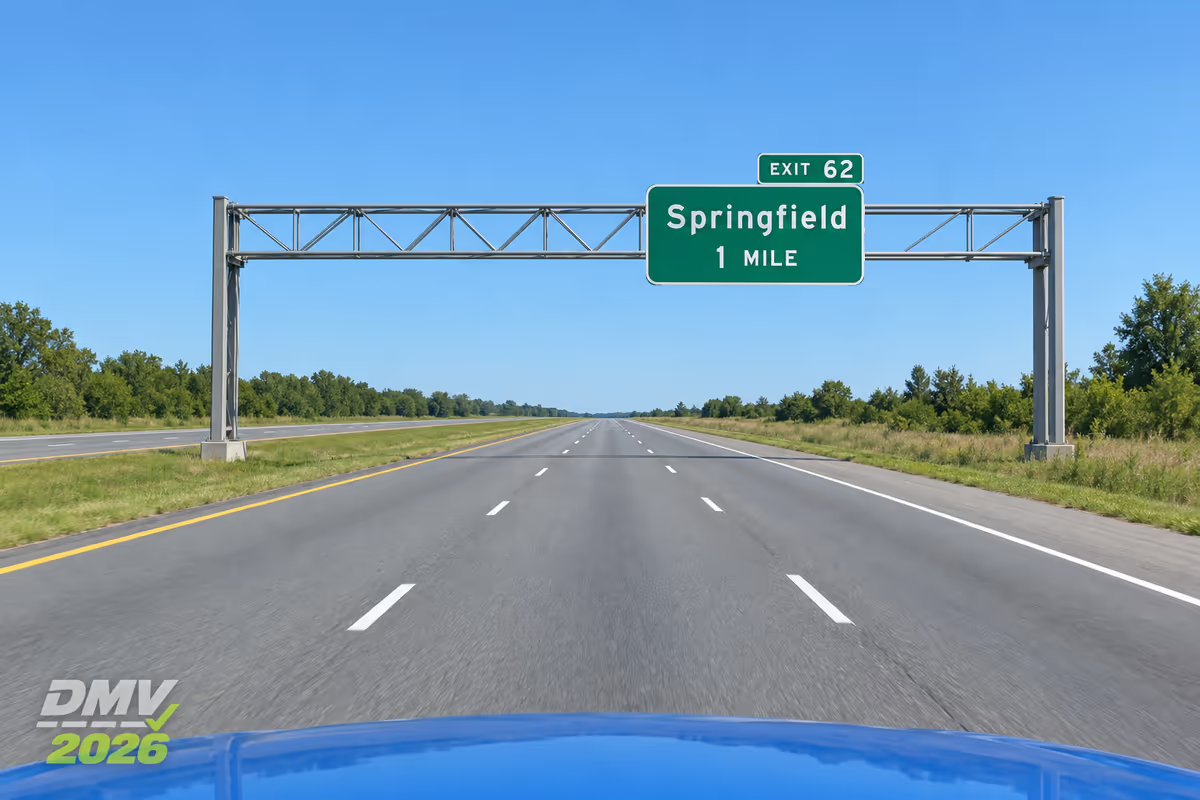
    Large green sign over a three-lane freeway, with a small green plaque on its top right corner reading EXIT 62, the word Springfield under it and 1 MILE on the bottom line. Your car is in the middle lane
    What does the bottom line of this sign tell you?
    Show the answer

    The answer is A: The exit is 1 mile ahead.

    The bottom line of an advance guide sign is the distance to the exit, not to the town. The first sign is usually 1 mile out, and a second comes at half a mile. That is your notice to get into the exit lane in good time.

    “An Interchange Advance guide sign (see Figure 2E-9) gives notice well in advance of the exit point of the principal destinations served by the next interchange and the distance to that interchange.”

    MUTCD, 11th Edition, page 353
  2. Question 2 of 10 · Highways, merging and exits

    As you come up to a toll plaza, expect other drivers to
    Show the answer

    The answer is B: change lanes and slow or stop.

    Drivers are sorting into the lane that takes their payment. They slow or stop to pay, then speed up again on the far side. The number of lanes often changes before and after the plaza. Slow down as you approach and pick your lane early.

    “Toll plaza operations often include lane-specific restrictions on vehicle type, forms of payment accepted, and speed limits or required stops. Vehicles are typically required to come to a stop to pay the toll or receive a toll ticket in the attended and exact change or automatic lanes.”

    MUTCD, 11th Edition, page 424
  3. Question 3 of 10 · Snow and ice

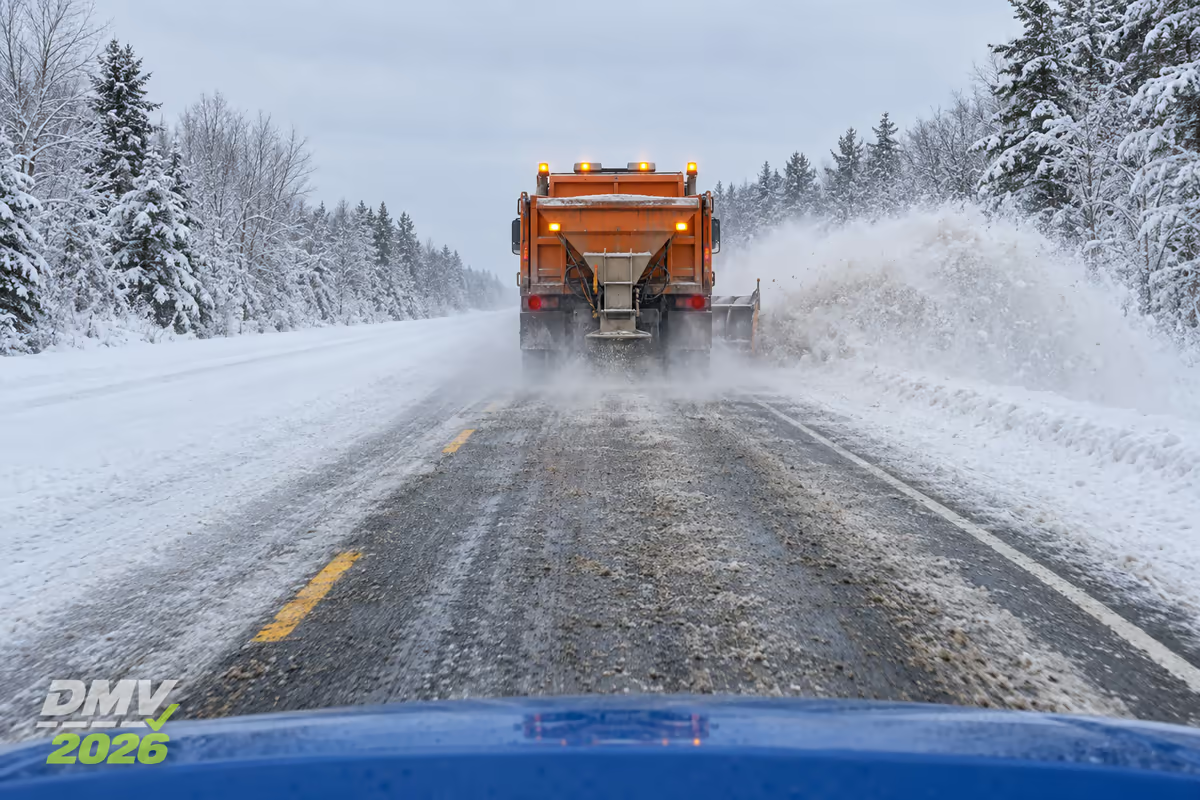
    View through the windshield of a two-lane highway in winter. A large orange snowplow truck drives ahead in your lane with amber lights flashing, its blade throwing a plume of snow onto the right shoulder and a cloud of blown snow hanging behind it. The lane behind the plow is wet and gritty, and the shoulder is deep in snow
    What should you do behind this snowplow?
    Show the answer

    The answer is B: Stay well back.

    Stay well back from a plow. It throws snow, salt and grit, and the cloud it raises can hide the truck and the road. Plows move slowly and may stop or back up. Pass only when you can see the whole truck, and never on the side its blade is pushing snow to.

    “Never crowd a snowplow. Pass snowplows only when you can see the entire vehicle. Stay well behind plows to avoid flying sanding materials, snow and ice that could hit your vehicle. Be alert for dangerous snow clouds or “whiteout” conditions. Snowplows can create clouds of blowing snow that may conceal the road and hide driving hazards.”

    Minnesota Driver's Manual, page 84
  4. Question 4 of 10 · Warning signs

    Bright yellow-green warning signs are used for ____.
    Show the answer

    The answer is B: schools, pedestrians and bicycles

    Fluorescent yellow-green is reserved for warnings about people: school, pedestrian, bicycle and playground signs. Road work is orange, and every other warning is plain yellow. The color tells you before you read the symbol that someone may be crossing.

    “F. Fluorescent Yellow-Green—pedestrian warning, bicycle warning, playground warning, school bus warning, and school warning”

    MUTCD, 11th Edition, page 74
  5. Question 5 of 10 · Passing

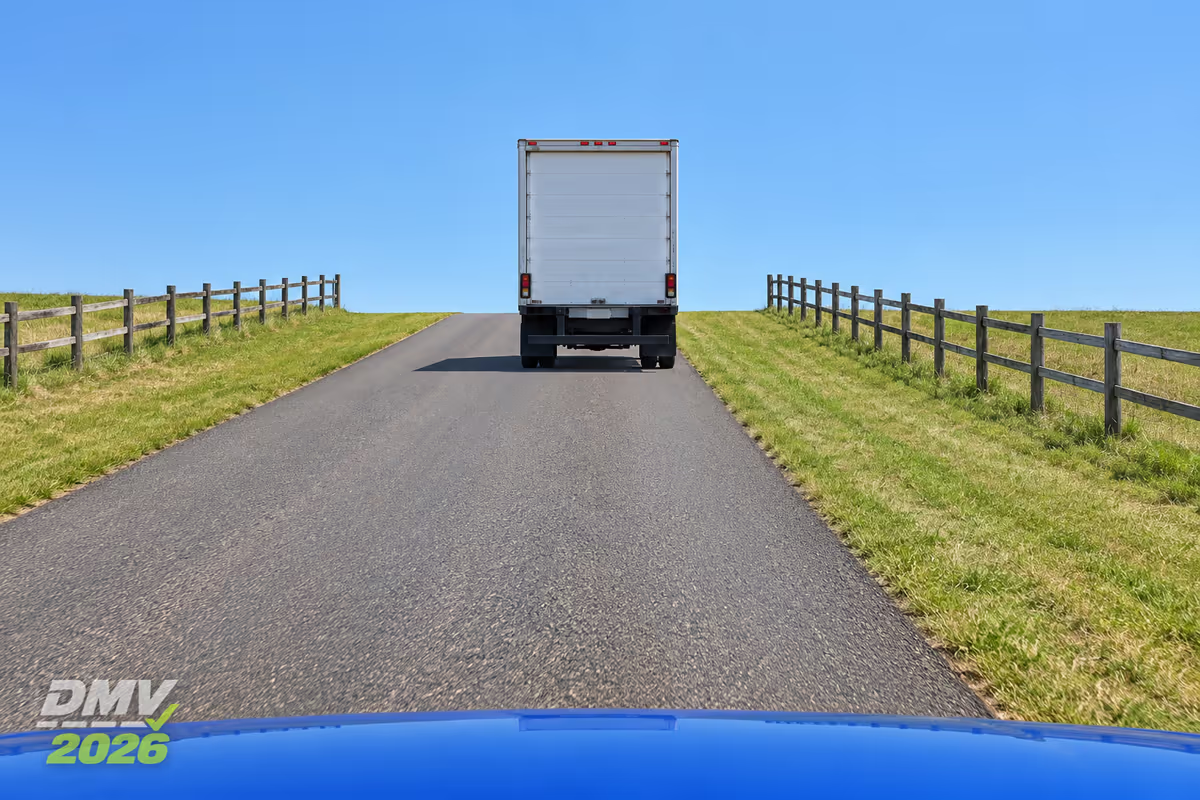
    Narrow two-lane road seen from your car, with no painted center line, rising to the top of a hill a short way ahead. A white truck is ahead of you in your lane, partway up the slope. Nothing beyond the top of the hill can be seen
    May you pass the truck here?
    Show the answer

    The answer is C: No. You cannot see over the hill.

    Do not pass where a hill or a curve hides the road ahead. A car coming the other way is out of sight until it is close. The whole pass has to fit in the road you can see. Stay behind until you can see past the top.

    “Do not attempt to pass when an oncoming vehicle is approaching, your view is blocked by a curve or a hill, at intersections, or before a highway-railroad crossing or bridge.”

    AAMVA Model Driver’s License Manual, page 28
  6. Question 6 of 10 · Rain, fog and slick roads

    A road is most slippery ____.
    Show the answer

    The answer is C: when the rain first starts

    The first rain mixes with the oil and dirt on the road into a greasy film. The road is at its worst in those first few minutes. Steady rain washes the film away, but the road stays slick until it dries. Slow down as soon as the first drops fall.

    “Slippery roads—Reduce speed at the first sign of rain, snow, sleet, or ice.”

    AAMVA Model Driver’s License Manual, page 29
  7. Question 7 of 10 · Pavement markings

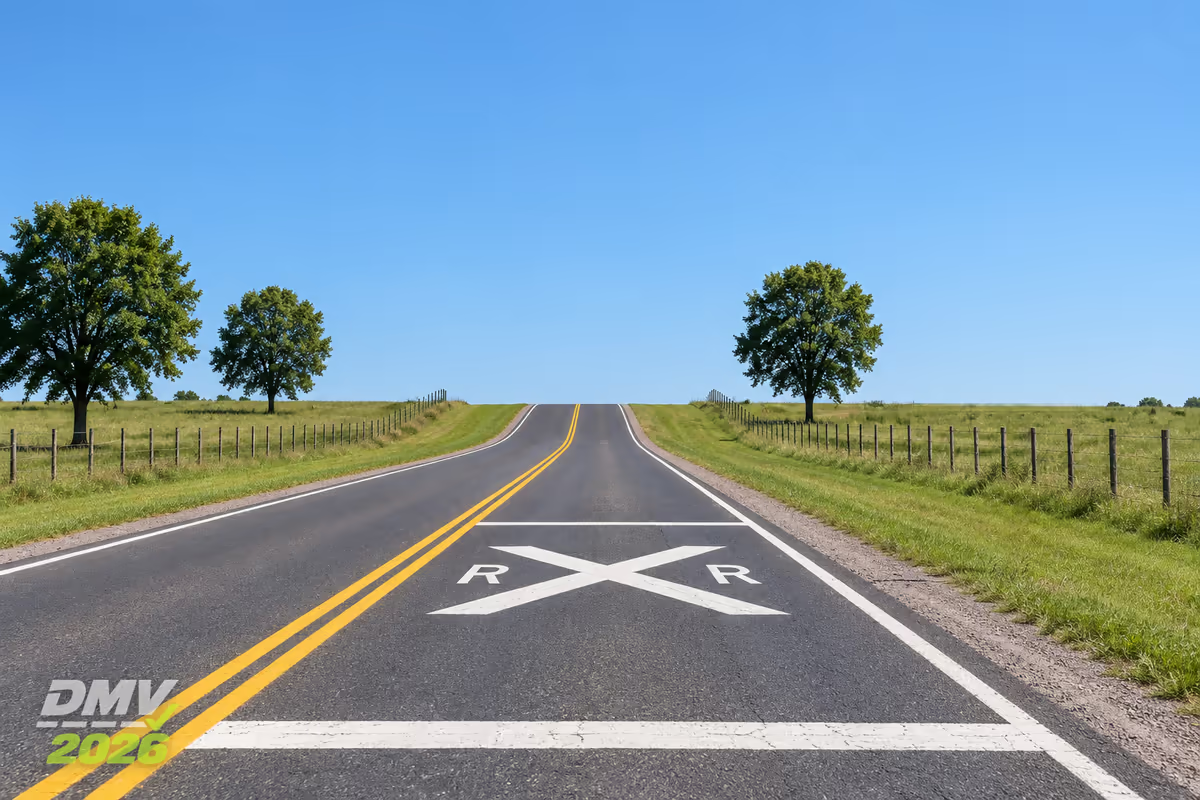
    Your lane from the driver's seat with a large white X and the letters R R painted across the pavement ahead
    What is this marking warning you about?
    Show the answer

    The answer is C: A railroad crossing ahead.

    A large X with the letters RR warns that a railroad crossing is coming, before you can see the rails. The center line usually turns solid with it, because passing is not allowed there. Slow down and look both ways.

    “No-passing zone markings shall be used on”

    MUTCD, 11th Edition, page 583
  8. Question 8 of 10 · Fatigue, vision and health

    Out of the corner of your eye, you can
    Show the answer

    The answer is B: spot something moving.

    You see sharply only in a narrow area straight ahead. Side vision picks up movement and shapes, but you cannot focus on anything out there. Glance to the side or check a mirror before you act on what the corner of your eye picked up.

    “Side Vision. You need to see “out of the corner of your eye.” This lets you spot vehicles and other potential trouble on either side of you while you look ahead. Because you cannot focus on things to the side, you must also use your side mirrors or glance to the side if necessary.”

    Connecticut Driver's Manual, page 7
  9. Question 9 of 10 · Stopping distance and braking

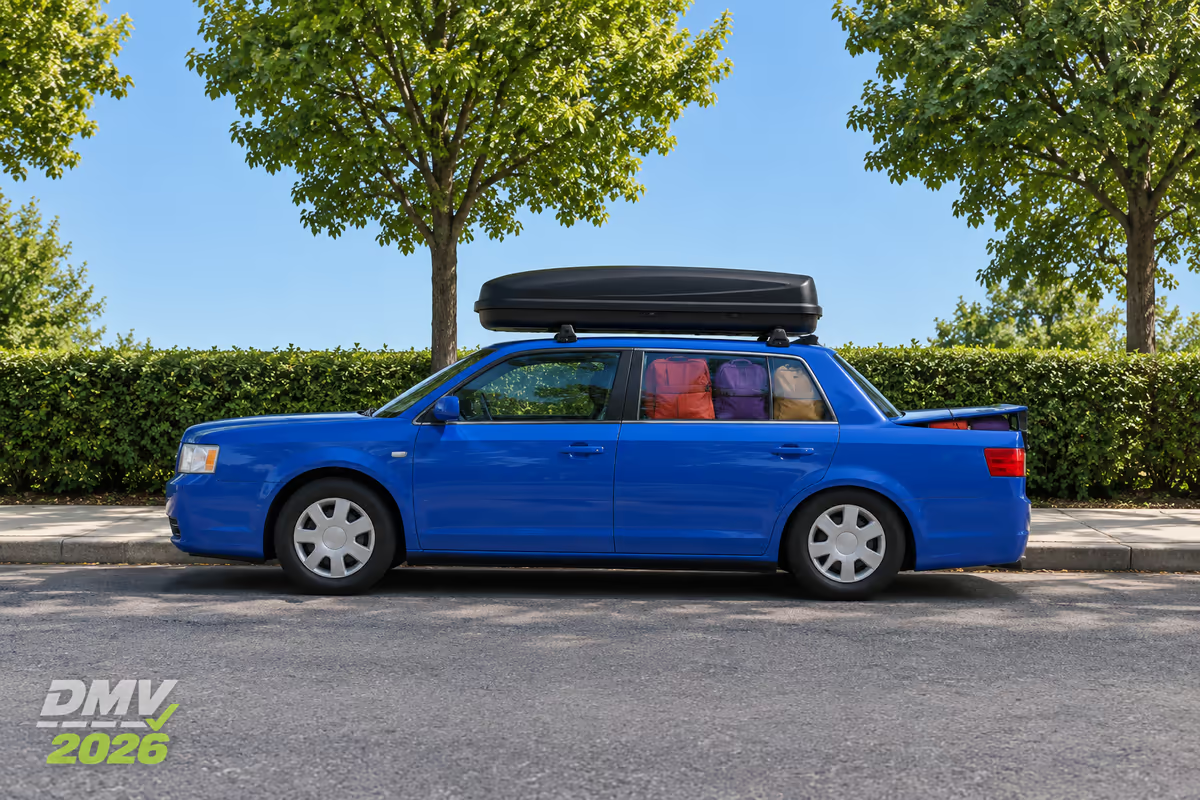
    Side view of a blue sedan standing at a curb, loaded for a trip. A box is fastened to the roof, suitcases are stacked in the trunk under a cord, and bags fill the back seat up to the windows. The rear of the car sits low
    A car loaded like this, compared with the same car empty, needs
    Show the answer

    The answer is B: more room to stop.

    Extra weight takes more braking to slow down, so a loaded car needs more road to stop. The same goes for a car pulling a trailer. Your reaction time does not change with the load, so leave extra room ahead whenever you carry a heavy load.

    “Because of a large vehicle’s size and weight, they take longer to stop than cars.”

    AAMVA Model Driver’s License Manual, page 39
  10. Question 10 of 10 · Speed limits

    Highway traffic is moving a little under the posted limit. What speed should you hold?
    Show the answer

    The answer is A: The speed of the traffic.

    Drive with the flow of traffic as long as it stays within the limit. Crashes often happen when one car goes much faster or slower than the cars around it. If the flow goes over the limit, the limit wins. If you need to go slower, keep right.

    “Driving safely means adjusting your vehicle speed for roadway and traffic conditions, providing an adequate following interval, and obeying the appropriate speed limits.”

    AAMVA Model Driver’s License Manual, page 29

These 10 questions are from the DMV Champ app’s practice set, last updated October 23, 2026. Spot a mistake in a question? Email us.

How many questions can you miss on the Rhode Island permit test?

12

You need 28 of the 40 right.

The test has 40 multiple choice questions.

“The computerized knowledge exam has a 90-minute maximum and consist of forty (40) multiple choice questions.”

Rhode Island Driver’s Manual, page 10

The Community College of Rhode Island, which gives the DMV’s knowledge test to its driver education students, says you need 70% to pass.

“The final exam serves as the Rhode Island DMV Knowledge Test. Students must earn a passing score of 70%.”

Community College of Rhode Island, driver education page

How old do you have to be to get a limited learner permit in Rhode Island?

The youngest you can be is 16.

“Although you cannot obtain a Limited Learner Permit from the DMV until you are sixteen (16), you are eligible to register for a driver education class”

Rhode Island Driver’s Manual, page 10

What happens if you fail the Rhode Island permit test?

If you fail, you must wait at least 8 days before you take the test again.

“Applicants that fail to pass the knowledge exam must wait at least 8 days before retaking the exam.”

Rhode Island DMV, Knowledge Exams page

If you fail the test through CCRI, you take it again at the DMV’s main office in Cranston.

“First-time applicants (and those who fail the RI DMV knowledge exam through CCRI) must take the computerized examination at the main office of the DMV in Cranston.”

Rhode Island Driver’s Manual, page 10

How do you take the Rhode Island permit test?

It’s given by the DMV.

“You must pass a computerized knowledge exam administered by the Division of Motor Vehicles (“DMV”).”

Rhode Island Driver’s Manual, page 10

The manual calls it the knowledge exam.

“Second: You must pass a computerized knowledge exam administered by the Division of Motor Vehicles”

Rhode Island Driver’s Manual, page 10

If you’re 18 or older, or under 18 with driver education from a school other than CCRI, you take the test on a computer at DMV headquarters in Cranston.

“Applicants 18 years of age and older must come to the DMV headquarters, 600 New London Ave, Cranston to take a computerized knowledge exam prior to issuance of a learner’s permit. Applicants under 18 who have completed a driver education class with an approved curriculum at a driving school other than CCRI must come to the DMV headquarters in Cranston with the class completion certificate to take a computerized knowledge exam.”

Rhode Island DMV, Knowledge Exams page

If you take your driver education course with CCRI, you take the DMV test through CCRI.

“All applicants who take the thirty-three (33) hour driver education course with CCRI take the RI DMV Knowledge examination (Permit test) through CCRI.”

Rhode Island Driver’s Manual, page 10

The computer test comes in English, Spanish and Portuguese, during business hours and by reservation only.

“Computerized knowledge exams are administered in English, Spanish and Portuguese. These tests are available during normal business hours by reservation only.”

Rhode Island DMV, Knowledge Exams page

You can ask to take a printed test in another language if you schedule it ahead of time.

“Applicants may request to take the knowledge exam (in a printed format) in a foreign language. Foreign language exams will need to be scheduled in advance to allow DMV time to prepare the test as requested.”

Rhode Island DMV, Knowledge Exams page

Test simulator

Practice in the Rhode Island format

40 questions28 to pass90 minutes

DMV Champ teaches every question with its explanation, then checks you with 5 simulated tests of 40 questions, graded against the 28-correct passing score. 35 topics in Rhode Island: the 34 every state tests, plus winter driving, because the Rhode Island handbook teaches it.

Download on the App Store