Vermont · Department of Motor Vehicles

Vermont DMV practice test: 20 questions, 80% to pass

Vermont’s knowledge test, given by the DMV, has 20 questions, and you need 16 right, or 80%, to pass.

20

questions

16

right to pass

80%

passing score

Checked against the Vermont Driver’s Manual (2025 edition) on October 25, 2026. How we check facts

Practice test

Take a 10-question Vermont DMV practice test

Pick an answer and check it. Every question comes with the reason behind the right answer and the sentence of an official document it rests on.

To pass here you need 8 of 10, since Vermont’s test asks for 80%.

  1. Question 1 of 10 · Regulatory signs

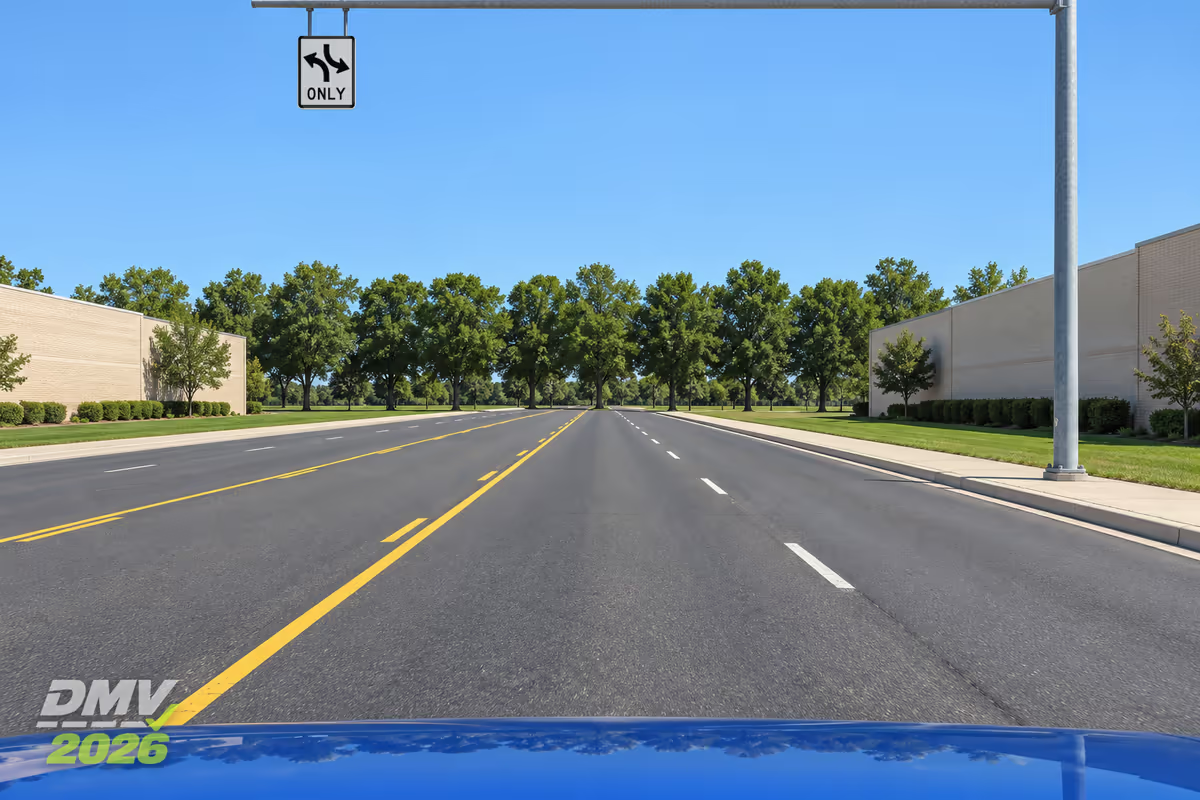
    White upright rectangular sign hanging over the center lane of a street, with two black arrows curving away from each other above the word ONLY; the center lane is bordered by a solid and a broken yellow line on each side
    This sign hangs over the center lane. Who may use that lane?
    Show the answer

    The answer is A: Left turns from both directions.

    The two opposed arrows mark a shared center turn lane. Drivers from either direction pull into it to wait for a gap and turn left. It is not for driving along, passing or getting up to speed. A car coming the other way may be in it too.

    “A Two-Way Left-Turn-Only (R3-9a or R3-9b) sign (see Figure 2B-6) should be used in conjunction with the required pavement markings where a non-reversible lane is reserved for the exclusive use of left-turning vehicles in either direction and is not used for passing, overtaking, or through travel.”

    MUTCD, 11th Edition, page 135
  2. Question 2 of 10 · Passing

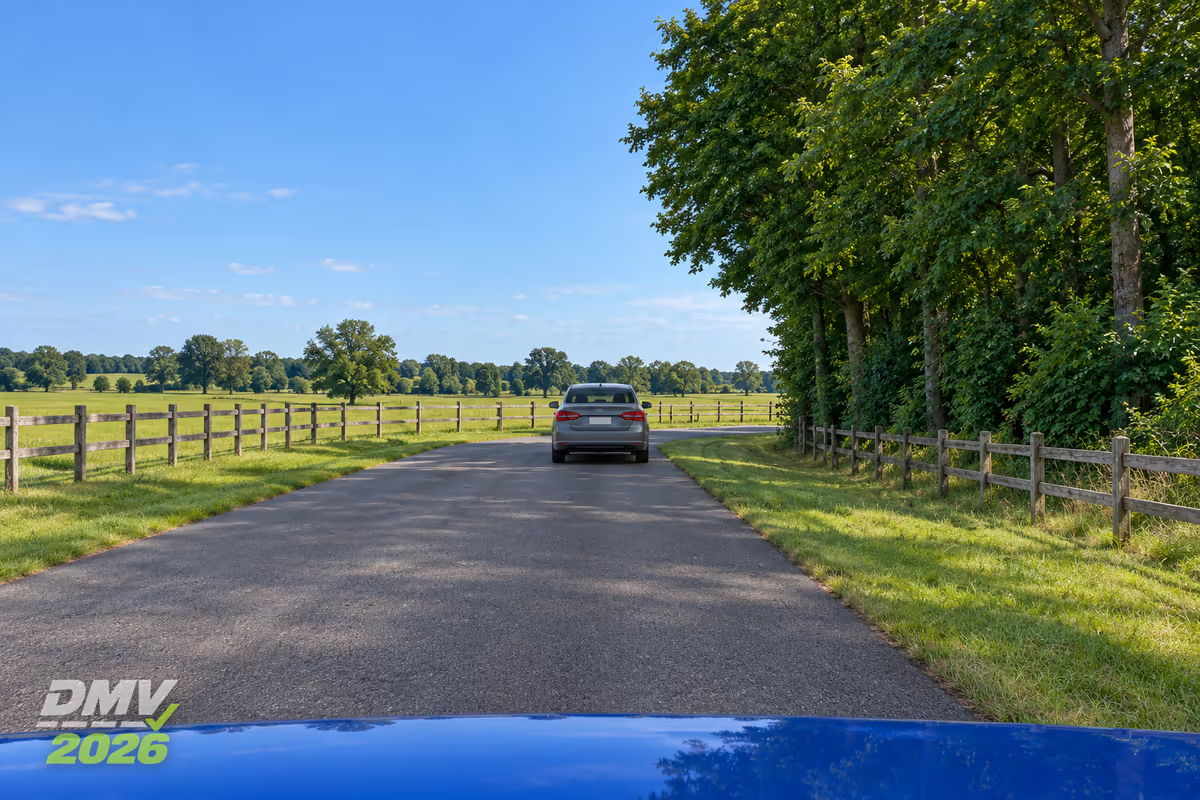
    Narrow two-lane road seen from your car, with no painted center line, bending to the right ahead and out of sight behind trees. A grey car is ahead of you in your lane, just before the bend
    Passing on this curve is not allowed because
    Show the answer

    The answer is A: you cannot see oncoming cars.

    You may pass only where you can see far enough ahead to finish. On a curve the road beyond the bend is hidden. An oncoming car can appear with no time for you to get back in. Hills hide the road the same way. Wait until the road straightens out.

    “Do not attempt to pass when an oncoming vehicle is approaching, your view is blocked by a curve or a hill, at intersections, or before a highway-railroad crossing or bridge.”

    AAMVA Model Driver’s License Manual, page 28
  3. Question 3 of 10 · Emergencies and crashes

    After a crash, what do you give the other driver?
    Show the answer

    The answer is C: Your name, license and insurance details.

    Give your name and address, your license and plate numbers, and your insurance company and policy number. Take the same from the other driver, and the names of any witnesses. Who was at fault is for the police and the insurers to settle, not for the roadside. Your state may also require a written report later.

    “Even if the crash involves only property damage, you must exchange information with other drivers involved. Give your name, address, driver license number and vehicle registration and insurance information. This includes the insurance policy number and effective date.”

    New York State Driver's Manual and Practice Tests, page 77
  4. Question 4 of 10 · Pavement markings

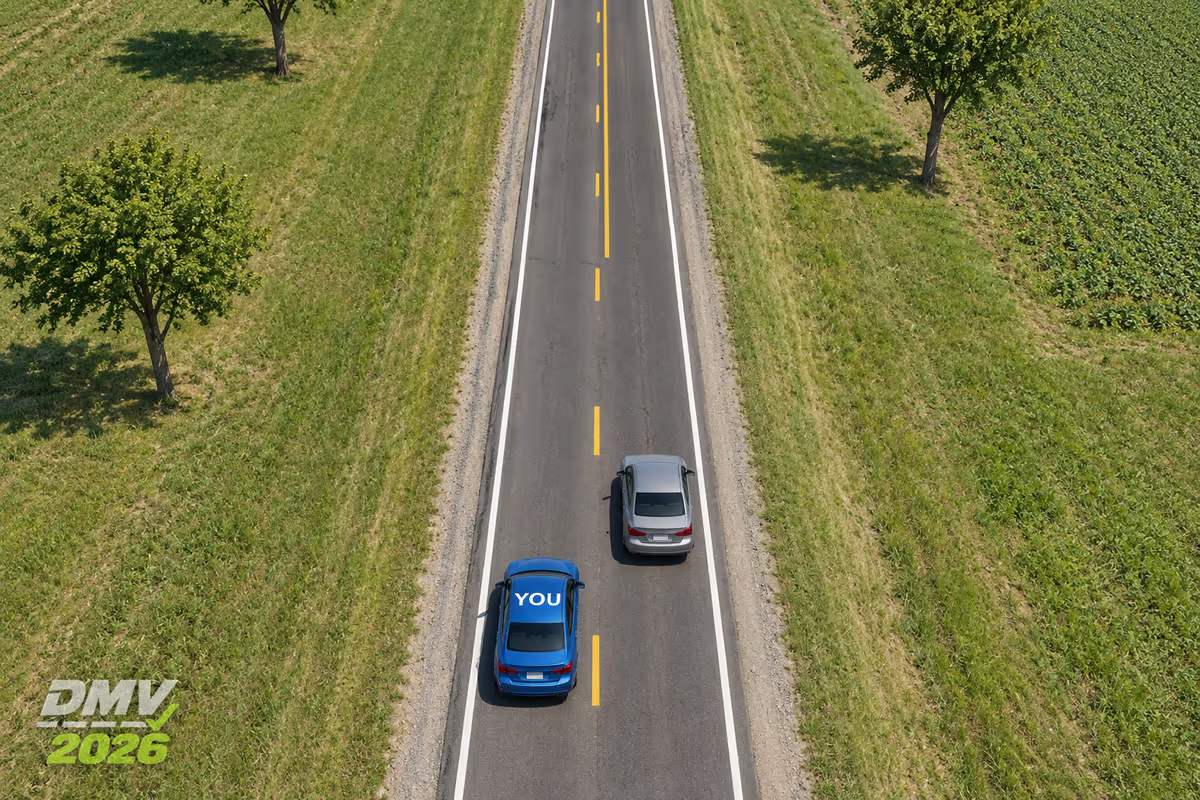
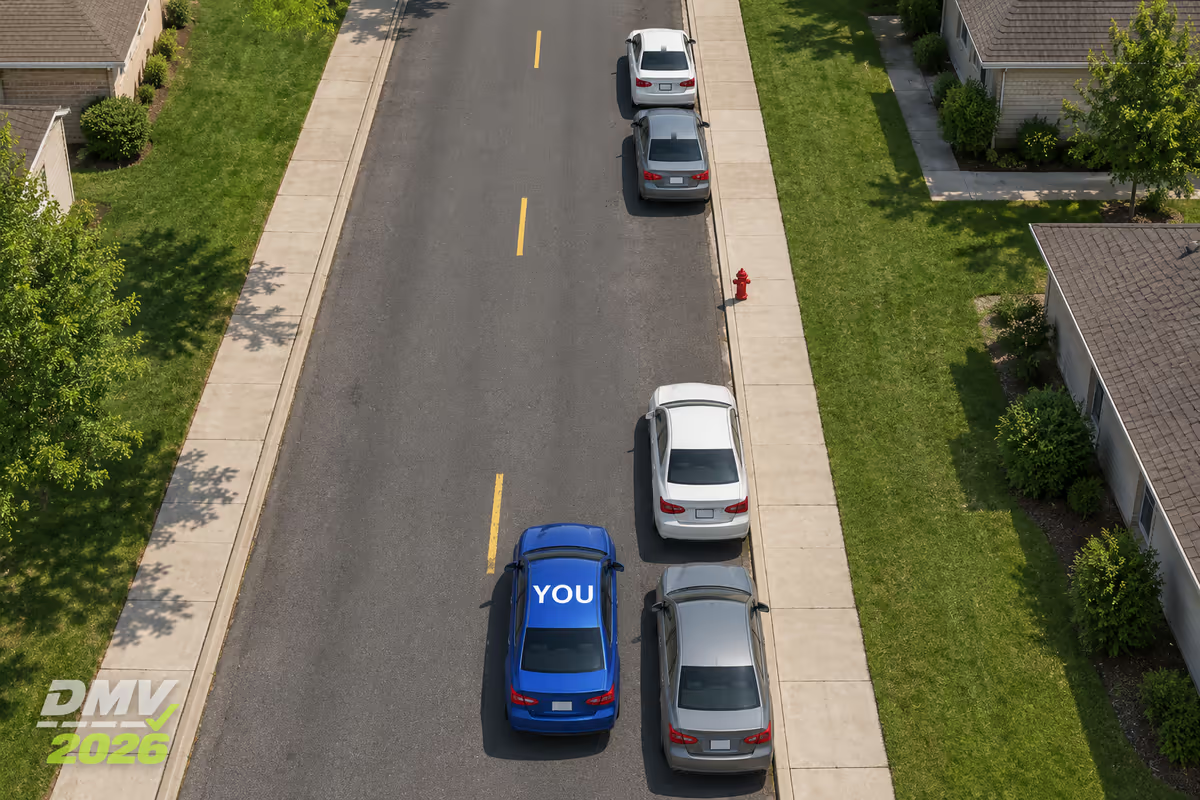
    Two-lane road seen from above with your car, marked YOU, out in the left lane beside a slower car, the center line broken yellow level with the cars and turning solid yellow on your side a short way ahead
    You are passing. May you still be in the left lane where the line turns solid?
    Show the answer

    The answer is C: No. Get back before the solid line.

    The solid line marks the end of the passing zone. You must be back in your lane before you reach it, even if you began on the broken line. The view ahead is too short to pass beyond it. If you cannot make it, slow down and drop back.

    “B. One-direction no-passing zone markings consisting of a double yellow line, one of which is a normal width broken yellow line and the other is a normal width solid yellow line, where crossing the center line markings for passing with care is permitted for the traffic traveling adjacent to the broken line, but is prohibited for traffic traveling adjacent to the solid line”

    MUTCD, 11th Edition, page 581
  5. Question 5 of 10 · Speed limits

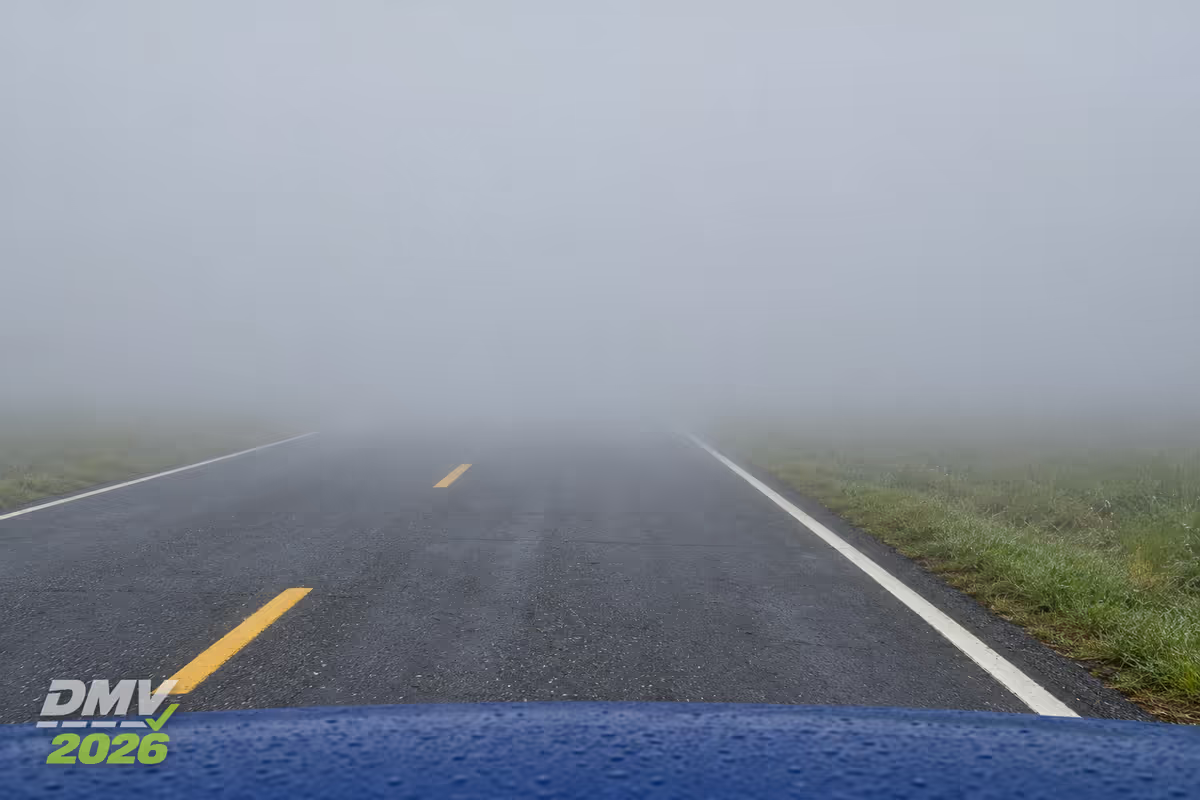
    View through the windshield of a two-lane highway in thick fog. The lane lines disappear into grey a short way ahead of the hood, and nothing else can be seen
    What should set your speed here?
    Show the answer

    The answer is B: How far you can see.

    In fog your speed has to fit the distance you can see. If something appears at the edge of your view, you need room to stop before you reach it. Slow down as the fog thickens. If you cannot see enough road to keep going, pull off and wait.

    “Areas of reduced vision—Blind corners created by wooded areas, crops growing in fields and steep hills can limit how far you can see. In areas with reduced vision always reduce your speed and be prepared to stop.”

    AAMVA Model Driver’s License Manual, page 43
  6. Question 6 of 10 · Slow-moving and farm vehicles

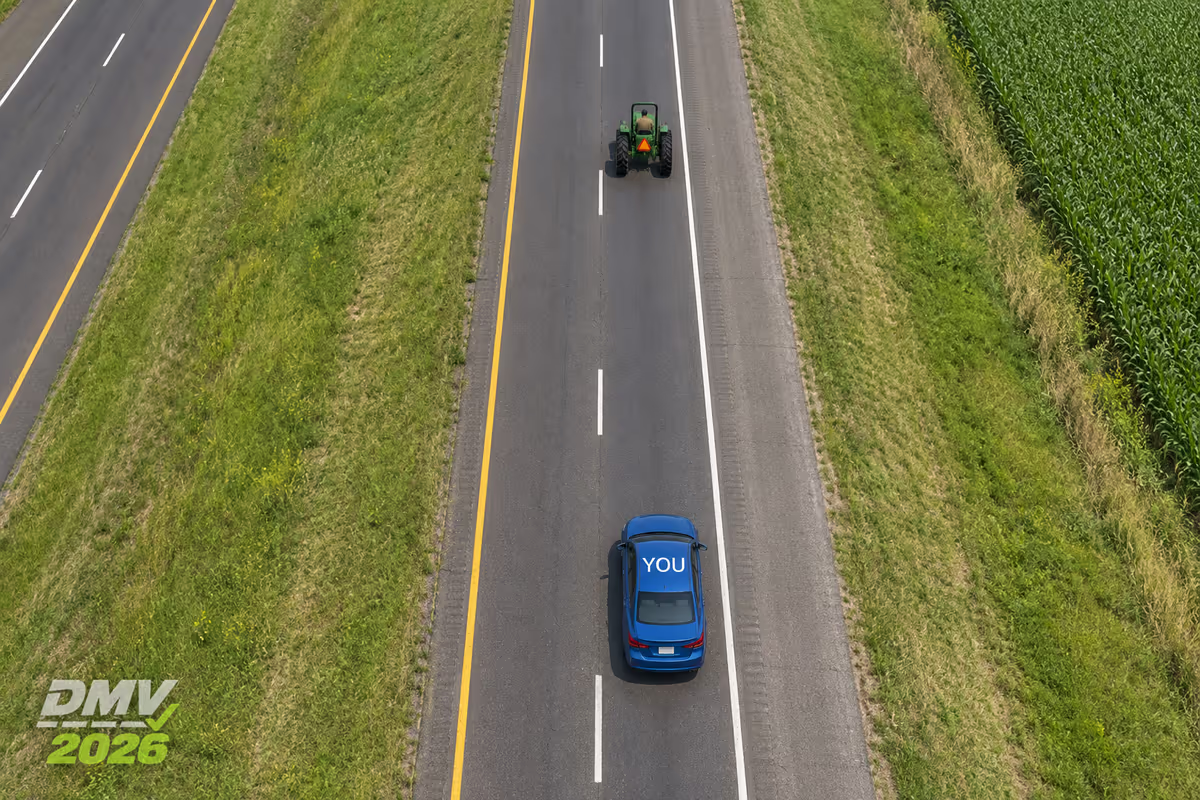
    Road seen from above with two lanes going your way, split by a broken white line, and a paved shoulder on the right. Your car, marked YOU, is in the right-hand lane behind a green tractor with an orange triangle on its back. The left lane is empty
    How should you pass this tractor?
    Show the answer

    The answer is A: Move fully into the left lane.

    Where a second lane goes your way, use all of it. Farm machinery is often wider than it looks, and its driver may not know you are there. The shoulder is never for passing. Move back only when the whole front of the tractor shows in your mirror.

    “If you need to pass an agricultural vehicle and there are two lanes in the same direction, move over one full lane.”

    Washington Driver Guide, page 106
  7. Question 7 of 10 · Guide and service signs

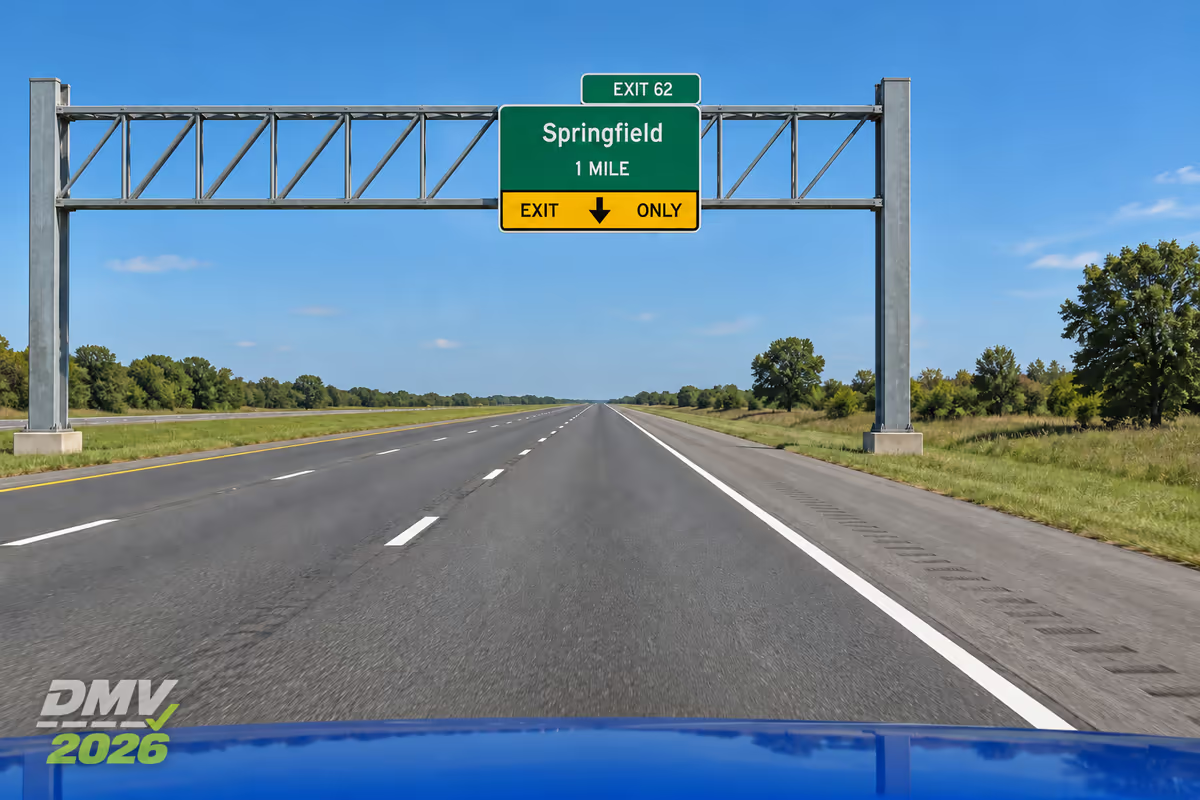
    Large green sign over the right lane of a three-lane freeway, with a plaque reading EXIT 62 at its top right, the word Springfield, 1 MILE, and a yellow panel across its bottom reading EXIT ONLY with a black arrow pointing down at the right lane. Your car is in the right lane under it
    What does the panel over your lane mean?
    Show the answer

    The answer is C: Your lane leaves the highway.

    A lane under an EXIT ONLY panel does not go through the interchange. It turns into the ramp, and anyone still in it leaves the highway. The panel is yellow so it stands out from the green sign. Move over early if you want to stay on.

    “An EXIT ONLY sign panel shall be used for all interchange lane drops at which the through route is carried on the main roadway.”

    MUTCD, 11th Edition, page 362
  8. Question 8 of 10 · Seat belts, airbags and car seats

    Where should your head restraint sit?
    Show the answer

    The answer is B: Level with the back of your head.

    A head restraint is there to prevent whiplash when you are hit from behind. Set it so it touches the back of your head and sits no lower than your ears. Lowered out of the way for a better view, it leaves your head with nothing behind it.

    “Head restraints are designed to prevent whiplash. Head restraints should be adjusted so the head restraint contacts the back of your head and not below the level of your ears.”

    AAMVA Model Driver’s License Manual, page 14
  9. Question 9 of 10 · Looking ahead, mirrors and backing up

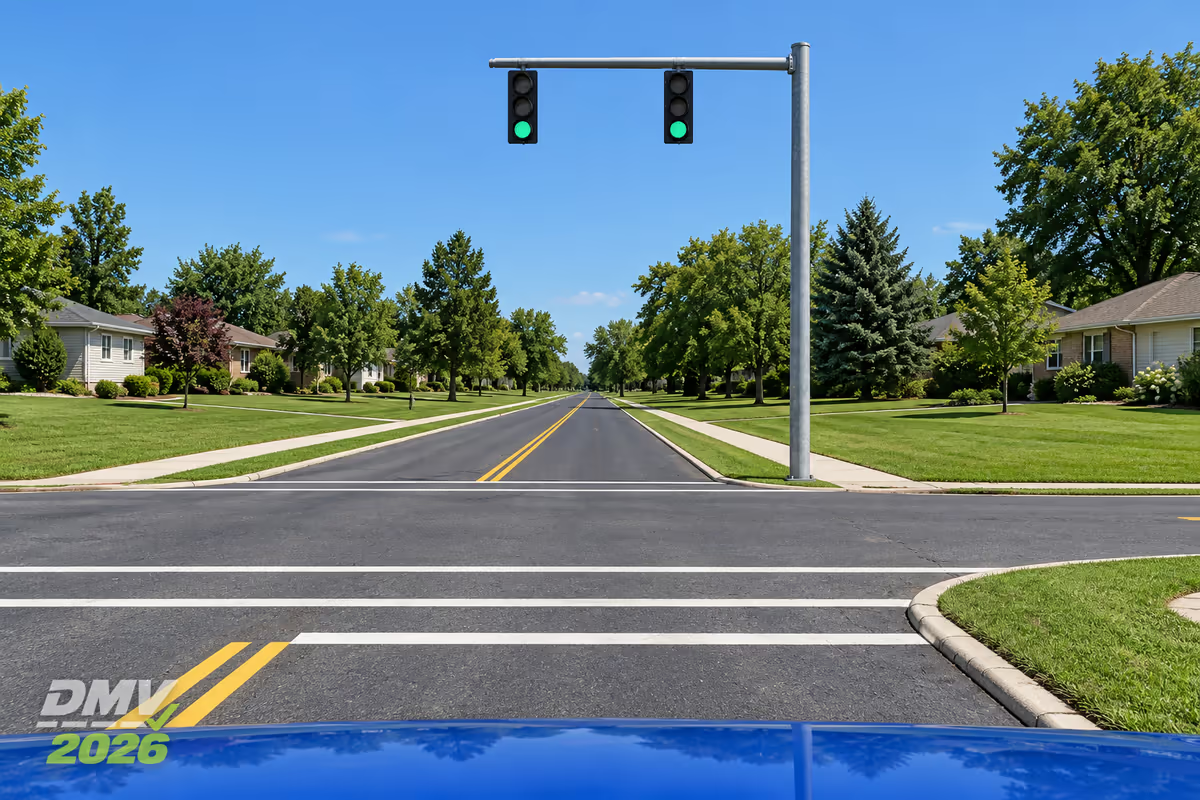
    Street seen from your car, with a traffic signal hanging over the intersection ahead. The signal has three round lenses one above the other, and the bottom one is lit green while the other two are dark. There is a stop line and a crosswalk across your lane, and no other cars
    Do you still look left and right before you go on this light?
    Show the answer

    The answer is A: Yes, before every crossing.

    A green light tells you the signal has changed, not that every driver has obeyed it. Look left and right before you move. Someone on the cross street may be running the red or still clearing the intersection. Go once your path is clear.

    “At a traffic signal when the light turns green, avoid immediately moving into the intersection. Take the time to make sure your path of travel is clear and there is no crossing traffic.”

    AAMVA Model Driver’s License Manual, page 26
  10. Question 10 of 10 · Parking and stopping

    City block seen from above with cars parked along the right curb and one empty space among them. A red fire hydrant stands on the sidewalk beside the middle of the empty space. Your car is coming along the traffic lane toward the space
    This is the only free space on the block. May you park in it?
    Show the answer

    The answer is C: No. Leave the hydrant clear.

    Never park beside a fire hydrant. In an emergency the fire crew has to reach it at once, and a car in the way costs time nobody has. The distance you have to leave is set by your state, so leave plenty of room on both sides of it.

    “Within 6 feet of a fire hydrant”

    Vermont Driver’s Manual, page 30

These 10 questions are from the DMV Champ app’s practice set, last updated October 23, 2026. Spot a mistake in a question? Email us.

How many questions can you miss on the Vermont permit test?

4

You need 16 of the 20 right.

The test has 20 questions.

“The knowledge test is online and has 20 questions.”

Vermont Driver’s Manual, page 19

You need at least 16 right answers to pass.

“You must answer at least 16 questions correctly to pass the test.”

Vermont Driver’s Manual, page 19

DMV Champ uses the same format for Alaska.

How old do you have to be to get a learner’s permit in Vermont?

The youngest you can be is 15.

“If you are a Vermont resident and want to drive in Vermont, you will have to get a Vermont Learner’s Permit. You must be at least 15 years old to take the test.”

Vermont Driver’s Manual, page 13

The manual calls it a learner’s permit.

“If you are a Vermont resident and want to drive in Vermont, you will have to get a Vermont Learner’s Permit.”

Vermont Driver’s Manual, page 13

What happens if you fail the Vermont permit test?

If you fail, you must wait at least 1 day before you try again.

“If you fail the test, you must wait at least one day before taking another one.”

Vermont Driver’s Manual, page 19

How do you take the Vermont permit test?

It’s an online test on the DMV’s website, mydmv.vermont.gov, not at an office.

“The learner permit test is no longer taken in our office. It is an online test available on our website, mydmv.vermont.gov.”

Vermont Driver’s Manual, page 3

Each question has 4 answer choices, and only 1 is right.

“Each question has four answers to choose from, of which only one is correct.”

Vermont Driver’s Manual, page 19

Test simulator

Practice in the Vermont format

20 questions16 to pass

DMV Champ teaches every question with its explanation, then checks you with 5 simulated tests of 20 questions, graded against the 16-correct passing score. 36 topics in Vermont: the 34 every state tests, plus winter driving and flooding, because the Vermont handbook teaches them.

Download on the App Store