District of Columbia · Department of Motor Vehicles

DC DMV practice test

DC’s knowledge test is given by the DC DMV. DMV Champ’s simulated tests use 25 questions, with 20 right to pass.

25 (DMV Champ’s figure, not confirmed by an official source)

questions

20 (DMV Champ’s figure, not confirmed by an official source)

right to pass

80% (DMV Champ’s figure, not confirmed by an official source)

passing score

75 min

time limit

* The figures DMV Champ’s simulated tests use, not confirmed by an official source.

Checked against the District of Columbia Driver Manual on October 25, 2026. How we check facts

Practice test

Take a 10-question DC DMV practice test

Pick an answer and check it. Every question comes with the reason behind the right answer and the sentence of an official document it rests on.

To pass here you need 8 of 10, the 80% DMV Champ’s simulated tests use.

  1. Question 1 of 10 · Work zones and flaggers

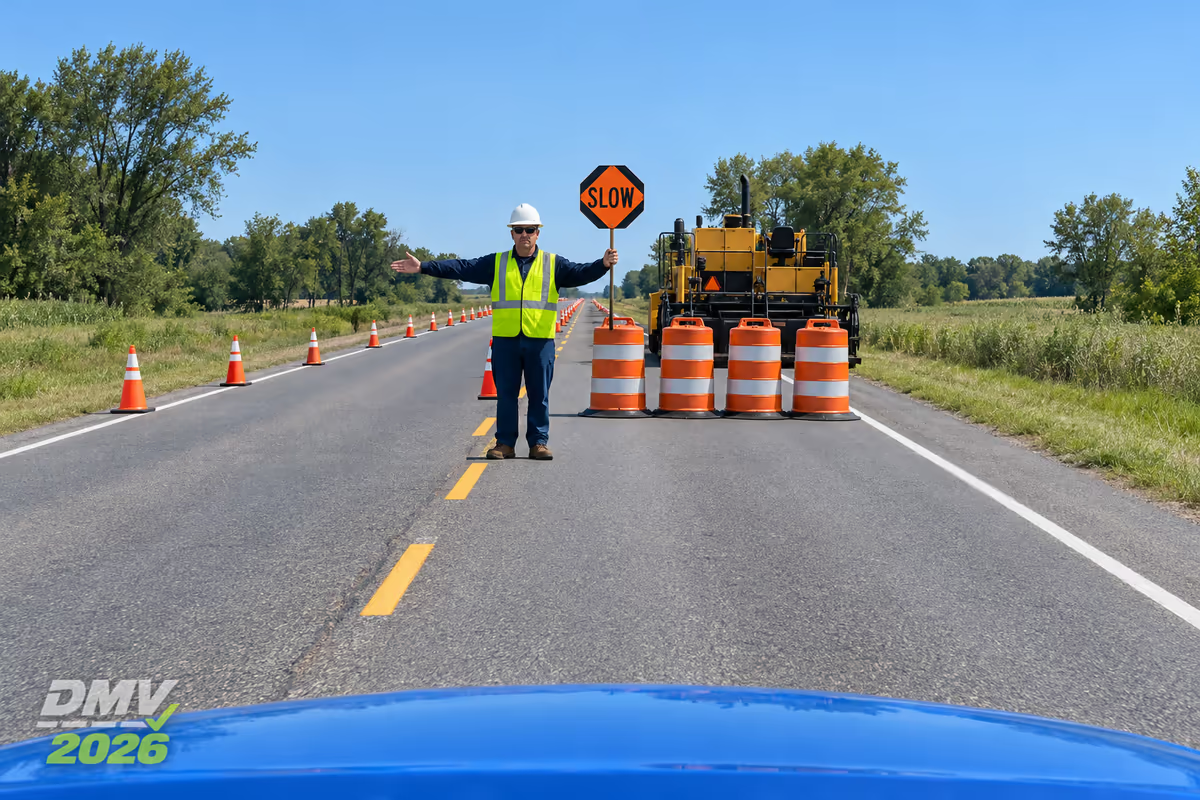
    Two-lane road seen from your car. Your own lane is blocked ahead by orange drums and a paving machine. A flagger in a bright vest stands beside the drums holding a paddle that reads SLOW, pointing with the other arm into the left lane, which is lined on both sides with orange cones and runs empty around the work
    The flagger sends you into the lane between the cones. What do you do?
    Show the answer

    The answer is C: Go where the flagger sends you, slowly.

    A flagger is in charge of traffic on the site. Follow their signals, even when a sign or a line of cones seems to say something else. The cones were set out earlier and the work has moved since. Go slowly and watch for people and machines.

    “In work zones, traffic may be controlled by a person with a sign or flag to tell you which direction to travel or to slow down or stop. You must follow their instructions.”

    AAMVA Model Driver’s License Manual, page 21
  2. Question 2 of 10 · Railroad crossings

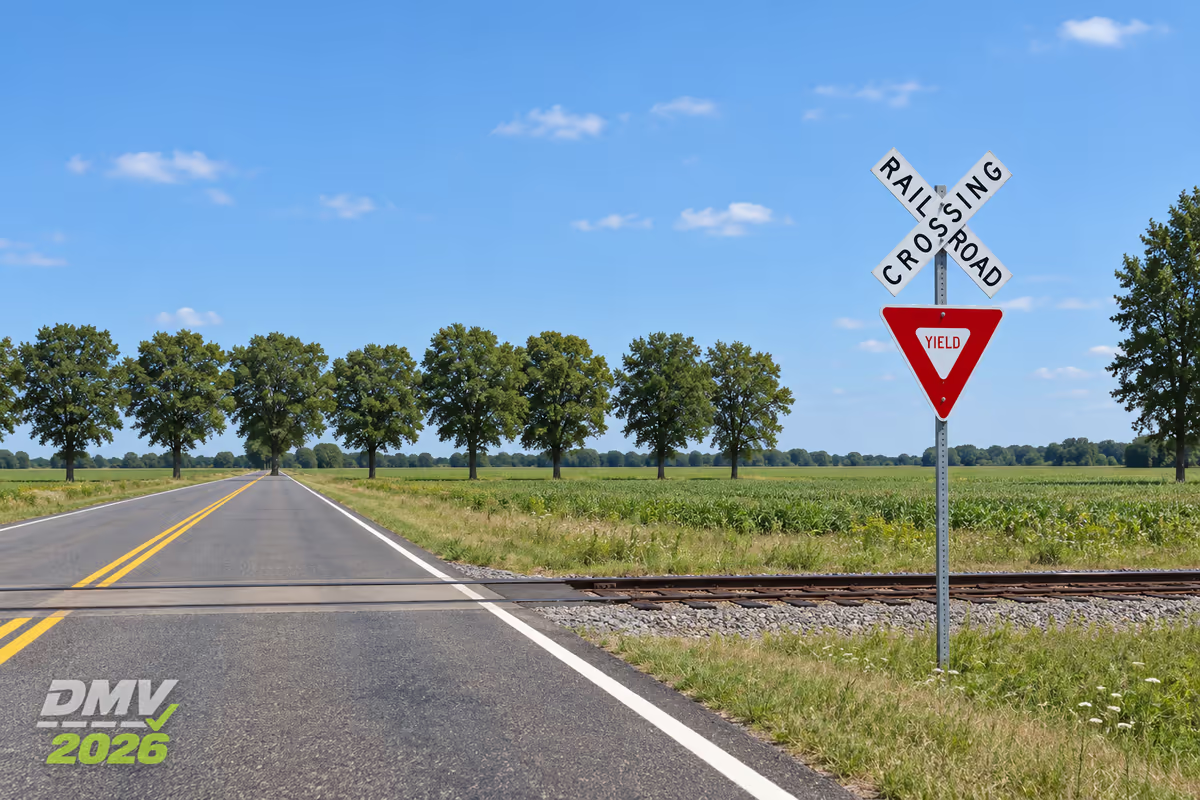
    Rural road seen from your car running up to a single railroad track, with a white X-shaped sign reading RAILROAD CROSSING in black on a post at the right. There is no gate, no light and no train
    At this crossing, the ____ has the right of way.
    Show the answer

    The answer is B: train

    The crossbuck marks the crossing itself, and it works like a yield sign. The train goes first. Slow down, look both ways and listen, and stop if a train is coming. A train cannot stop for you, so there is no first-come rule here. Cross only when you are sure the tracks are clear.

    “In most States, the Crossbuck sign requires road users to yield the right-of-way to rail traffic at a grade crossing.”

    MUTCD, 11th Edition, page 1034
  3. Question 3 of 10 · Snow and ice

    Your tires spin as you pull away on packed snow. Should you press the gas harder?
    Show the answer

    The answer is C: No. Ease off and feed it in gently.

    A spinning tire grips less than one that is barely turning. Ease off the gas, then press it again so gently that the wheels turn slowly. Spinning the wheels gets you nowhere and wears the tires. If you are stuck, rock the car forward and back without spinning them.

    “Start out very slowly. It is useless to burn the rubber off your tires by spinning the wheels.”

    Texas Driver Handbook, page 55
  4. Question 4 of 10 · Regulatory signs

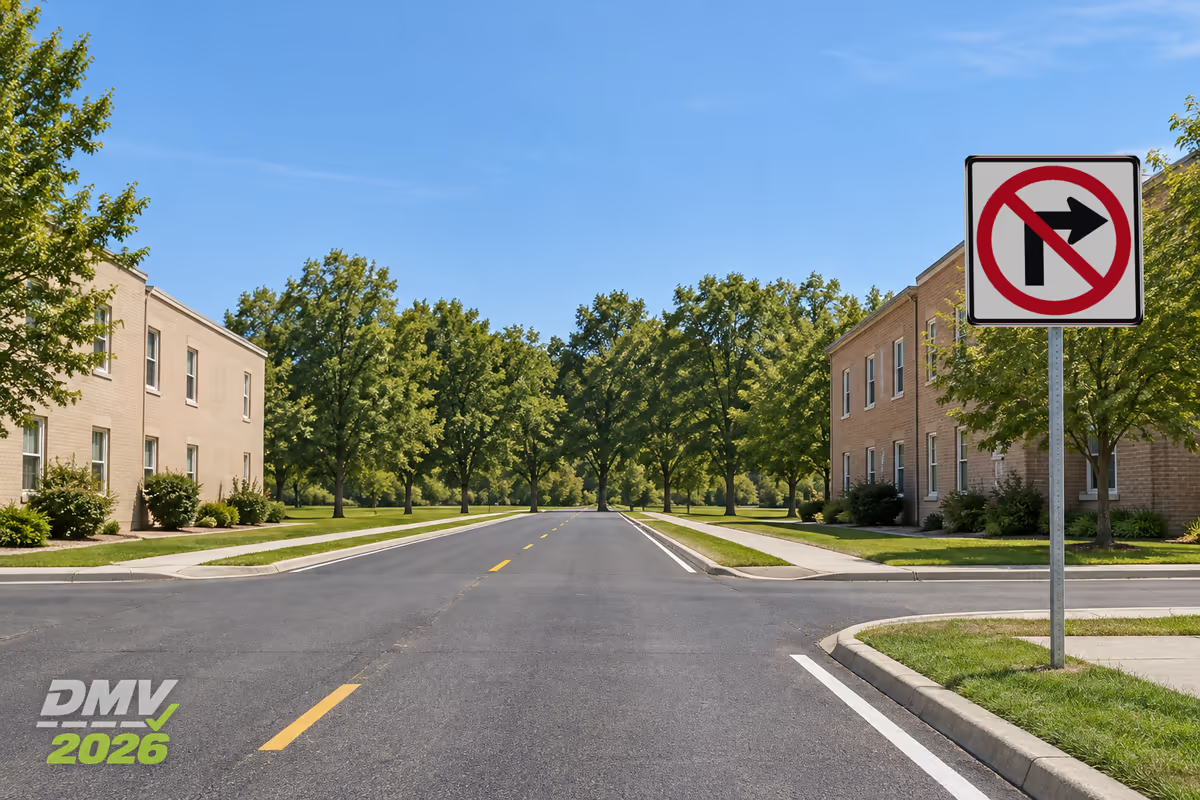
    City street seen from your car coming up to an intersection, with a white square sign on a post at the right showing a black right-curving arrow inside a red circle with a slash through it
    What does this sign mean?
    Show the answer

    The answer is C: No right turn.

    A right-turn arrow inside a red circle with a slash means no right turn at this corner. Read the red circle first: it turns any symbol into a ban. The sign for a lane that has to turn right is a plain black arrow over the word ONLY, with no circle.

    “If a No Right Turn (R3-1) sign (see Figure 2B-4) is used, at least one should be placed either over the roadway or at a right-hand corner of the intersection.”

    MUTCD, 11th Edition, page 130
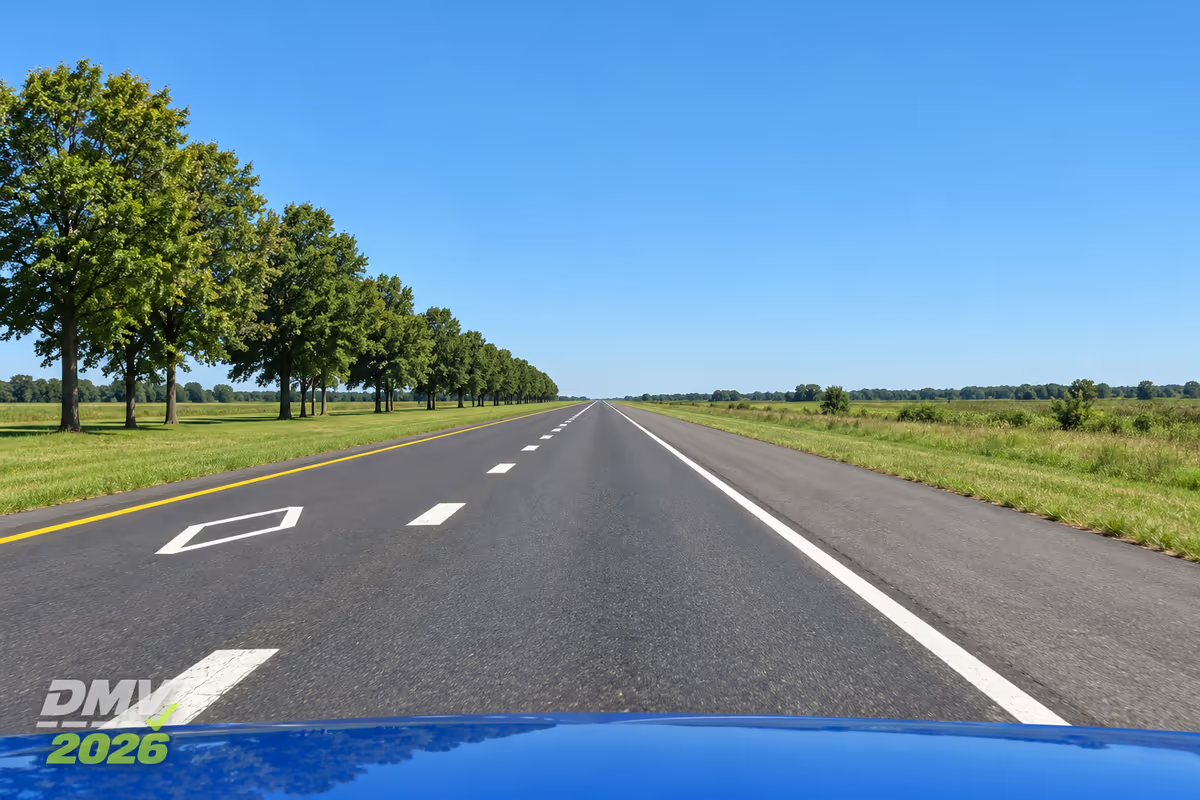
  5. Question 5 of 10 · Lane use and changing lanes

    Highway from the driver's seat, your car in the right lane, and a white diamond painted on the pavement of the lane to your left
    How many people must be in your car to use this lane?
    Show the answer

    The answer is C: As many as the sign says.

    The diamond marks a carpool lane, also called an HOV lane. The number of people it takes is set road by road. The sign for the lane posts it, with the hours it applies. Some roads ask for 2, others for 3 or more. Read the sign before you move in.

    “High-Occupancy Vehicle (HOV)—a motor vehicle carrying at least two (or more than two if the signs for a specific roadway indicate a higher minimum occupancy requirement) persons, including carpools, vanpools, and buses.”

    MUTCD, 11th Edition, page 59
  6. Question 6 of 10 · Looking ahead, mirrors and backing up

    When you back up, turn the steering wheel
    Show the answer

    The answer is A: toward the side you want the back to go.

    In reverse, the back of your car goes the way you turn the wheel. Turn it toward the side you want the back to go, and only a little. A car is much harder to steer backwards. Go slowly. Glance at the front and sides as you turn, because the front of the car swings out the other way.

    “The steering wheel is always turned in the direction you want the vehicle to move, whether moving forward or in reverse.”

    AAMVA Model Driver’s License Manual, page 17
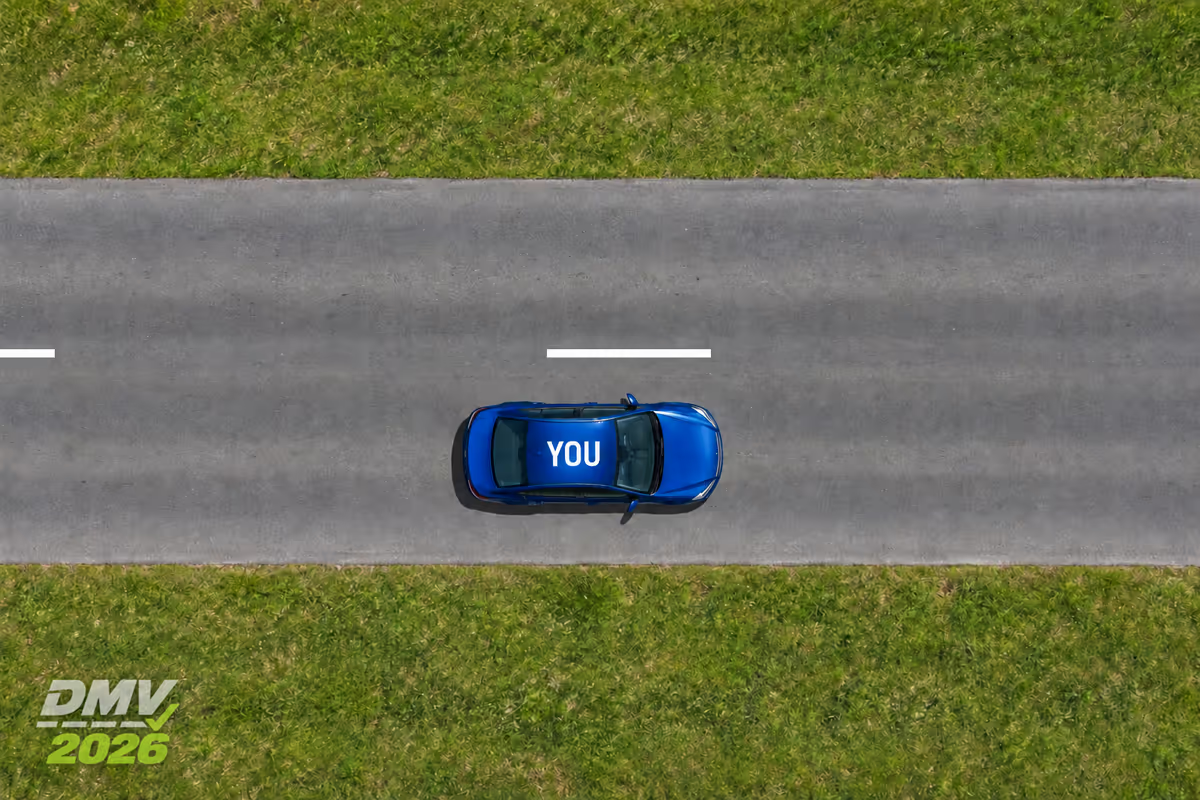
  7. Question 7 of 10 · Pavement markings

    Wide road seen from above with two lanes, your car in the lower one and a broken white line between the lanes; the other lane is empty
    What does the white line on your left tell you?
    Show the answer

    The answer is A: The lane beside you goes the same way.

    White lines separate lanes going the same way, so the lane on your left is going where you are going. The line is broken, so you may cross it to change lanes. A yellow line there would mean traffic coming toward you.

    “When used, lane line pavement markings delineating the separation of traffic lanes that have the same direction of travel shall be white.”

    MUTCD, 11th Edition, page 587
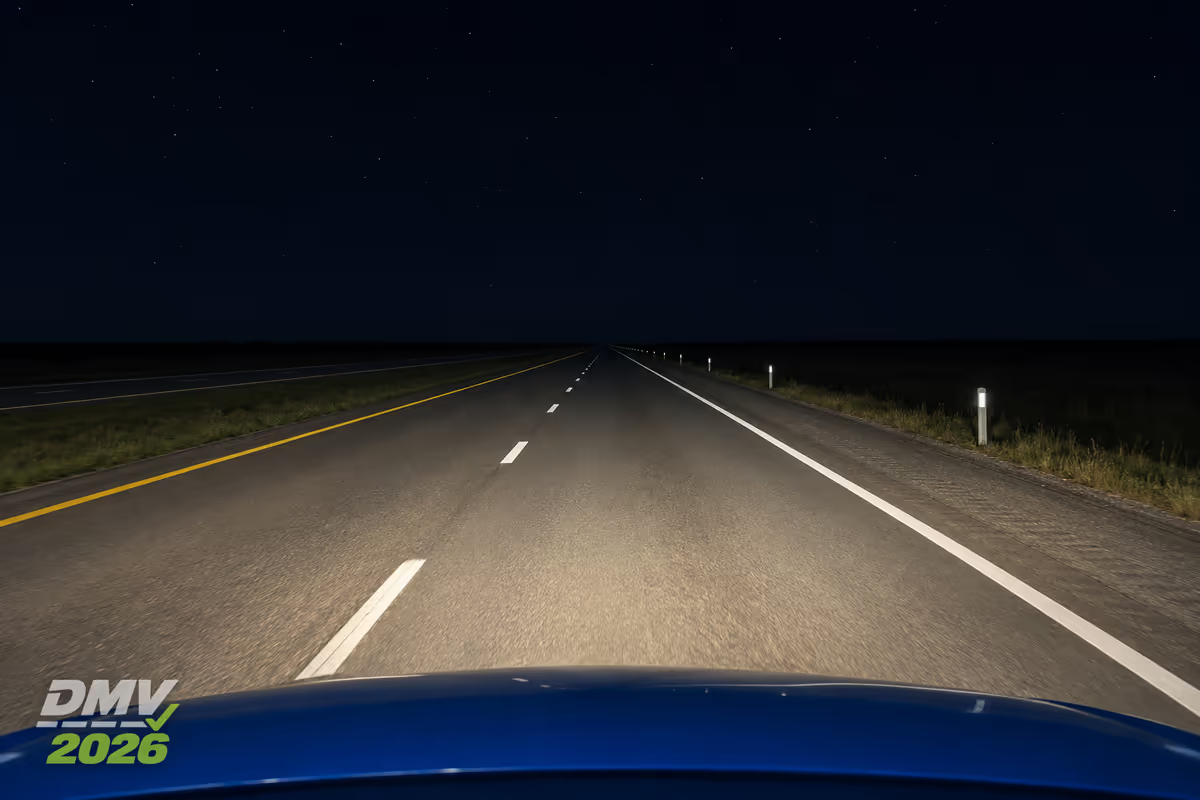
  8. Question 8 of 10 · Fatigue, vision and health

    View through your windshield at night on a long, straight, empty divided highway. Your headlights light the lane lines a short way ahead, and the road runs on into darkness with nothing else in sight. Your hood is at the bottom of the picture
    Late at night on a road like this, a driver is most likely to
    Show the answer

    The answer is A: fall asleep at the wheel.

    Late at night your body wants to sleep whatever you do. A long straight road with nothing to look at makes it worse. This dull, sleepy state is called highway hypnosis. Try not to drive late at night, and on a long trip stop to rest before you feel you need to.

    “Try not to drive late at night.”

    AAMVA Model Driver’s License Manual, page 9
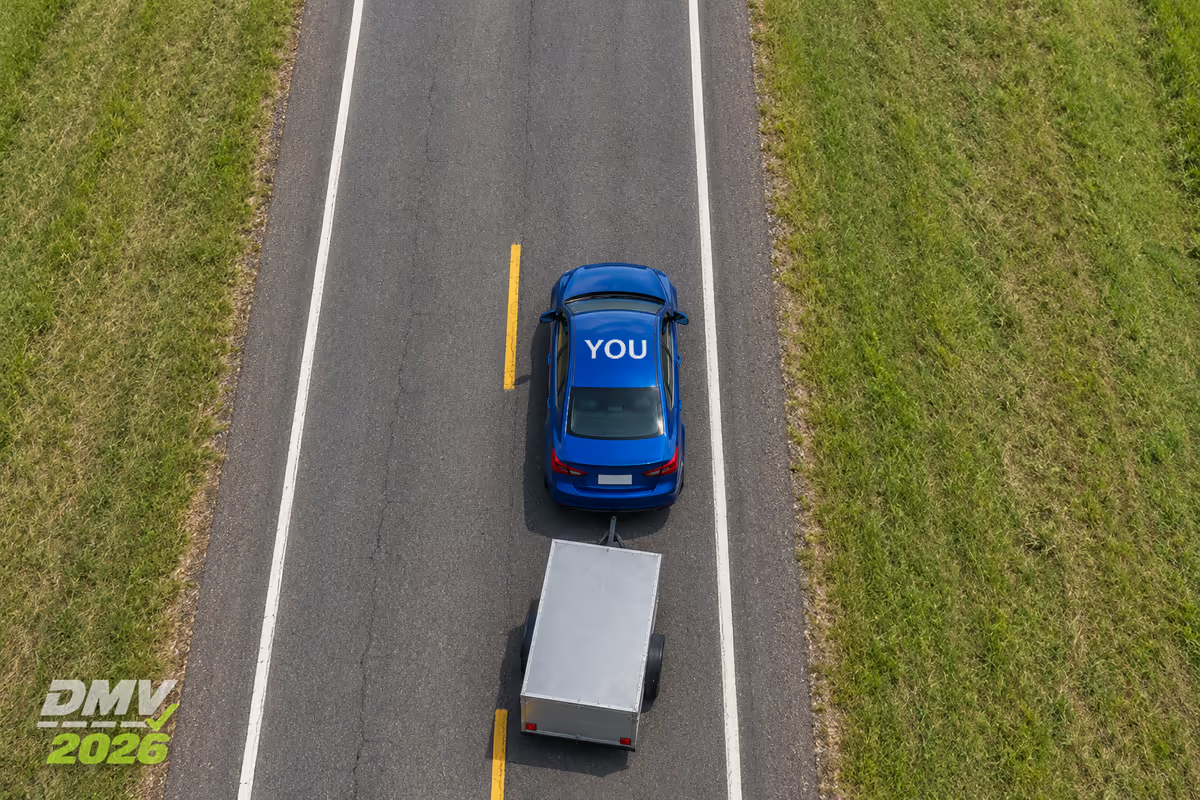
  9. Question 9 of 10 · Before you drive

    Seen from above, your blue car, marked YOU, pulls a small grey trailer along a straight two-lane road. The trailer is angled to one side of the car's path. No other vehicles
    Your trailer starts to sway like this. What should you do?
    Show the answer

    The answer is D: Steer straight and slow down.

    Steer straight and slow down gradually. Do not brake, and never speed up. When you can, get completely off the road and check the load. A trailer must be loaded heavier at the front to keep it from swaying.

    “If the trailer begins to sway or whip, steer straight and reduce speed gradually; do not apply the brakes. Never increase speed. Stop as soon as you can safely get completely off the roadway. Check the cargo first to be sure the trailer is loaded heavier in front.”

    AAMVA Model Driver’s License Manual, page 44
  10. Question 10 of 10 · Right-of-way

    A bicyclist stops at an all-way stop as you do, on your right. Does the rider go first?
    Show the answer

    The answer is B: Yes, the same as a car would.

    At an intersection, you yield to a bicyclist the way you would to another vehicle. A rider on your right who stops when you do goes first, exactly as a car would. Slow down near a bicycle and let the rider clear the intersection before you move.

    “Yield to bicyclists in intersections as you would for pedestrians and other vehicles.”

    AAMVA Model Driver’s License Manual, page 37

These 10 questions are from the DMV Champ app’s practice set, last updated October 23, 2026. Spot a mistake in a question? Email us.

How many questions can you miss on the DC permit test?

On DMV Champ’s 25-question simulated test, you can miss 5.

Those figures aren’t confirmed by an official source.

How old do you have to be to get a learner permit in DC?

The youngest you can be is 16.

“To obtain a learner permit you must be at least 16 years old, pass the knowledge test and vision screening.”

District of Columbia Driver Manual, page 14

What happens if you fail the DC permit test?

If you fail, you can take the test again after 3 full calendar days.

“If you do not receive a passing score on the driver knowledge test, you may take the test again after waiting three full calendar days.”

DC DMV, Knowledge Tests page

If you fail 6 times within 12 months, you can’t take a 7th test until 12 months after your first failed test.

“If you do not receive a passing score six times within a 12-month period, you will not be allowed to take the seventh test until 12 months after you failed the first test.”

DC DMV, Knowledge Tests page

Using a phone, notes or talking during the test counts as cheating, so you fail and can’t retest for 60 days.

“Using smart devices (i.e. cellphone or watch), study materials, talking, etc. during the test is considered cheating and will result in a failed test. Additionally, you will not be allowed to retest for 60 days.”

DC DMV, Knowledge Tests page

How do you take the DC permit test?

It’s given by the DC DMV.

“DC DMV’s driver knowledge examination tests your knowledge of traffic laws, road signs, and driving safety rules and determines whether you are prepared to operate a vehicle in accordance with DC law.”

DC DMV, Knowledge Tests page

You get 75 minutes for the learner permit test (GRAD) and 60 minutes for the non-commercial test.

“Non-Commercial – 60 minutes GRAD, or Learner Permit Knowledge – 75 minutes”

DC DMV, Knowledge Tests page

You can take the test at any DC DMV service center, first come, first served.

“Knowledge testing is available at all DC DMV Service Centers on a first-come, first-serve basis.”

DC DMV, Knowledge Tests page

You can also take it online or at a Test Proctoring Center, and both need an appointment.

“Knowledge testing is now available virtually and via a local Test Proctoring Center, with the exception of motorcycle and CDL knowledge tests. An appointment is required to take the test virtually and at the Test Proctoring Center.”

DC DMV, Knowledge Tests page

You can take it in English, Amharic, Arabic, Cantonese, French, German, Japanese, Korean, Mandarin, Portuguese, Russian, Spanish, Tagalog, Thai or Vietnamese, and an audio test helps if reading is hard for you.

“The test can be taken in English, Amharic, Arabic, Cantonese, French, German, Japanese, Korean, Mandarin, Portuguese, Russian, Spanish, Tagalog, Thai, and Vietnamese. Audio assisted tests are also available to those who need assistance with reading.”

DC DMV, Knowledge Tests page

DC residents can now also take it in Turkish, Hungarian, Finnish, Danish, Indonesian, Dutch, Farsi, Italian or Swedish.

“In addition to the 15 languages currently available above, District residents may now take the Knowledge Test in Turkish, Hungarian, Finnish, Danish, Indonesian, Dutch, Farsi, Italian, and Swedish.”

DC DMV, Knowledge Tests page

Test simulator

Practice in the DC format

25 questions20 to pass60 minutes

DMV Champ teaches every question with its explanation, then checks you with 5 simulated tests of 25 questions, graded against the 20-correct passing score. 36 topics in DC: the 34 every state tests, plus winter driving and flooding, because the DC handbook teaches them.

Download on the App Store