Connecticut · Department of Motor Vehicles

Connecticut DMV practice test: 25 questions, 80% to pass

Connecticut’s knowledge test, given by the DMV, has 25 questions, and you need 20 right, or 80%, to pass.

25

questions

20

right to pass

80%

passing score

Checked against the Connecticut Driver’s Manual (revised March 2023) on October 25, 2026. How we check facts

Practice test

Take a 10-question Connecticut DMV practice test

Pick an answer and check it. Every question comes with the reason behind the right answer and the sentence of an official document it rests on.

To pass here you need 8 of 10, since Connecticut’s test asks for 80%.

  1. Question 1 of 10 · Regulatory signs

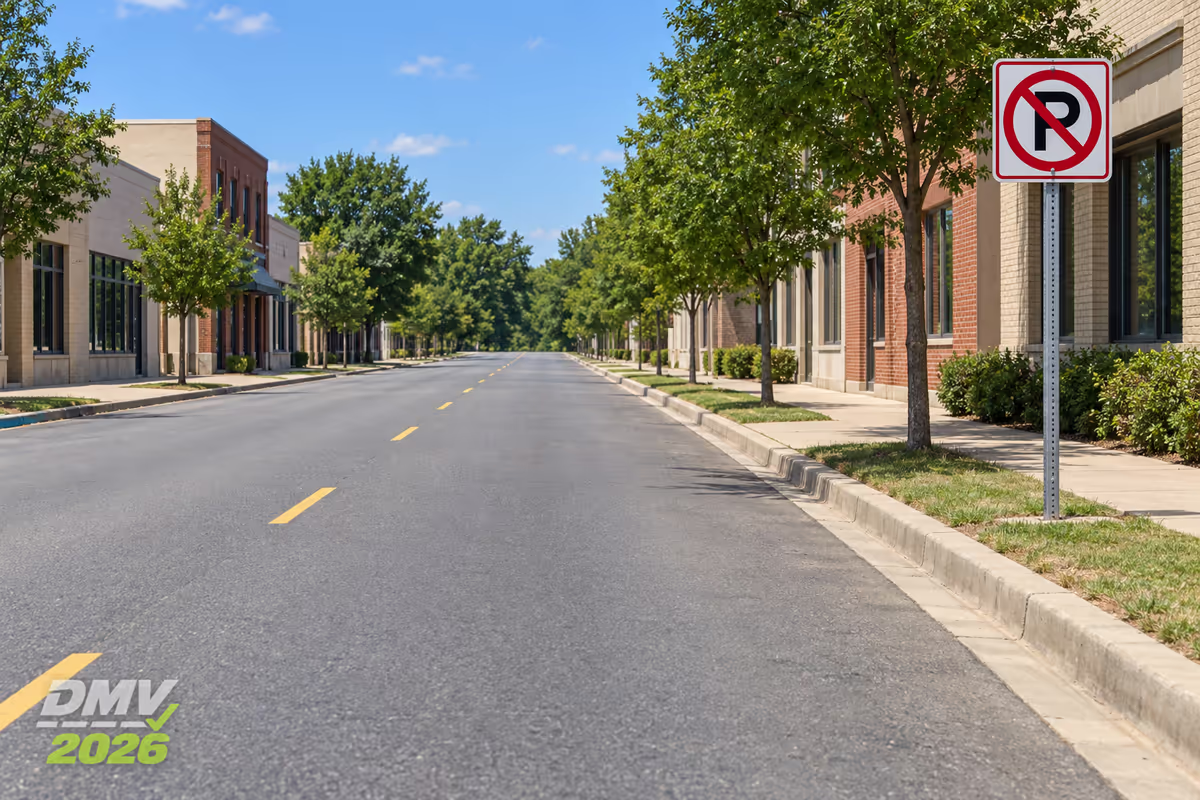
    City street seen from your car with an empty curb on the right and a white square sign on a post at the curb showing a black letter P inside a red circle with a slash through it
    What is banned where this sign stands?
    Show the answer

    The answer is A: Parking.

    The letter P stands for parking, and the red circle with a slash bans it. Prohibition signs use red letters and borders. A parking sign with green letters allows parking with a limit, such as a time limit. Where a sign names hours, the rule applies only during them.

    “parking signs shall have a red legend and border on a white background and, when the parking prohibition symbol is used, the symbol “P” shall be black.”

    MUTCD, 11th Edition, page 164
  2. Question 2 of 10 · Turns and U-turns

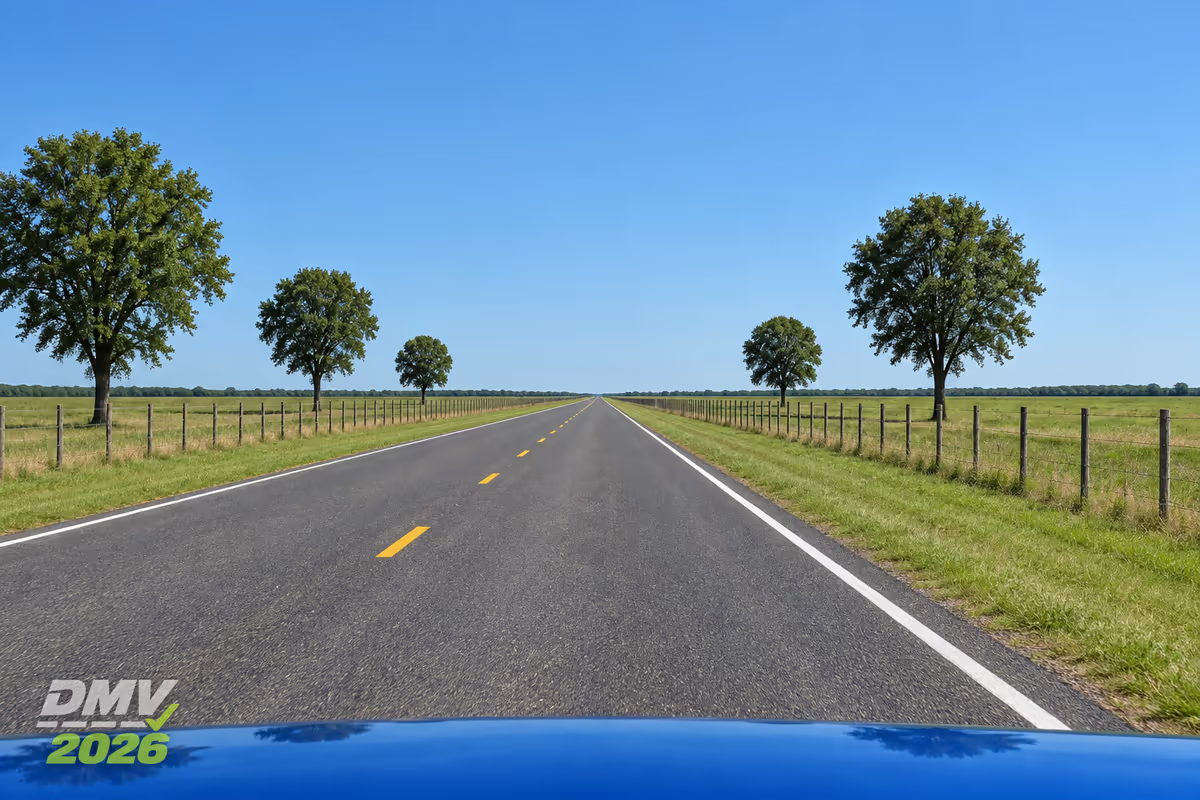
    View through the windshield of a flat, straight two-lane road with a broken yellow center line running away between open fields. Nothing is coming in either direction, and there are no signs
    No sign forbids a U-turn here. May you make one?
    Show the answer

    The answer is B: Yes, if it is clear both ways.

    Where no sign forbids it and you can see far in both directions, you may turn around when nothing is coming. Signal, start from the lane nearest the center line, and turn in one smooth sweep. Some cities limit U-turns to intersections, so look for signs first.

    “You can make a U-turn if your path is clear and it is safe to do so. You cannot make a U-turn if a NO U-TURN sign is posted.”

    Massachusetts Driver's Manual, English, page 106
  3. Question 3 of 10 · Following distance and space

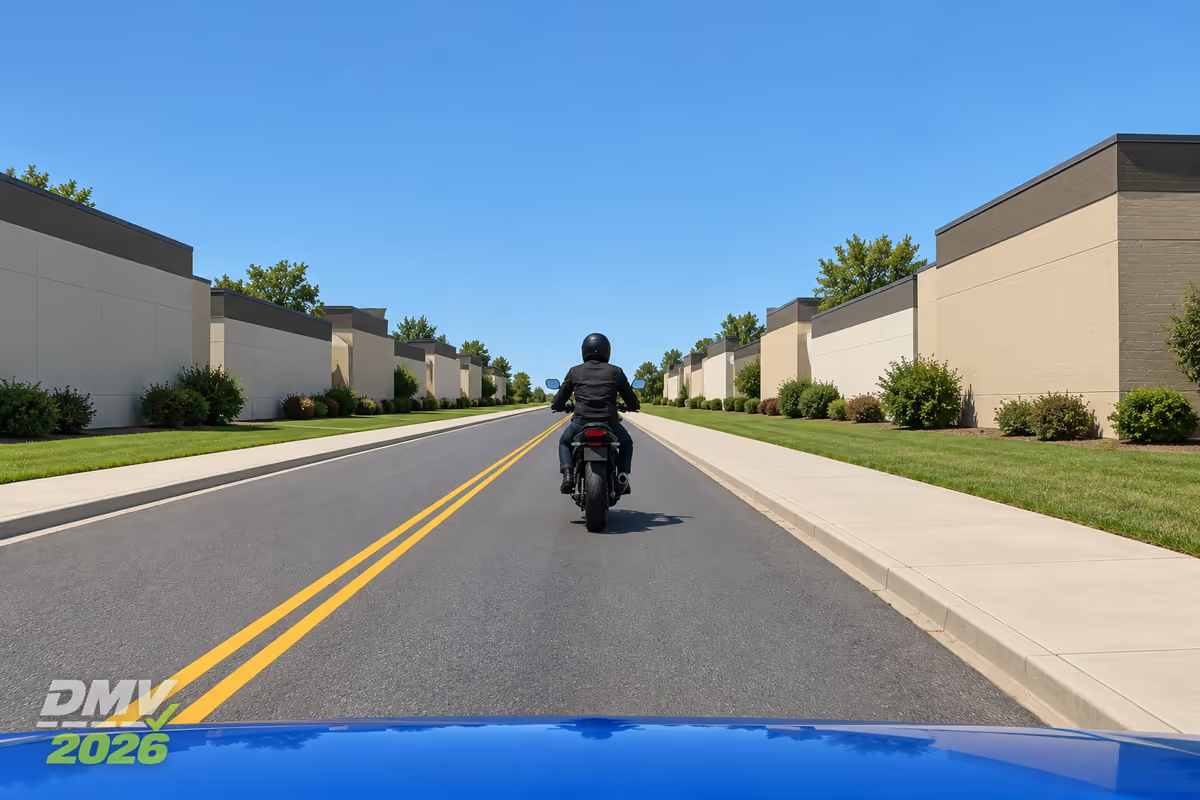
    View through your windshield of a dry city street with a motorcycle and rider ahead of you in the middle of your lane, riding straight. There is no other traffic, and your hood is at the bottom of the picture
    May you follow this motorcycle closer than you would follow a car?
    Show the answer

    The answer is C: No. Give it more room.

    Leave more room behind a motorcycle than behind a car. A rider may slow suddenly, often with no brake light showing, or swerve to miss a pothole or a patch of gravel. On a wet road or a metal bridge grating, open the gap further still.

    “When following a motorcyclist, allow for a minimum 4-second following distance or more in wet conditions, or you may not have enough time or space to avoid a crash. Motorcycle riders may suddenly need to change speed or adjust”

    AAMVA Model Driver’s License Manual, page 38
  4. Question 4 of 10 · Traffic signals and arrows

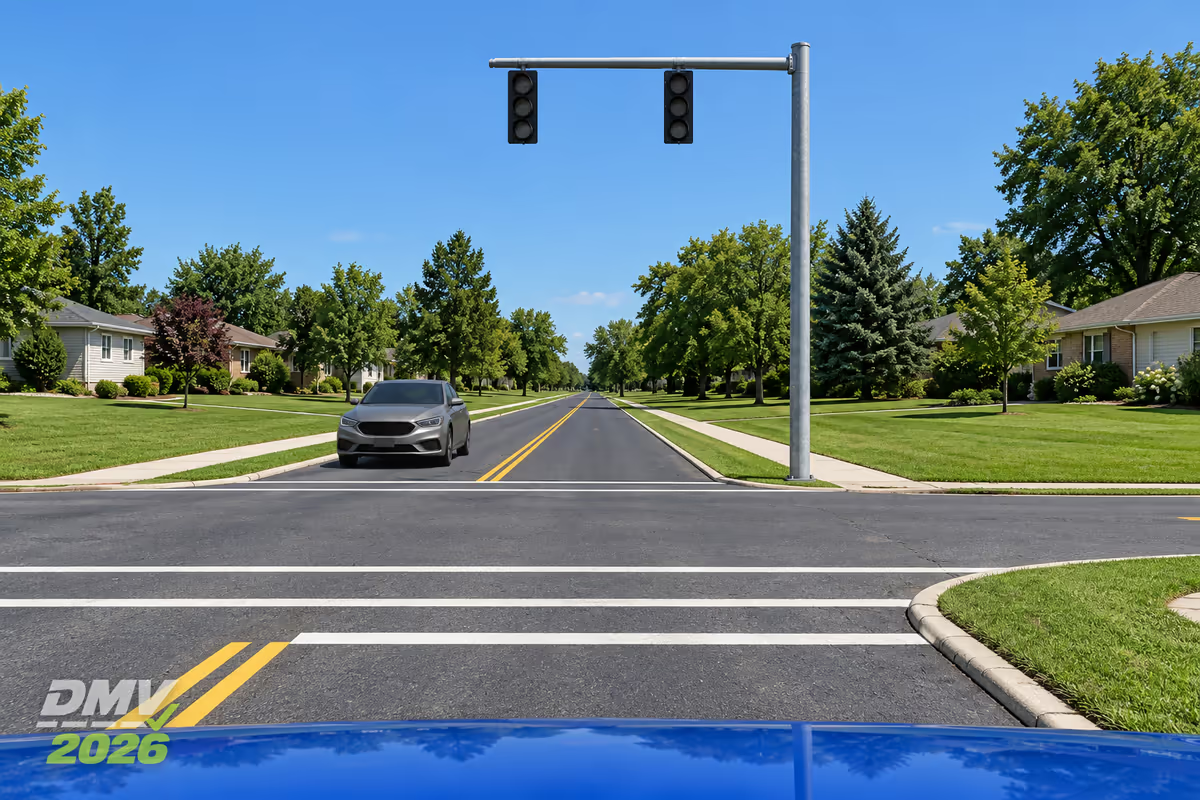
    Street seen from your car, with an upright traffic signal over the intersection ahead whose three round lenses are all dark and drawn the same dark grey. One car is coming toward you on the far side of the intersection. There is a stop line and a crosswalk across your lane
    On an upright signal, the red light is at the ____.
    Show the answer

    The answer is A: top

    Red is at the top, yellow in the middle and green at the bottom, on every upright signal. The order is fixed so a signal reads the same everywhere you drive. On a sideways signal the same order runs left to right, with red at the left end.

    “The relative positions of signal sections in a vertically-arranged signal face, from top to bottom, shall be as follows: CIRCULAR RED”

    MUTCD, 11th Edition, page 719
  5. Question 5 of 10 · Turn signals, horn and lights

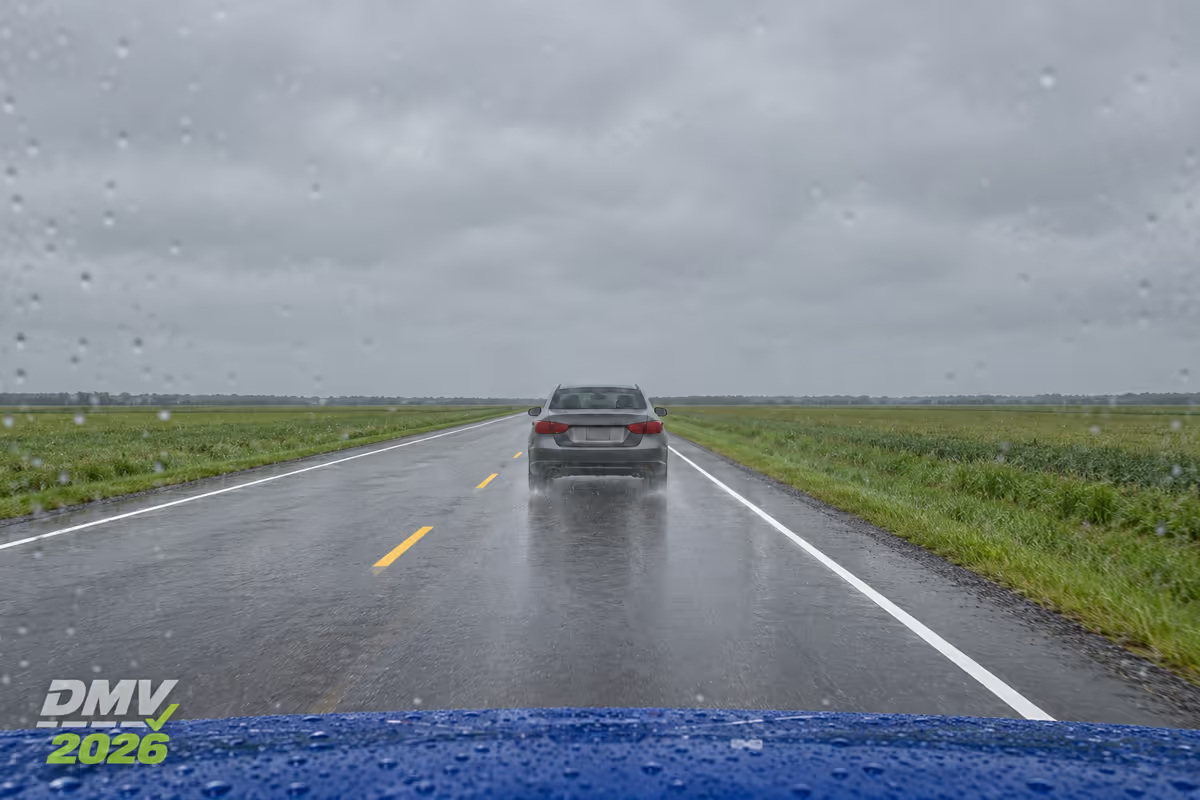
    View through your windshield in rain, with water streaking the glass and a car ahead in your lane with none of its lights lit
    When your wipers are on, your ____ should be on too.
    Show the answer

    The answer is A: headlights

    Turn your headlights on whenever your wipers are on. In rain, snow or fog they are there to be seen as much as to see. In most states that is the law, and headlights go on when it starts to get dark as well. Use low beams, since high beams throw glare back at you in rain.

    “Use headlights—Turning on your headlights helps other roadway users to see you.”

    AAMVA Model Driver’s License Manual, page 31
  6. Question 6 of 10 · Looking ahead, mirrors and backing up

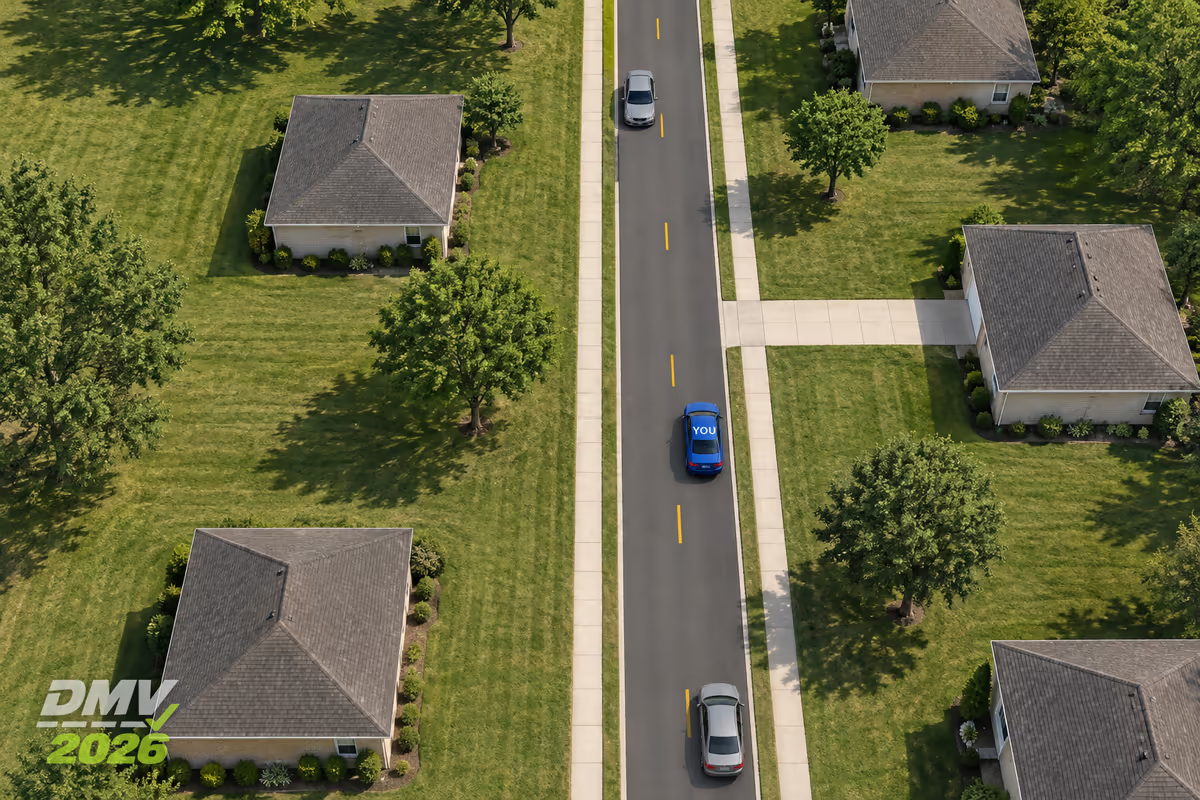
    Street seen from above with a driveway on your right leading up to a house. Your car, marked YOU, is stopped in your lane just short of the driveway. A grey car is coming the other way in the far lane and another is behind you in your lane. The driveway is empty
    Which is the safer way to use this driveway?
    Show the answer

    The answer is B: Back in, then drive out forward.

    Back into the driveway and drive out forward. Backing is the slow part, so do it from the street, where you can see what is coming. Backing out puts the rear of your car into the street before you can see traffic. Do not back in where a sign forbids it.

    “It is hard for you to see behind your vehicle. Try to do as little backing as possible. In a shopping center, try to find a parking space you can drive through so that you can drive forward when you leave.”

    Connecticut Driver’s Manual, page 26
  7. Question 7 of 10 · Guide and service signs

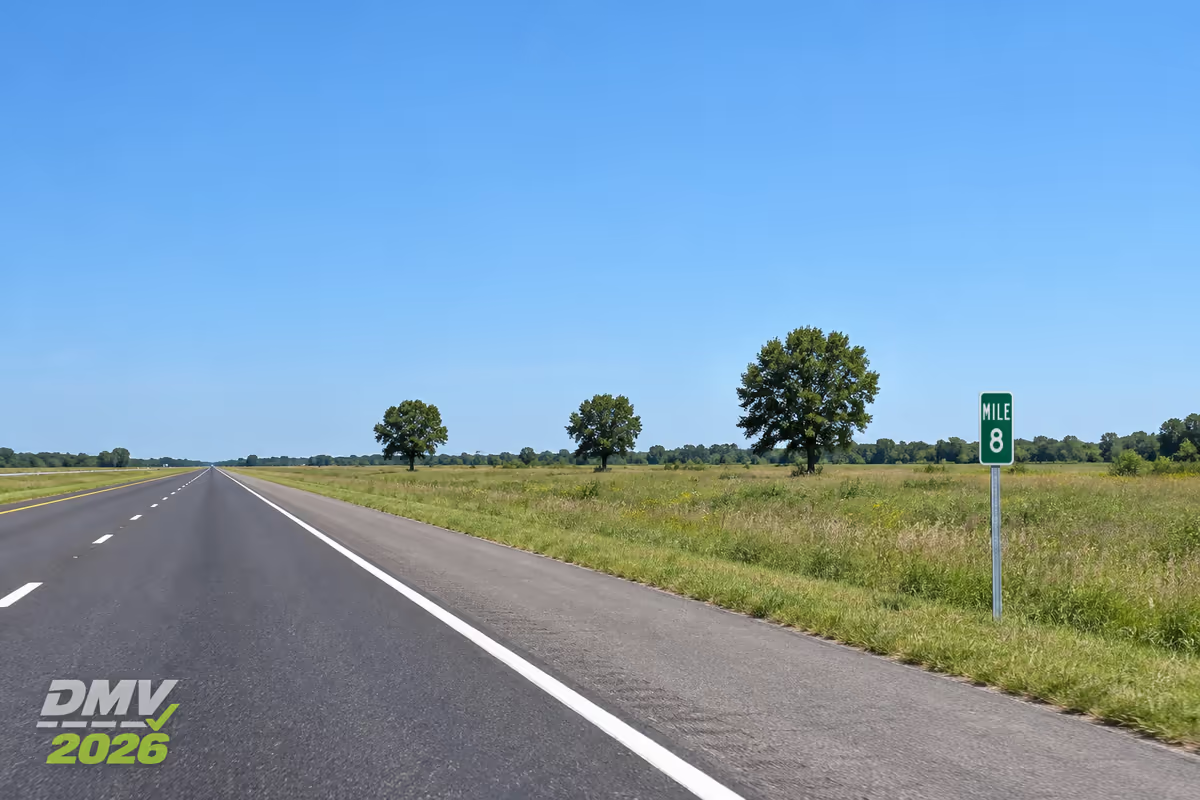
    Small green upright panel with the word MILE above the white number 8, on a short post beside a freeway
    Your car breaks down and you call for help. How does this sign help?
    Show the answer

    The answer is C: It tells the dispatcher where you are.

    Mile markers count the miles along a route, and the number is the quickest way to say where you are. Give it with the route and the direction you are heading. The markers also let you judge how far your exit is, since exit numbers usually match them.

    “Reference Location (D10-1 through D10-3) signs shall be placed on all expressway facilities that are located on a route where there is reference location sign continuity and on all freeway facilities to assist road users in estimating their progress, to provide a means for identifying the location of emergency incidents and traffic crashes, and to aid in highway maintenance and servicing.”

    MUTCD, 11th Edition, page 507
  8. Question 8 of 10 · Licensing, insurance and penalties

    A suspension puts your license on hold. A revocation ____ it.
    Show the answer

    The answer is C: cancels

    A suspension is temporary. When the period is over and you have met the conditions and paid the fee, you get the license back. A revocation ends the license itself. To drive again you wait out the period, then apply as a new driver and pass the tests your state asks for.

    “Suspension is the temporary removal of your driving privilege.”

    Arizona Driver License Manual and Customer Service Guide, page 62
  9. Question 9 of 10 · Stopping distance and braking

    Your tires are worn nearly bald. Does that change how far you need to stop?
    Show the answer

    The answer is A: Yes. You need more room.

    Worn tires have little tread left, so they grip the road less and the car slides farther before it stops. The brakes can be perfect and the stop is still longer. Turning gets harder too, most of all on a wet road.

    “Worn or bald tires can increase your stopping distance and make turning more difficult when the road is wet.”

    Connecticut Driver’s Manual, page 13
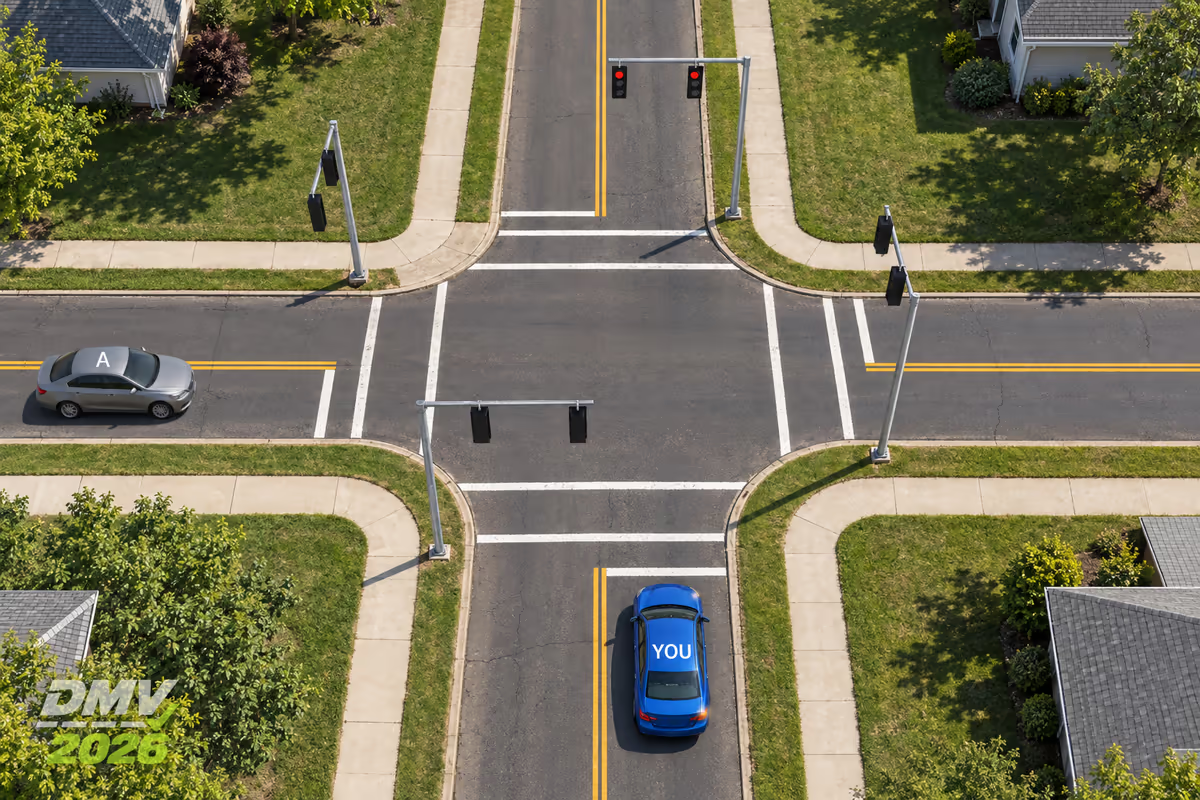
  10. Question 10 of 10 · Right-of-way

    Intersection seen from above. Your car is stopped at a red light at the bottom approach with its right turn signal on. A car marked A is coming along the cross street from your left
    You want to turn right, and no sign forbids it. Who goes first?
    Show the answer

    The answer is C: Car A. Its light is green.

    A right turn on red comes after a complete stop, and only when the way is clear. Car A has the green light, so it goes first. Wait for a gap in the cross traffic and for anyone in the crosswalk, then turn.

    “GREEN Traffic Light— This means you may go through the intersection if it is clear to do so, with caution.”

    AAMVA Model Driver’s License Manual, page 19

These 10 questions are from the DMV Champ app’s practice set, last updated October 23, 2026. Spot a mistake in a question? Email us.

How many questions can you miss on the Connecticut permit test?

5

You need 20 of the 25 right.

The test has 25 questions, and you need 20 right to pass.

“The knowledge test consists of 25 questions and you need 20 correct answers to pass.”

Connecticut Driver’s Manual, page 7

DMV Champ uses the same format for Arkansas, Colorado, Iowa, Kansas, Missouri, Nebraska, Nevada, North Carolina, North Dakota, South Dakota and Wyoming.

How old do you have to be to get a learner’s permit in Connecticut?

The youngest you can be is 16.

“To obtain a learner’s permit: • You must be at least 16 years of age.”

Connecticut Driver’s Manual, page 7

The manual calls it a learner’s permit.

“You must pass a knowledge test before you receive your learner’s permit.”

Connecticut Driver’s Manual, page 7

How do you take the Connecticut permit test?

It’s given by the DMV.

“DMV offices conduct knowledge testing for operator licensing on an appointment basis.”

Connecticut Driver’s Manual, page 7

You must take the test in person.

“All testing must be done in person.”

Connecticut DMV, knowledge and vision test page

The test is given by appointment only, at select DMV offices.

“Testing is offered by appointment only at select DMV offices.”

Connecticut DMV, knowledge and vision test page

The test comes in 11 languages: Albanian, Arabic, English, French, Italian, Mandarin Chinese, Polish, Portuguese, Russian, Spanish and Vietnamese.

“Languages offered for the knowledge test: Albanian, Arabic, Mandarin Chinese, English, French, Italian, Polish, Portuguese, Russian, Spanish, and Vietnamese.”

Connecticut DMV, knowledge and vision test page

You can also ask for a paper test in 24 more languages, from Amharic to Urdu.

“Applicants also have the option to request and complete in hard copy format a written knowledge test in these additional languages: Amharic Ethiopia, Armenian, Bosnian, Chinese Simplified, Croatian, Dari, German, Greek, Haitian Creole, Hindi, Japanese, Khmer, Korean, Nepali, Pashto, Persian Farsi, Portuguese Brizil, Punjabi, Romanian, Somali, Thai, Turkish, Ukrainian, and Urdu.”

Connecticut DMV, knowledge and vision test page

Test simulator

Practice in the Connecticut format

25 questions20 to pass

DMV Champ teaches every question with its explanation, then checks you with 5 simulated tests of 25 questions, graded against the 20-correct passing score. 35 topics in Connecticut: the 34 every state tests, plus winter driving, because the Connecticut handbook teaches it.

Download on the App Store