Indiana · Bureau of Motor Vehicles

Indiana BMV practice test: 2 parts, 80% on each

Indiana’s knowledge test is given by the BMV. The test has 2 parts, traffic maneuvers and road signs, and you need at least 80% right on each part to pass. DMV Champ’s simulated tests use 50 questions, with 42 right to pass.

50 (DMV Champ’s figure, not confirmed by an official source)

questions

42 (DMV Champ’s figure, not confirmed by an official source)

right to pass

84% (DMV Champ’s figure, not confirmed by an official source)

passing score

* The figures DMV Champ’s simulated tests use, not confirmed by an official source.

Checked against the Indiana Driver’s Manual (published July 2026) on October 25, 2026. How we check facts

Practice test

Take a 10-question Indiana BMV practice test

Pick an answer and check it. Every question comes with the reason behind the right answer and the sentence of an official document it rests on.

To pass here you need 9 of 10, the 84% DMV Champ’s simulated tests use.

  1. Question 1 of 10 · Warning signs

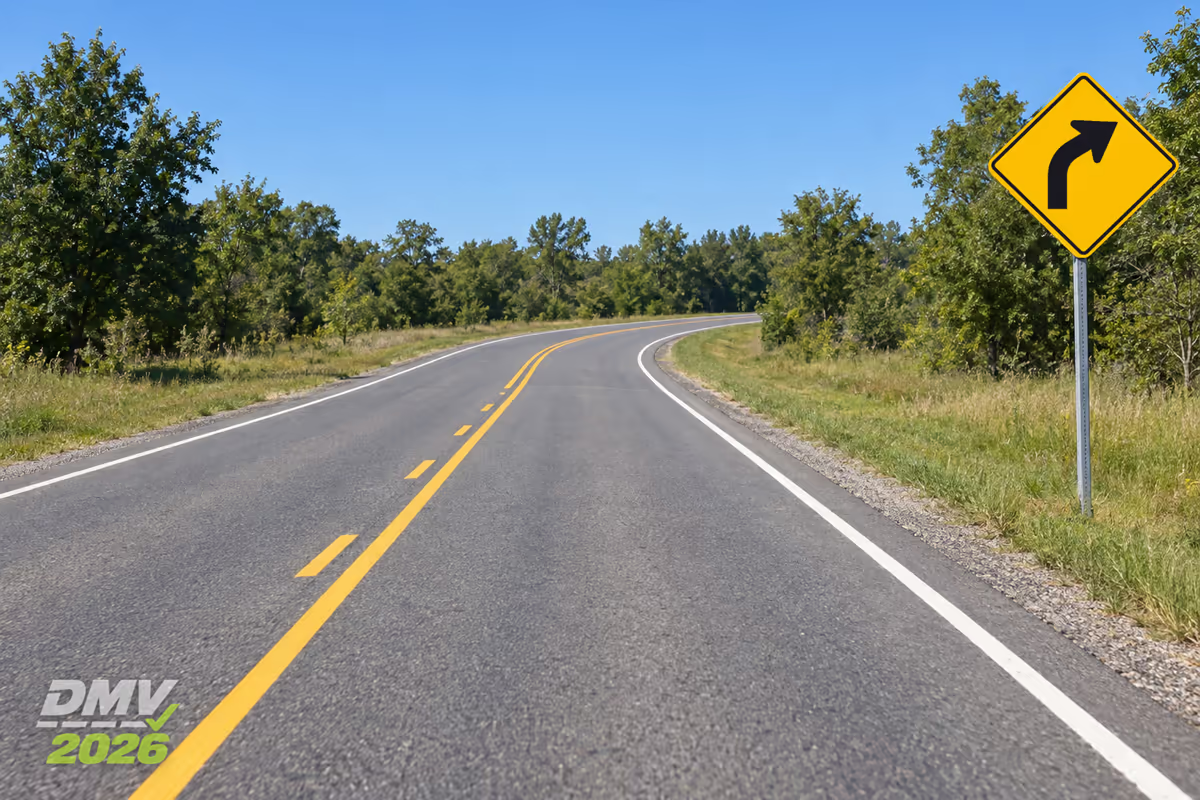
    Yellow diamond sign on a post at the right of a two-lane road, showing a black arrow that bends gently to the right. The road behind it curves away to the right. No vehicles
    What does this sign mean?
    Show the answer

    The answer is A: A curve to the right ahead.

    A curved arrow warns that the road bends ahead, here to the right. The sign stands before the bend so you can slow down on the straight, not in the curve. A side road or a lane that ends has a sign of its own.

    “the sign installed in advance of the curve shall be a Curve (W1-2) sign unless a different sign is recommended or allowed by the provisions of this Section.”

    MUTCD, 11th Edition, page 196
  2. Question 2 of 10 · Speed limits

    Driving much slower than the traffic around you
    Show the answer

    The answer is B: is a hazard of its own.

    Cars stack up behind a slow driver, and people start passing where passing is a bad idea. Most states can ticket you for holding up the normal flow of traffic, and some highways post a minimum speed as well. If you cannot keep pace, stay right and let others by.

    “Where engineering judgment determines that slow speeds on a highway might impede the normal and reasonable movement of traffic, the Minimum Speed Limit (R2-4P) plaque may be installed below a Speed Limit (R2-1) sign to indicate the minimum legal speed.”

    MUTCD, 11th Edition, page 128
  3. Question 3 of 10 · Snow and ice

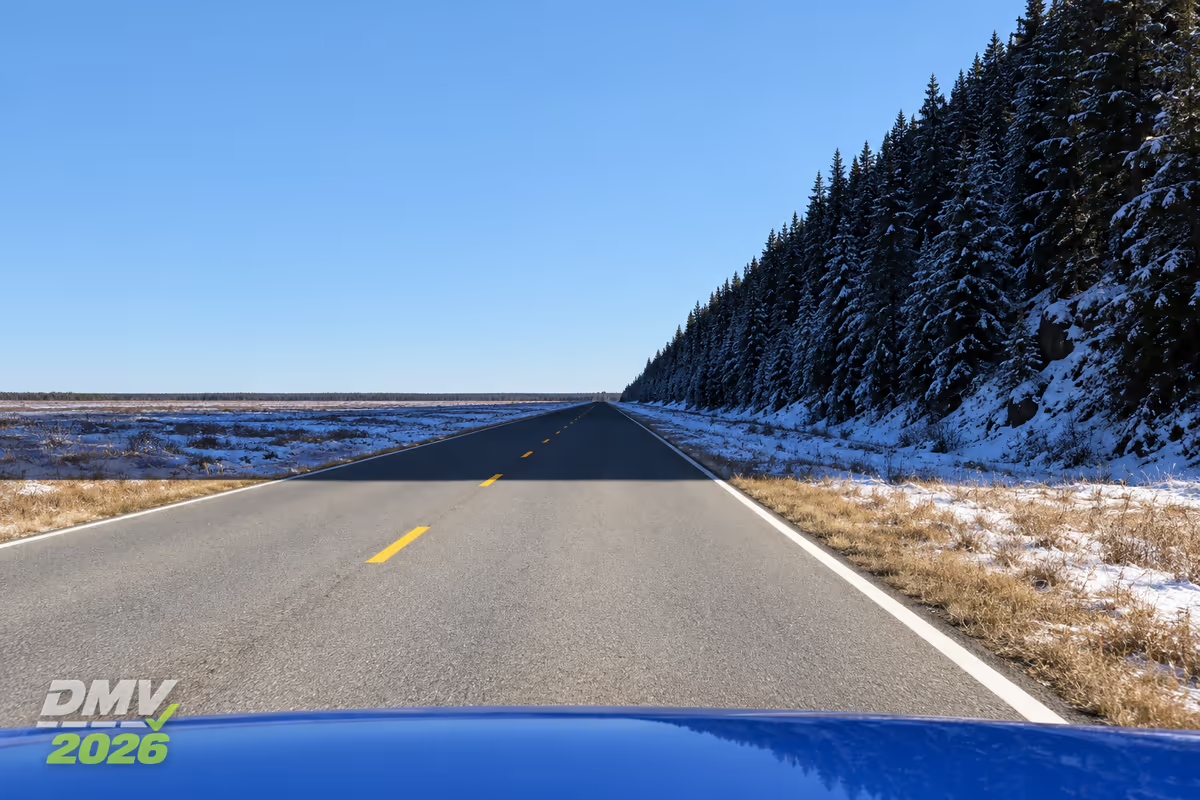
    View through the windshield of a straight two-lane road on a sunny winter day with snow on the verges. The near stretch is dry and bright. Ahead the road runs into the deep shadow of a wooded hillside, where the pavement is simply dark. The lane is empty
    The road has been dry for miles. May you hold your speed into the shade ahead?
    Show the answer

    The answer is A: No. Shade can hide ice.

    On a cold day, a stretch the sun does not reach freezes first and dries out last. The road can be dry for a mile and icy in the next patch of shade. Watch under trees, beside a building or below a hill. Ease off before you reach it, while you still have grip.

    “Shade from trees or buildings can hide icy spots on cold, wet days. These areas freeze first and dry out last.”

    California Driver's Handbook, page 67
  4. Question 4 of 10 · Traffic signals and arrows

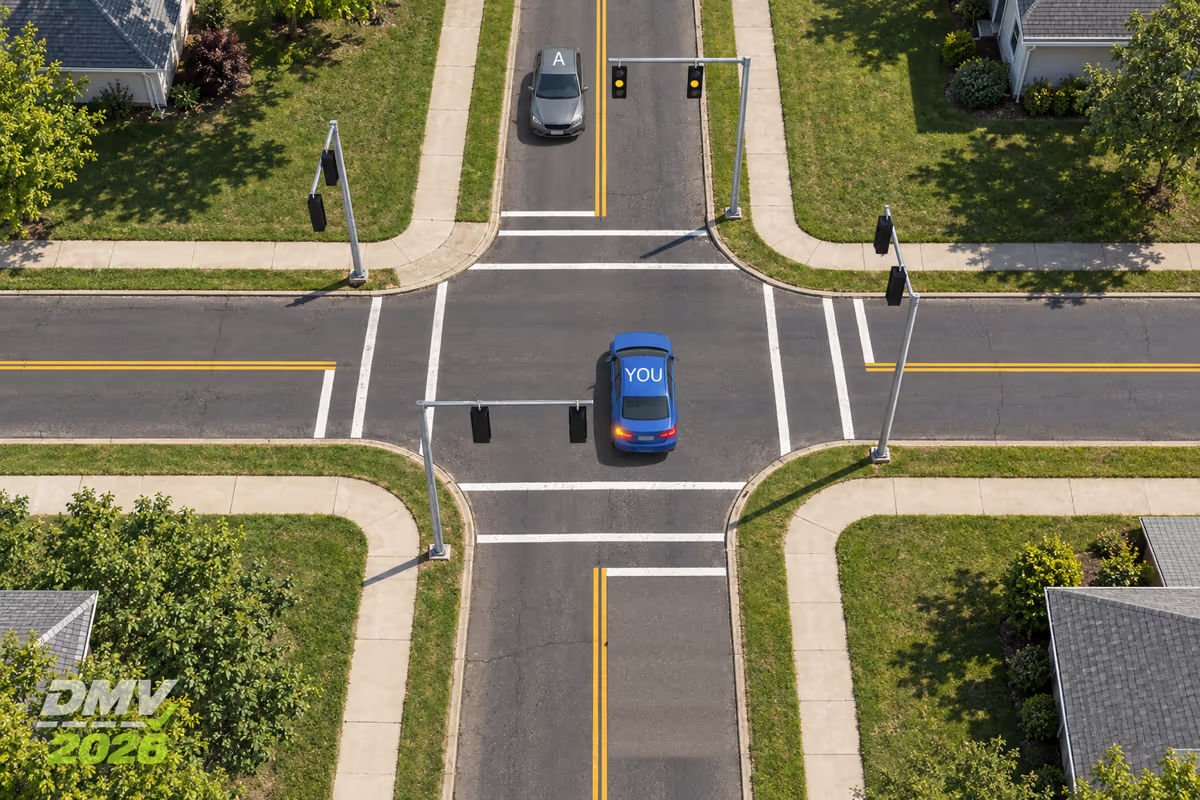
    Intersection seen from above. Your car has moved a little way into the intersection from the bottom, just right of the center line, with its left turn signal on and its wheels straight, waiting to turn left. The signal facing it shows yellow. One car, marked A, is coming toward you from the far side, heading straight through and not yet in the intersection
    You are in the intersection waiting to turn left. The yellow light comes on. What now?
    Show the answer

    The answer is A: Finish the turn when the way is clear.

    Once you are in the intersection, you are committed. The yellow does not change the rule you entered under: yield to oncoming traffic, then turn. Watch the oncoming cars, since most stop on their yellow but some run it. Finish the turn as soon as it is clear, and never sit in the middle through a whole light.

    “The rules set forth concerning vehicular operation under the movement(s) being terminated shall continue to apply while the steady CIRCULAR YELLOW signal indication is displayed.”

    MUTCD, 11th Edition, page 685
  5. Question 5 of 10 · Roundabouts and intersections

    You have just driven past your exit in a roundabout. What should you do?
    Show the answer

    The answer is C: Go around again.

    A roundabout is a loop, so a missed exit costs you one more lap. Stay in your lane and follow the circle until your exit comes up again. Never back up or stop inside the circle. Nobody behind you expects either one.

    “7. If you miss your exit, continue around until you return to your exit.”

    California Driver's Handbook, page 46
  6. Question 6 of 10 · Rain, fog and slick roads

    It is raining on the highway. May you use cruise control?
    Show the answer

    The answer is B: No. Turn it off.

    Keep cruise control off on a wet road. It keeps feeding power to hold the speed you set. If the tires lose grip, that power can turn a slip into a slide. With your own foot on the gas, the car slows the moment you lift.

    “Do not use your vehicle's cruise control system on wet pavement. The cruise control system will continue to provide power to the tires if you lose traction and may cause you to lose control.”

    Missouri Driver Guide, page 65
  7. Question 7 of 10 · Pavement markings

    Narrow street from the driver's seat with a broken white line down the middle and one lane either side of it; your car is in the right lane and the far lane is empty
    Look at the line down the middle of this street. What does it tell you?
    Show the answer

    The answer is A: Both lanes go the same way.

    The center line is white, and white separates lanes going the same way. So this is a one-way street. A yellow center line would mean traffic coming toward you. Check the line color when you turn onto a street you do not know.

    “white markings for longitudinal lines shall delineate: A. The separation of traffic flows in the same direction”

    MUTCD, 11th Edition, page 578
  8. Question 8 of 10 · Seat belts, airbags and car seats

    The shoulder belt rubs your neck, so you tuck it under your arm. What can happen in a crash?
    Show the answer

    The answer is B: Serious injuries inside your body.

    The shoulder belt goes over your shoulder and across your chest, snug, with little or no slack. Under your arm it lies over your stomach, and in a crash it can cause serious injuries inside you. Behind your back is just as wrong.

    “A shoulder harness is worn across the shoulder and chest with minimal, if any, slack. The shoulder harness should not be worn under the arm or behind the back. Wearing the harness the wrong way could cause serious internal injuries in a crash.”

    AAMVA Model Driver’s License Manual, page 14
  9. Question 9 of 10 · Curves and hills

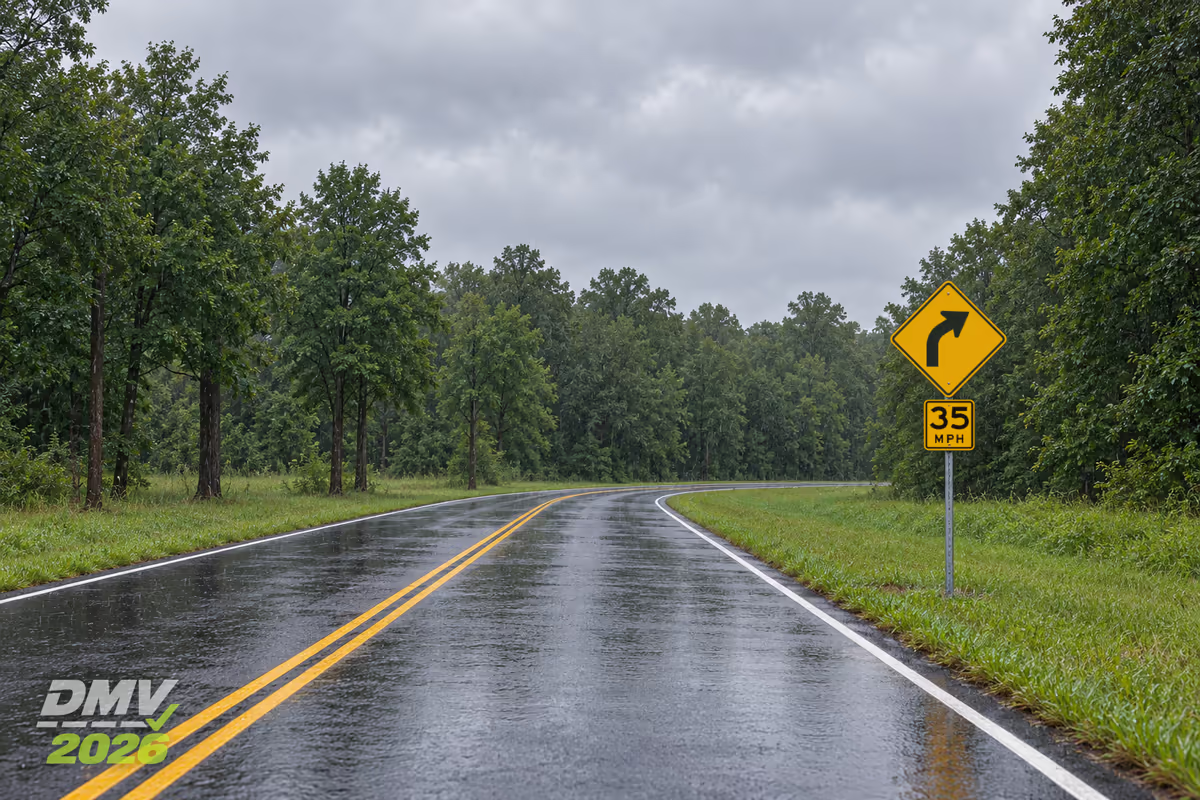
    Two-lane country road in light rain, the pavement wet, bending to the right ahead. On a post at the right side of the road stands a yellow diamond sign with a black arrow bending to the right and, under it, a small square yellow plaque reading 35 MPH
    How fast should you take this curve?
    Show the answer

    The answer is B: Under the speed on the plaque.

    The plaque gives the recommended speed for the curve in good conditions. It is not a limit, but when the road is dry it is the speed to use. Rain gives the tires less grip, so go under it. The road's speed limit still applies, but it is not the safe speed for this bend.

    “Advisory Speed—a recommended speed for all vehicles operating on a section of highway and based on the highway design, operating characteristics, and conditions.”

    MUTCD, 11th Edition, page 54
  10. Question 10 of 10 · Lane use and changing lanes

    Your mirrors show the next lane is clear. Is that enough to move over?
    Show the answer

    The answer is C: No. Check your blind spot first.

    Mirrors do not show the lane right beside you. Before you steer over, turn your head and look over your shoulder on that side. Then signal, look once more, and move while the lane is still clear.

    “Check your “blind spots,” or areas around your vehicle that cannot be seen by other vehicles, by turning your head and looking over your shoulder in the direction you plan to move.”

    AAMVA Model Driver’s License Manual, page 27

These 10 questions are from the DMV Champ app’s practice set, last updated October 23, 2026. Spot a mistake in a question? Email us.

How many questions can you miss on the Indiana permit test?

On DMV Champ’s 50-question simulated test, you can miss 8.

Those figures aren’t confirmed by an official source.

The test has 2 parts, traffic maneuvers and road signs, and you need at least 80% right on each part to pass.

“The exam include multiple choice questions divided into two sections concerning traffic maneuvers and knowledge of types of traffic signs. Eighty percent or higher correct responses on each component must be achieved to pass the exam.”

Indiana BMV, knowledge exam page

How old do you have to be to get a learner’s permit in Indiana?

The youngest you can be is 15.

“If you are under 16 years of age, you must meet the following requirements to obtain a learner’s permit: • Be at least 15 years of age and show proof of your enrollment in a BMV licensed Behind-the-wheel training provider”

Indiana Driver’s Manual, page 8

The manual calls it a learner’s permit.

“A learner’s permit allows an Indiana resident to practice driving before applying for a driver’s license.”

Indiana Driver’s Manual, page 8

What happens if you fail the Indiana permit test?

If you fail, you can take the test again on the next business day.

“If you fail the knowledge exam, you must wait until the next business day to retake it.”

Indiana Driver’s Manual, page 10

How do you take the Indiana permit test?

It’s given by the BMV, in 19 languages besides English, among them Spanish, Arabic, Burmese, Mandarin Chinese and Vietnamese.

“The BMV currently offers the knowledge exam in the following languages:”

Indiana BMV, knowledge exam page

The manual calls it the knowledge exam.

“The driver’s knowledge exam is a multiple-choice exam based on Indiana law, defensive driving practices, and information contained in this driver’s manual.”

Indiana Driver’s Manual, page 10

You don’t need an appointment, but get to a BMV branch at least 30 minutes before it closes to take the test on a computer that day.

“You don't need to schedule an appointment for a knowledge exam. But, you MUST arrive at the branch at least 30 minutes before it closes to take the computer-based knowledge exam that day.”

Indiana BMV, knowledge exam page

If you need an American Sign Language interpreter for the test, you can set it up by phone or at any branch.

“Customers that require an ASL translator for a knowledge exam or other services may call the BMV's Contact Center at 888-692-6841 to schedule an appointment. Customers can also schedule an appointment for an ASL translator at any branch.”

Indiana BMV, knowledge exam page

Test simulator

Practice in the Indiana format

50 questions42 to pass

DMV Champ teaches every question with its explanation, then checks you with 5 simulated tests of 50 questions, graded against the 42-correct passing score. 36 topics in Indiana: the 34 every state tests, plus winter driving and flooding, because the Indiana handbook teaches them.

Download on the App Store