Michigan · Department of State

Michigan permit practice test: knowledge and sign tests

Michigan’s knowledge test is given by the Secretary of State. To get a temporary instruction permit, you must pass a road sign test as well as the written knowledge test. DMV Champ’s simulated tests use 50 questions, with 40 right to pass.

50 (DMV Champ’s figure, not confirmed by an official source)

questions

40 (DMV Champ’s figure, not confirmed by an official source)

right to pass

80% (DMV Champ’s figure, not confirmed by an official source)

passing score

* The figures DMV Champ’s simulated tests use, not confirmed by an official source.

Checked against What Every Driver Must Know (October 2025 edition) on October 25, 2026. How we check facts

Practice test

Take a 10-question Michigan permit practice test

Pick an answer and check it. Every question comes with the reason behind the right answer and the sentence of an official document it rests on.

To pass here you need 8 of 10, the 80% DMV Champ’s simulated tests use.

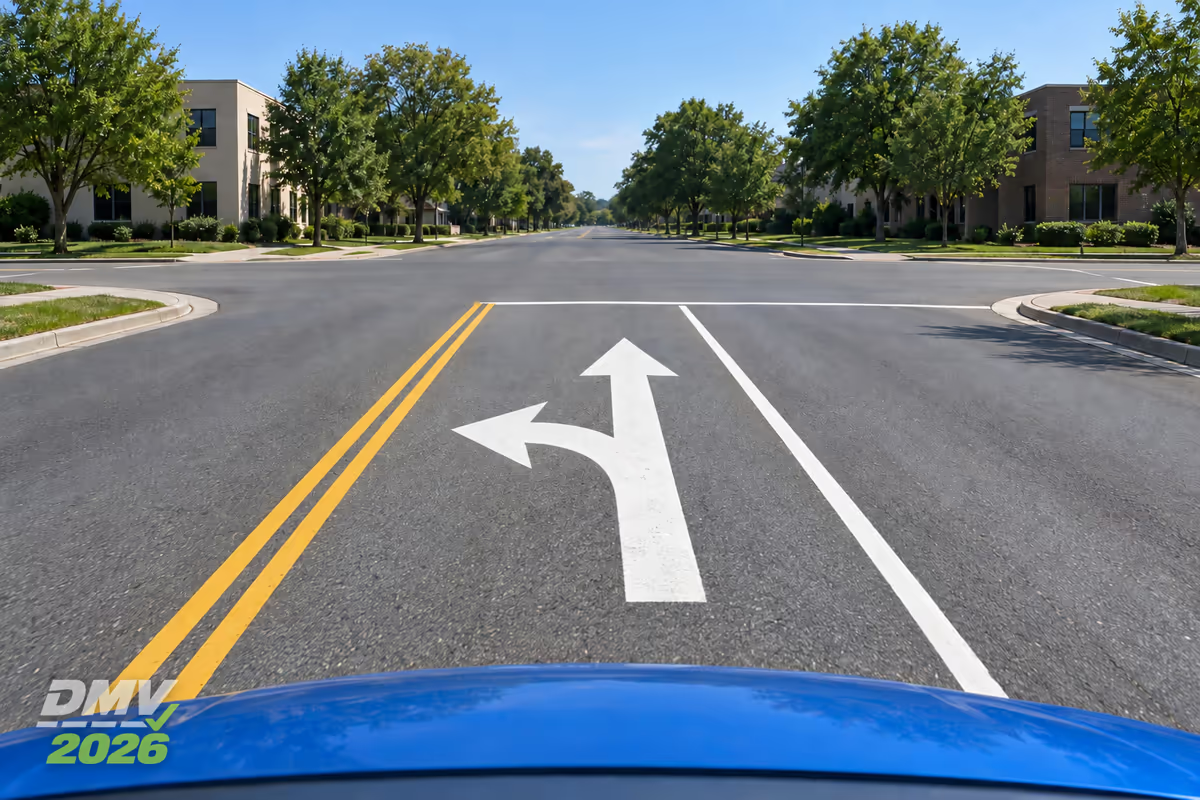
  1. Question 1 of 10 · Pavement markings

    Your lane from the driver's seat with a white arrow painted on the pavement ahead that has one head pointing straight on and a second head curving to the left
    What may you do from this lane?
    Show the answer

    The answer is C: Go straight or turn left.

    An arrow with two heads gives you a choice: go straight or turn the way the curved head points. A single arrow with the word ONLY leaves no choice. Read the arrows early, while you can still move to the lane you need.

    “Lane-use arrow markings (see Figure 3B-21) are used to indicate the mandatory or permissible movements in certain lanes”

    MUTCD, 11th Edition, page 619
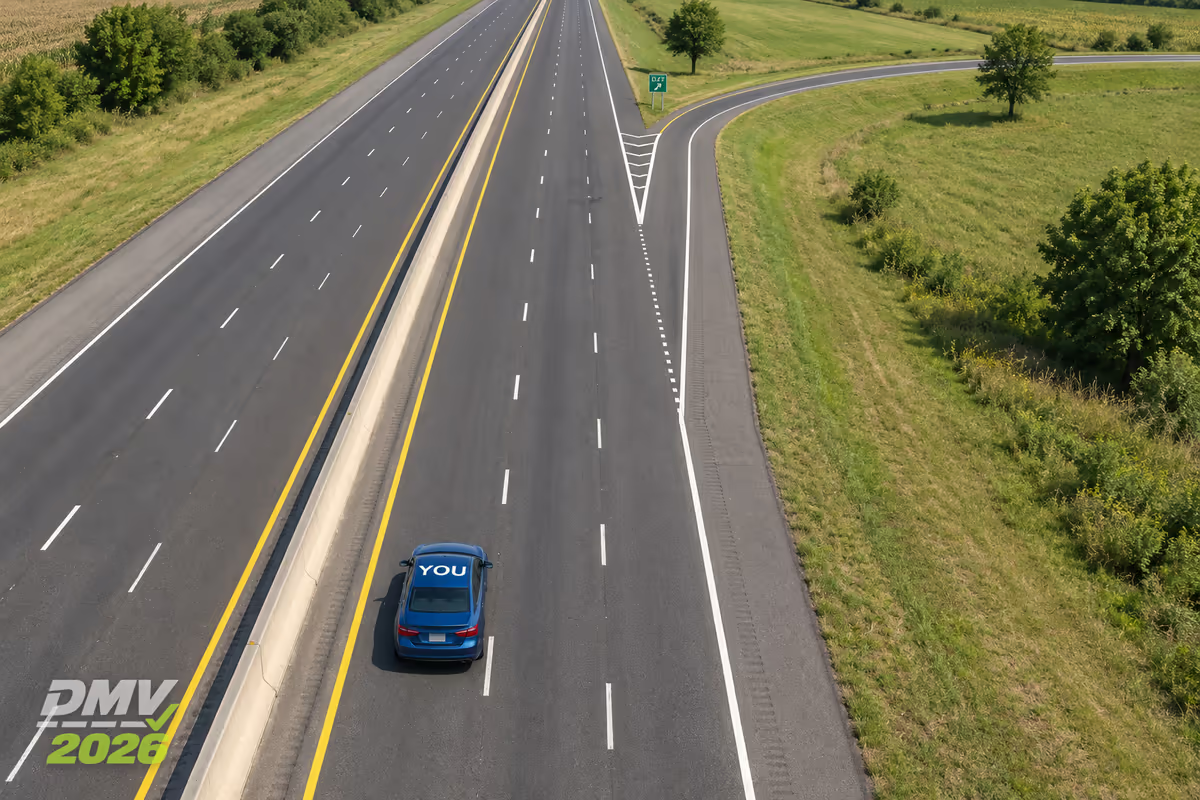
  2. Question 2 of 10 · Highways, merging and exits

    Freeway seen from above with three lanes running the same way. On the right, a lane peels off and curves away as an exit ramp, with a striped triangle and a green EXIT sign in the wedge between the ramp and the through lanes. Your car is in the left-hand lane
    Where do you slow down when you leave the highway?
    Show the answer

    The answer is B: In the exit lane, once you are in it.

    Keep your speed as long as you are on the main road. Braking in a through lane catches out the driver behind you, who is doing highway speed. The exit lane is there to give you room to slow down, and the ramp gives you more.

    “Maintain your vehicle speed as long as you are on the main roadway.”

    AAMVA Model Driver’s License Manual, page 28
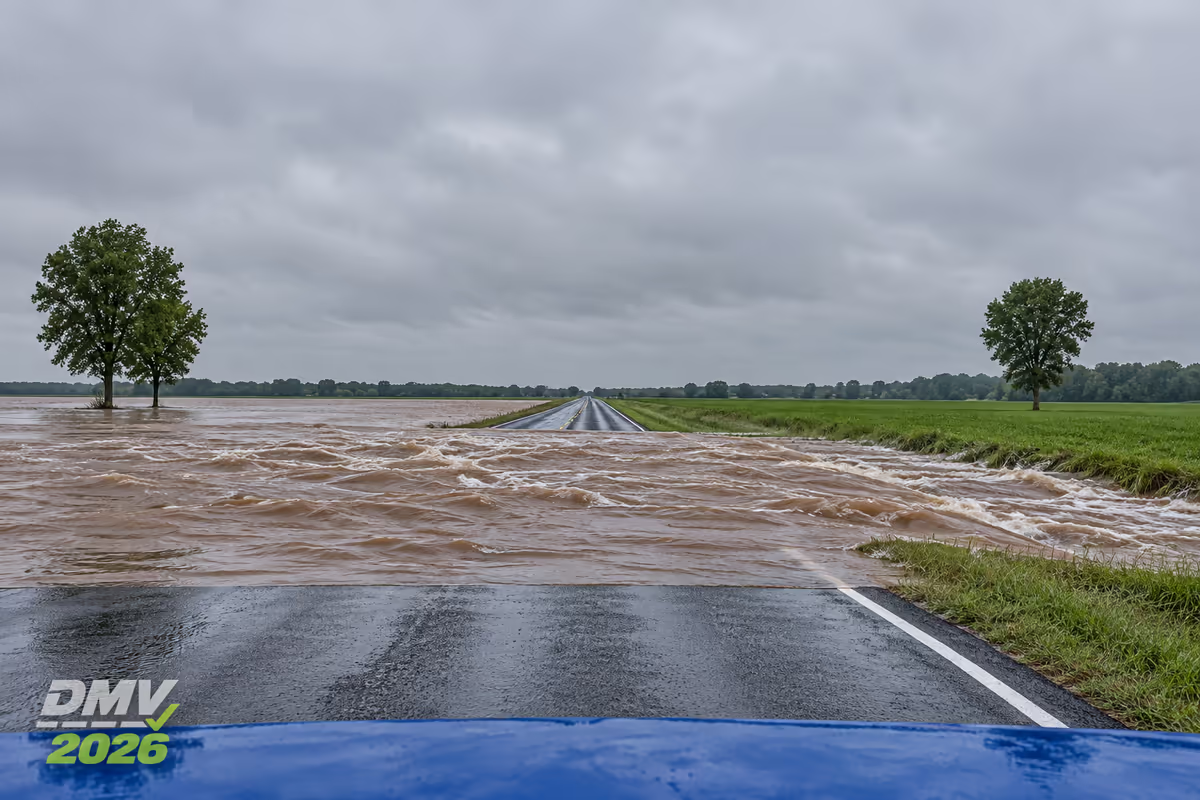
  3. Question 3 of 10 · Flooding and high water

    View through the windshield of a straight two-lane road after rain. A short way ahead brown water covers the road from edge to edge and is flowing across it from left to right, with ripples and streaks of foam showing the current. The road comes back out of the water in the distance
    What makes moving water like this worse than still water?
    Show the answer

    The answer is B: It can push a car off the road.

    Water flowing across a road pushes against the side of the car while it lifts the tires. Once the car is light enough, the current carries it, even with the wheels still on the pavement. Still water hides the same holes and can stall the engine, but it does not shove. Do not cross water that is flowing over the road.

    “In moving water, all that is needed is for a vehicle to become buoyant enough to allow the water’s force to push it sideways, even while the wheels remain in contact with the pavement.”

    Tennessee Comprehensive Driver License Manual, page 90
  4. Question 4 of 10 · Guide and service signs

    You are looking for the turn into a state park. Which color sign marks it?
    Show the answer

    The answer is C: Brown.

    Brown marks places people visit: parks, campgrounds, museums and historic sites. Nothing else uses it, so a brown sign is always something to see or do. Green would give you the way to a town, and blue would point to fuel or food.

    “C. Brown—recreational and cultural interest area guidance”

    MUTCD, 11th Edition, page 74
  5. Question 5 of 10 · Railroad crossings

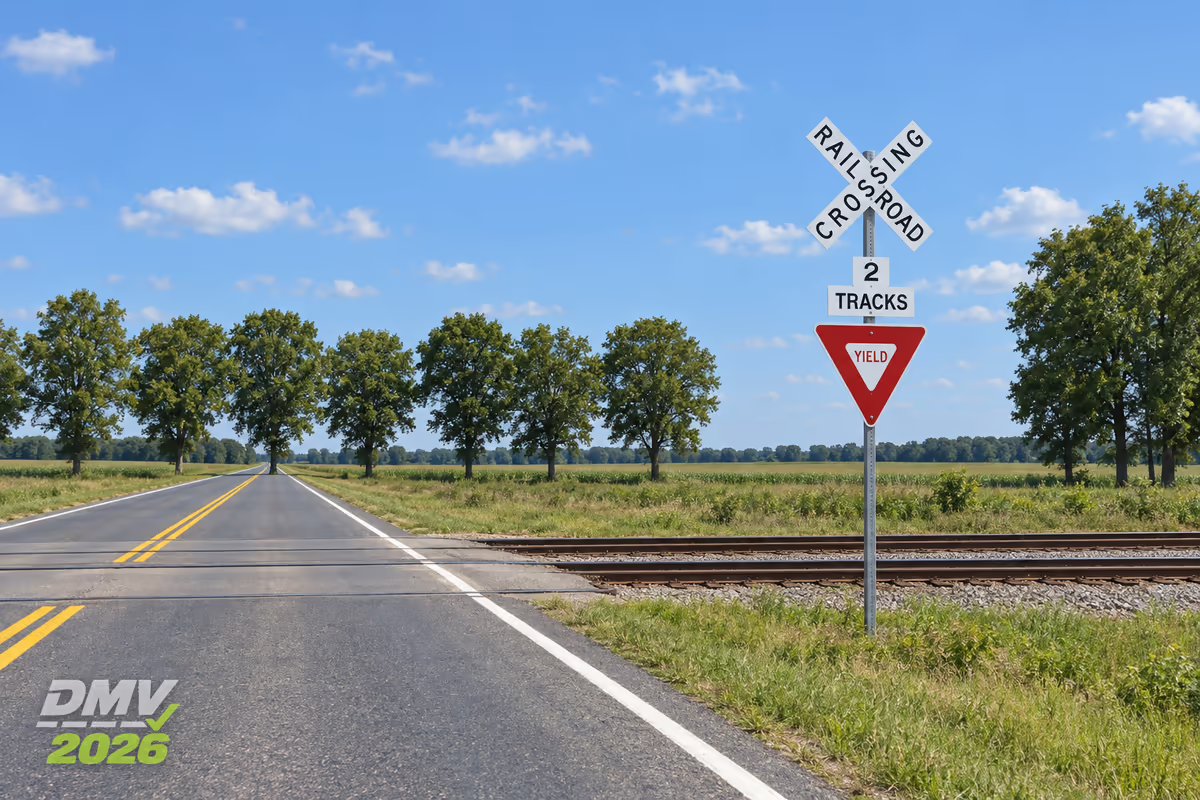
    Rural road seen from your car running up to two parallel railroad tracks, with a white X-shaped RAILROAD CROSSING sign on a post at the right and a small white plate under it reading 2 TRACKS in black
    You are waiting at this crossing. A train has just gone by. What do you do before you go?
    Show the answer

    The answer is A: Look both ways down both tracks.

    Two tracks can carry two trains. A second one may be coming the other way on the far track, hidden behind the one that just passed. Wait until you can see a long way down both tracks, and until any lights have stopped. Then cross without stopping.

    “These signs warn you that there is more than one track and there may be more than one train crossing. Not all highway-railroad grade crossings with more than one train track will have these signs, so it is important to check for more than one track, train, or railroad vehicle at each highway-railroad grade crossing.”

    AAMVA Model Driver’s License Manual, page 21
  6. Question 6 of 10 · Night driving and headlights

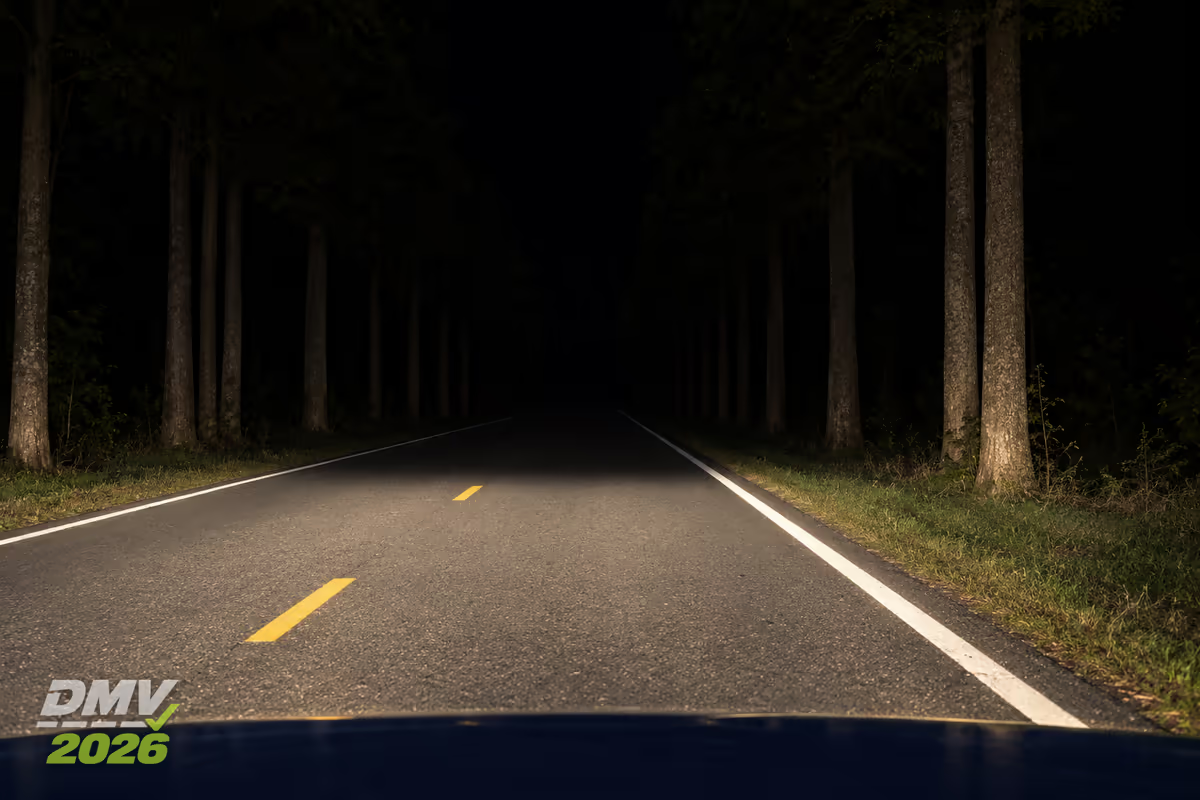
    Night view through your windshield of a two-lane country road. Your headlights light a short stretch of the road ahead, and beyond it everything is dark
    Driving on this road at night is
    Show the answer

    The answer is B: more dangerous than by day.

    Driving at night is harder and more dangerous than driving by day. You can see only as far as your headlights light the road. That leaves you less time to spot a problem and stop. Lighter traffic does not make up for what you cannot see.

    “Driving at night is more difficult and hazardous than daytime driving. The distance you can see in front is limited by light provided by your headlights.”

    AAMVA Model Driver’s License Manual, page 42
  7. Question 7 of 10 · Work zones and flaggers

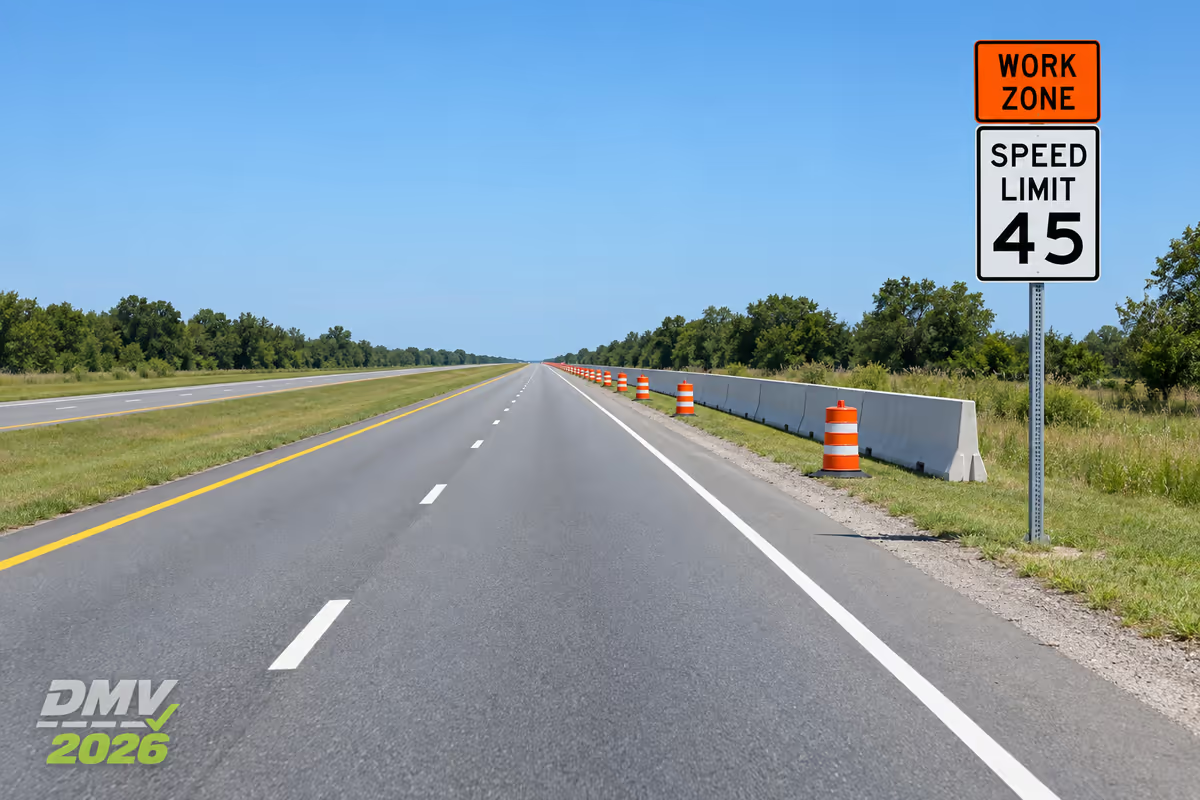
    Orange rectangular plate with the words WORK ZONE in black, mounted above a white rectangular sign reading SPEED LIMIT over a large number
    You cannot see anyone working. What does this sign require?
    Show the answer

    The answer is B: Drive no faster than the number on it.

    A white speed limit sign is the law, in a work zone as anywhere else. It applies whether or not you see a crew, unless a plate under it says when it applies. An orange plate with a number under a warning sign is advice, not the limit.

    “If a TTC zone requires regulatory measures different from those existing, the existing permanent regulatory devices shall be removed or covered and superseded by the appropriate temporary regulatory signs.”

    MUTCD, 11th Edition, page 834
  8. Question 8 of 10 · Seat belts, airbags and car seats

    Which kind of seat does a baby use first?
    Show the answer

    The answer is A: The rear-facing seat.

    A child moves through four stages. First a rear-facing seat, then a forward-facing seat with a harness, then a booster, then the car's own belt. A baby rides facing the rear. Keep a child in each stage as long as the seat allows, since that is the best protection.

    “A child should remain in each stage of restraint as long as the seat allows for the best protection.”

    Washington Driver Guide, page 53
  9. Question 9 of 10 · Before you drive

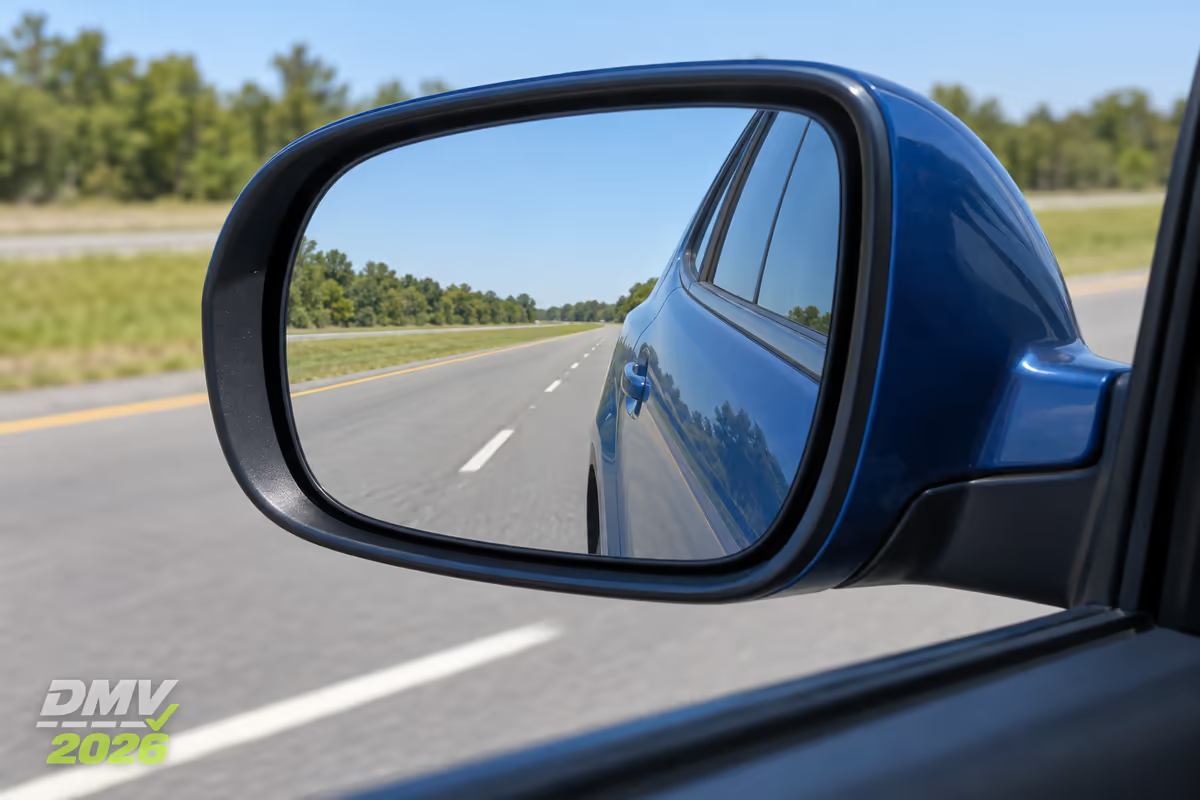
    The driver's side mirror as seen from the driver's seat. More than a third of the glass, along its inner edge, shows the side of your own blue car. The rest shows a narrow strip of empty lane and the road behind. No other vehicle is in view
    What is wrong with how this side mirror is set?
    Show the answer

    The answer is B: It shows too much of your own car.

    A side mirror aimed at your own car wastes view and leaves a bigger blind spot beside you. Aim it outward, so it barely shows the edge of your car and mostly shows the lane next to you. Even a mirror set well cannot show everything, so look over your shoulder before you move sideways.

    “Outside mirrors should be adjusted to reduce blind spots and to provide maximum visibility to the side and rear on both sides of the vehicle.”

    AAMVA Model Driver’s License Manual, page 14
  10. Question 10 of 10 · Roundabouts and intersections

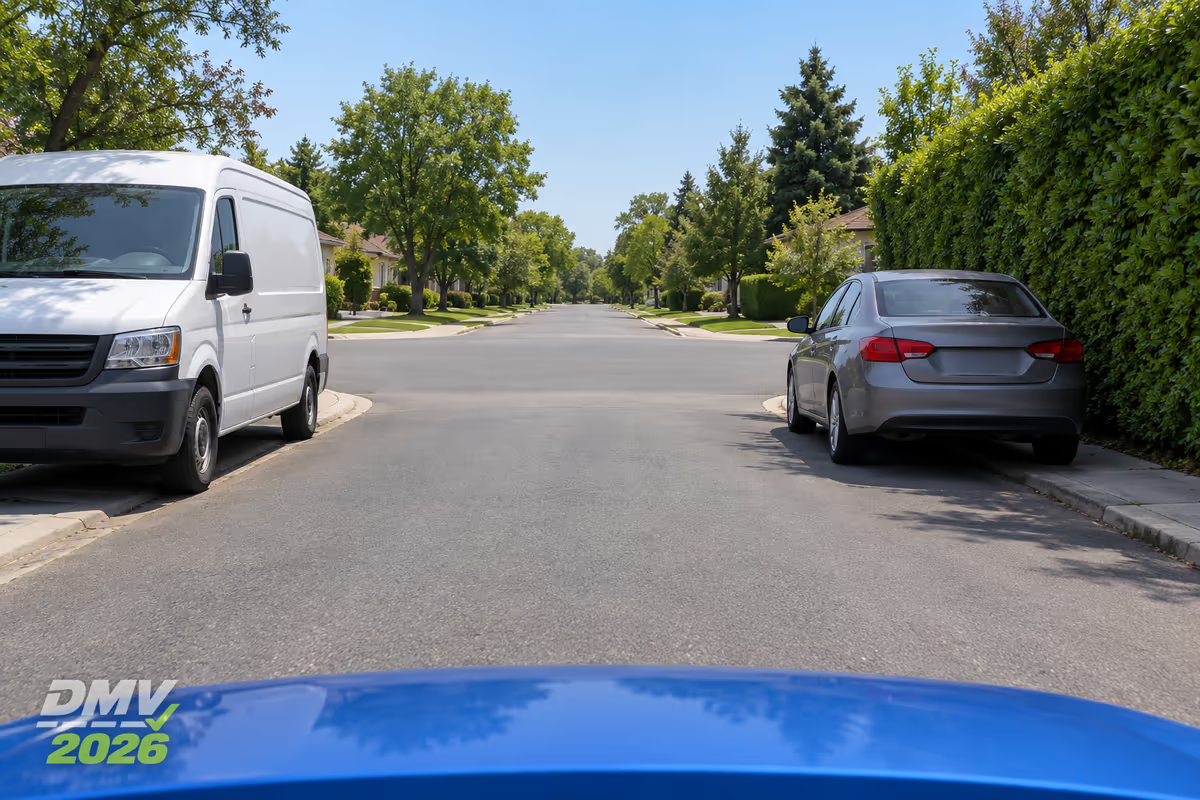
    View through the windshield at a corner on a quiet street. A tall hedge and a parked car on the right, and a parked van on the left, hide the cross street in both directions. There is no sign, signal or painted line at the corner
    What should you do at this corner?
    Show the answer

    The answer is B: Edge out until you can see.

    A corner where you cannot see the cross street is a blind intersection. Slow almost to a stop and move out a few feet at a time until the view opens up. Edging out also lets a driver on the cross street see your front bumper before you see them. Do not count on them yielding to a car they cannot see.

    “An intersection is considered blind if it has no stop signs at any corner. If your view is blocked, move slowly forward until you can see.”

    California Driver's Handbook, page 57

These 10 questions are from the DMV Champ app’s practice set, last updated October 23, 2026. Spot a mistake in a question? Email us.

How many questions can you miss on the Michigan permit test?

On DMV Champ’s 50-question simulated test, you can miss 10.

Those figures aren’t confirmed by an official source.

To get a temporary instruction permit, you must pass a road sign test as well as the written knowledge test.

“Pass the written knowledge and road sign tests.”

What Every Driver Must Know, page 21

DMV Champ uses the same format for Florida, New Jersey, Utah and Wisconsin.

How old do you have to be to get a level 1 learner’s license in Michigan?

The youngest you can be is 14 and 9 months.

“GDL Level 1 Learner’s License: To apply, you must be at least 14 years, 9 months old, visit a Secretary of State office with your parent or legal guardian”

What Every Driver Must Know, page 18

How do you take the Michigan permit test?

It’s given by the Secretary of State.

“The written knowledge test is provided at all Secretary of State offices”

What Every Driver Must Know, page 20

You can take the knowledge test online at home on a computer or laptop.

“The written driver’s license knowledge test is also available online (and is taken at home using a computer or laptop)”

What Every Driver Must Know, page 91

If you take the test at a Secretary of State office, arrive at least 1 hour before closing so you have time to finish.

“If you are required to take a knowledge test for your original operator’s or chauffeur’s license, or a commercial driver’s license, arrive at the Secretary of State office at least one hour before closing to allow enough time to complete the test.”

What Every Driver Must Know, page 21

The tests come in many languages, on screen, on paper or in audio.

“Original driver’s license tests are available in many foreign languages in electronic, paper, or audio formats.”

What Every Driver Must Know, page 91

If English is hard for you, office staff can give you a list of interpreters you may use for the written test.

“If you have difficulty speaking or reading English, office staff will provide a list of available foreign language interpreters. Foreign language interpreters may be used on all written tests, except CDL knowledge tests.”

What Every Driver Must Know, page 21

Test simulator

Practice in the Michigan format

50 questions40 to pass

DMV Champ teaches every question with its explanation, then checks you with 5 simulated tests of 50 questions, graded against the 40-correct passing score. 36 topics in Michigan: the 34 every state tests, plus winter driving and flooding, because the Michigan handbook teaches them.

Download on the App Store