Missouri · State Highway Patrol

Missouri permit practice test: 25 questions, 80% to pass

Missouri’s knowledge test, given by the Missouri State Highway Patrol, has 25 questions, and you need 20 right, or 80%, to pass. To get an instruction permit, you must pass a vision test, a road sign test and the written test.

25

questions

20

right to pass

80%

passing score

Checked against the Missouri Driver Guide (revised August 2026) on October 25, 2026. How we check facts

Practice test

Take a 10-question Missouri permit practice test

Pick an answer and check it. Every question comes with the reason behind the right answer and the sentence of an official document it rests on.

To pass here you need 8 of 10, since Missouri’s test asks for 80%.

  1. Question 1 of 10 · Regulatory signs

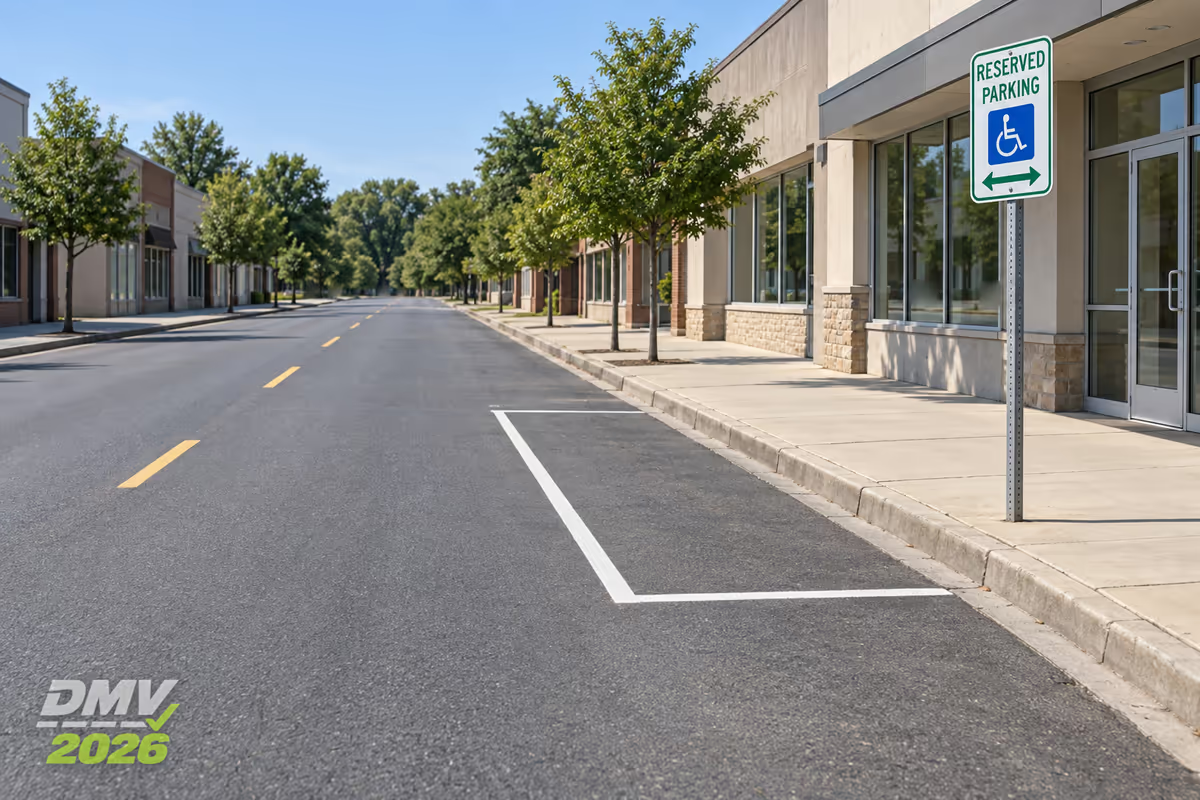
    City street seen from your car with an empty parking space at the right curb in front of a store, and a white sign on a post at the curb reading RESERVED PARKING in green above a blue square with the white wheelchair symbol and a green arrow pointing both ways
    This sign reserves the space for ____.
    Show the answer

    The answer is C: people with disabilities

    The wheelchair symbol marks parking reserved for people with disabilities. It is reserved by law, not by courtesy, so leave it for them even when every other space is full. Who qualifies, and the permit or plate that shows it, is set by your state.

    “Where parking spaces are reserved for persons with disabilities, the Accessible Parking (R7-8) sign (see Drawing D in Figure 2B-25) shall be used to designate the space and shall display the official International Symbol of Accessibility.”

    MUTCD, 11th Edition, page 167
  2. Question 2 of 10 · Railroad crossings

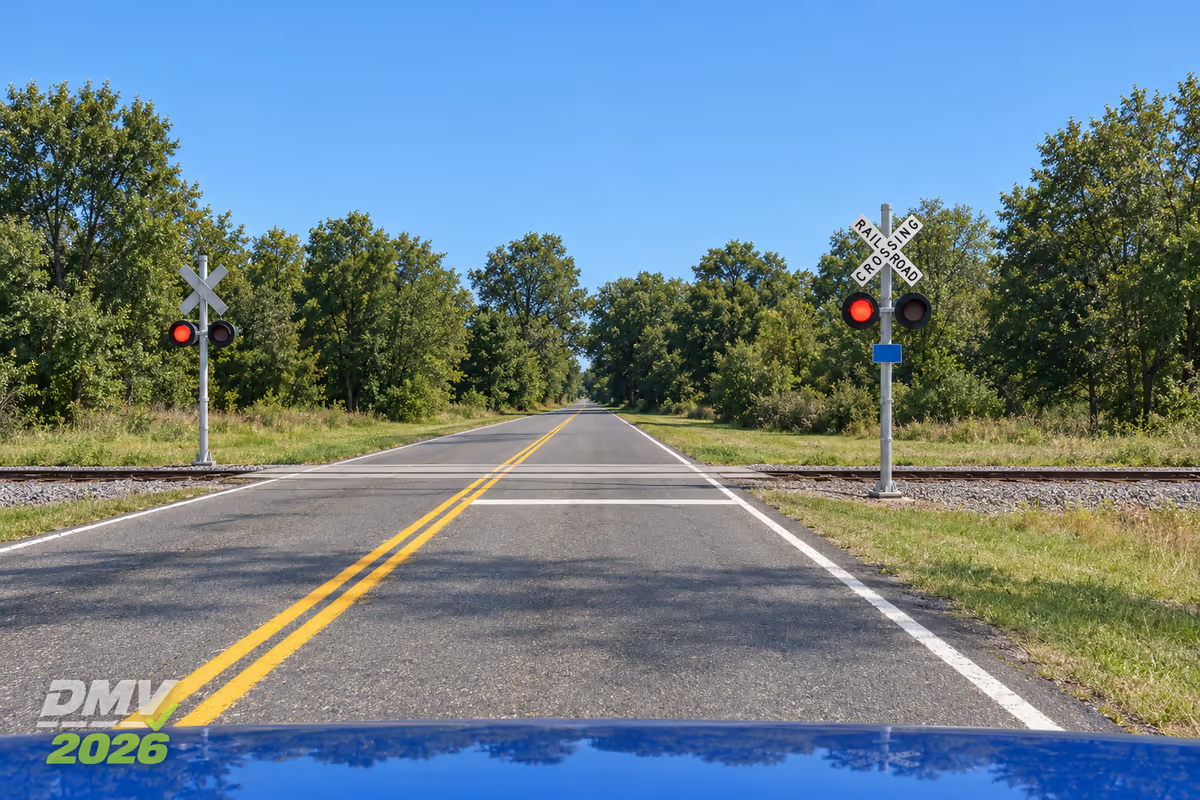
    Railroad crossing seen through your windshield, a white stop line across your lane and a single track beyond it. The signal mast at the right carries a crossbuck over a pair of red lights, one of them lit, and has no gate arm. No train is in view
    A train is coming. Where do you stop?
    Show the answer

    The answer is A: Behind the white line.

    Stop behind the white stop line, or behind the gate where there is one. Where there is no line, stop at least 15 feet from the nearest rail. Do not creep closer to see better. The space in front of the line is there to keep you clear of the train.

    “When a train or railroad vehicle is approaching the intersection, you must stop behind the stop line or before the intersection until the intersection is clear.”

    AAMVA Model Driver’s License Manual, page 21
  3. Question 3 of 10 · Pedestrians and bicyclists

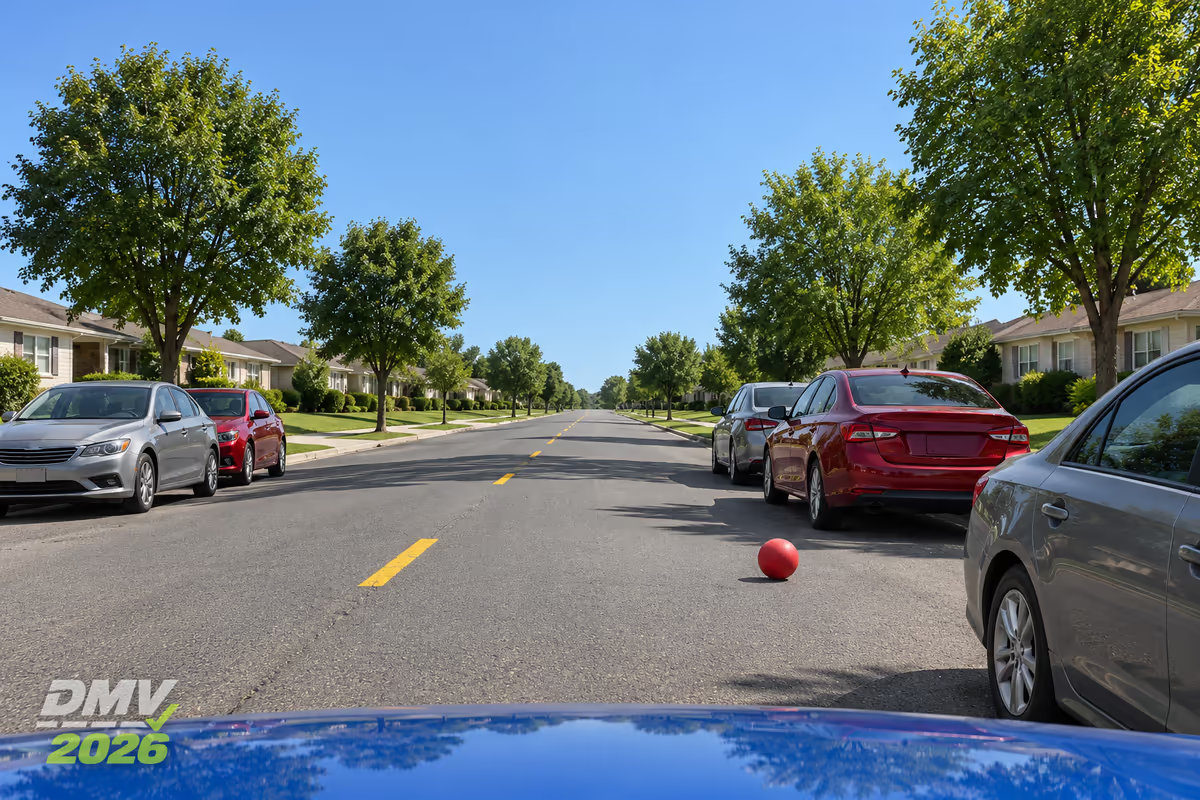
    Residential street seen from your car, with cars parked along both curbs. A red ball is rolling out into the road from the gap between two parked cars on the right. Nobody is in sight
    A ball rolls into the street ahead of you. What should you do?
    Show the answer

    The answer is C: Slow down and be ready to stop.

    A child is often right behind a ball and may run out between the parked cars without looking. Slow down and be ready to stop before you reach the gap. If you wait until you see the child, it is too late to stop.

    “Be careful in playground and residential areas where children could run out from between parked vehicles. It is a good idea to drive slower than the speed limit in these areas and be prepared to stop quickly.”

    AAMVA Model Driver’s License Manual, page 36
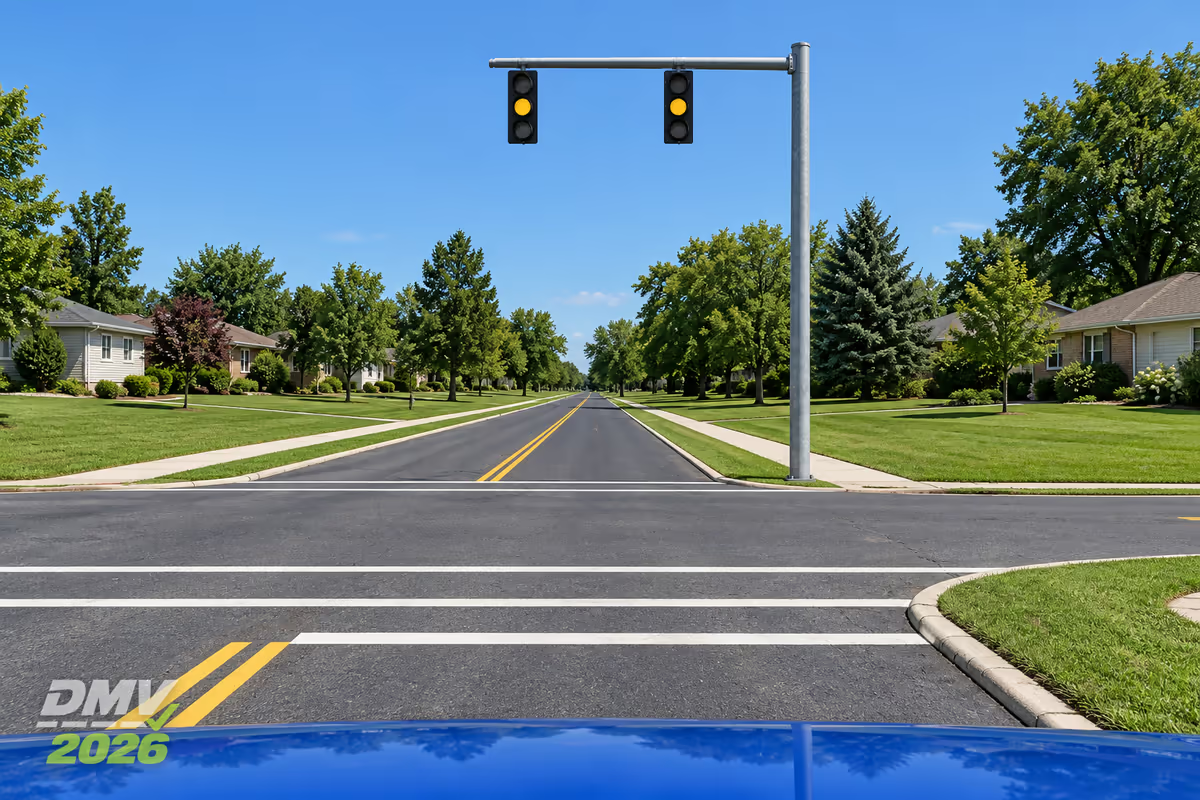
  4. Question 4 of 10 · Traffic signals and arrows

    Street seen from your car, with a traffic signal hanging over the intersection ahead. The signal has three round lenses one above the other, and the middle one is lit yellow while the other two are dark. There is a stop line and a crosswalk across your lane, and no other cars
    The yellow light comes on while you have plenty of room to stop. What do you do?
    Show the answer

    The answer is D: Stop before the stop line.

    When you have room to stop, yellow means stop. Brake early and smoothly so the driver behind you has time to slow too. The wait for the next green is short. Trying to beat a yellow you had room for is a common cause of crashes at lights.

    “YELLOW Traffic Light—This means the traffic light is about to change to red.”

    AAMVA Model Driver’s License Manual, page 19
  5. Question 5 of 10 · Turn signals, horn and lights

    Before a turn, your turn signal should go on
    Show the answer

    The answer is A: well before the corner.

    Signal early, before you slow down or start to turn. A signal is a warning, and it only works if the drivers around you have time to react. Most states ask for at least 100 feet before the turn, and more at higher speed. A signal that comes on as you turn the wheel tells people what you are already doing.

    “Signal before changing direction—An appropriate signal gives other roadway users time to react to your vehicle movements.”

    AAMVA Model Driver’s License Manual, page 32
  6. Question 6 of 10 · Motorcycles, trucks and buses

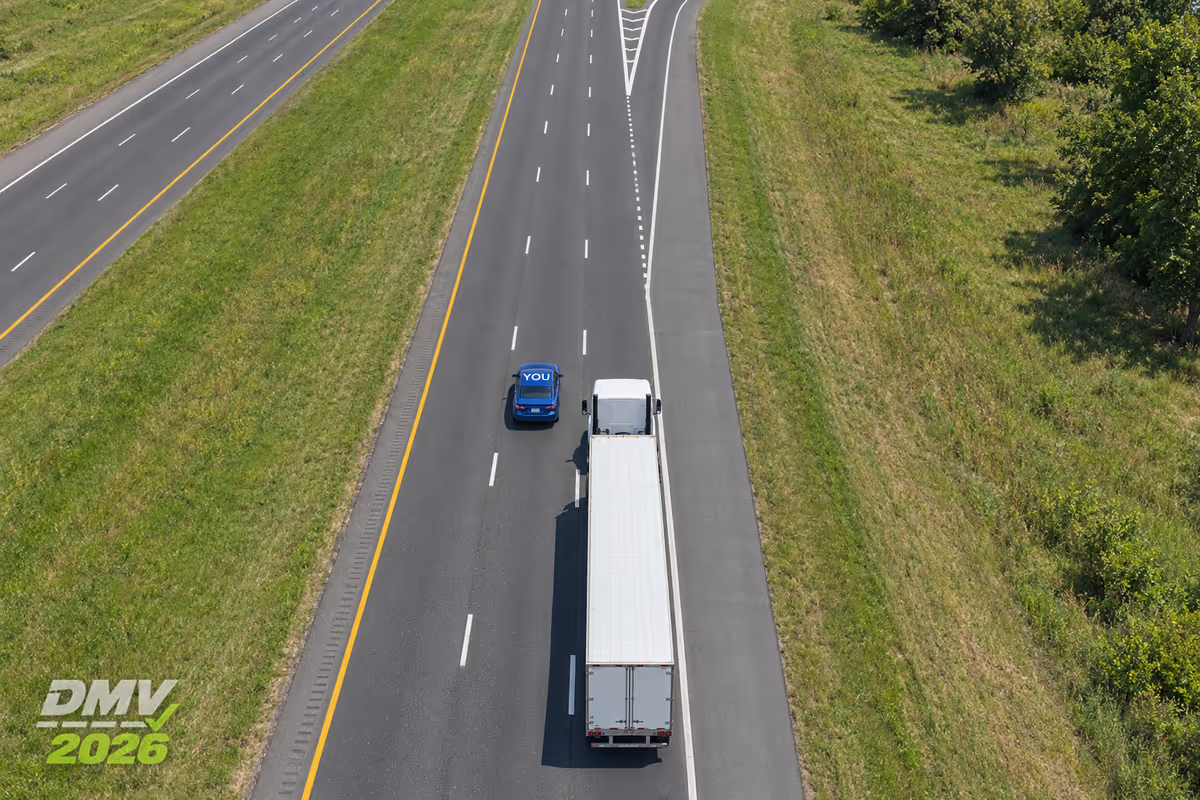
    Three-lane highway seen from above. Your car, marked YOU, is in the middle lane. A tractor-trailer is in the right lane just behind you, and an exit ramp leaves the highway on the right a short way ahead. The road is otherwise empty
    Your exit is just ahead. May you cut in front of this truck to reach it?
    Show the answer

    The answer is B: No. It needs more room to stop.

    A loaded truck needs far more room to stop than a car. If you cut in and then slow for the exit, the driver may not be able to stop or swerve in time. The few seconds you save are not worth it. Slow down, let the truck pass, and exit behind it.

    “Do not cut off a large vehicle in traffic or on the highway to reach an exit or turn or to beat a truck into a single-lane construction zone. The few seconds that might be saved are not worth a life. If the driver needs to swerve or change lanes, the chances of a crash are greatly increased.”

    AAMVA Model Driver’s License Manual, page 39
  7. Question 7 of 10 · Pavement markings

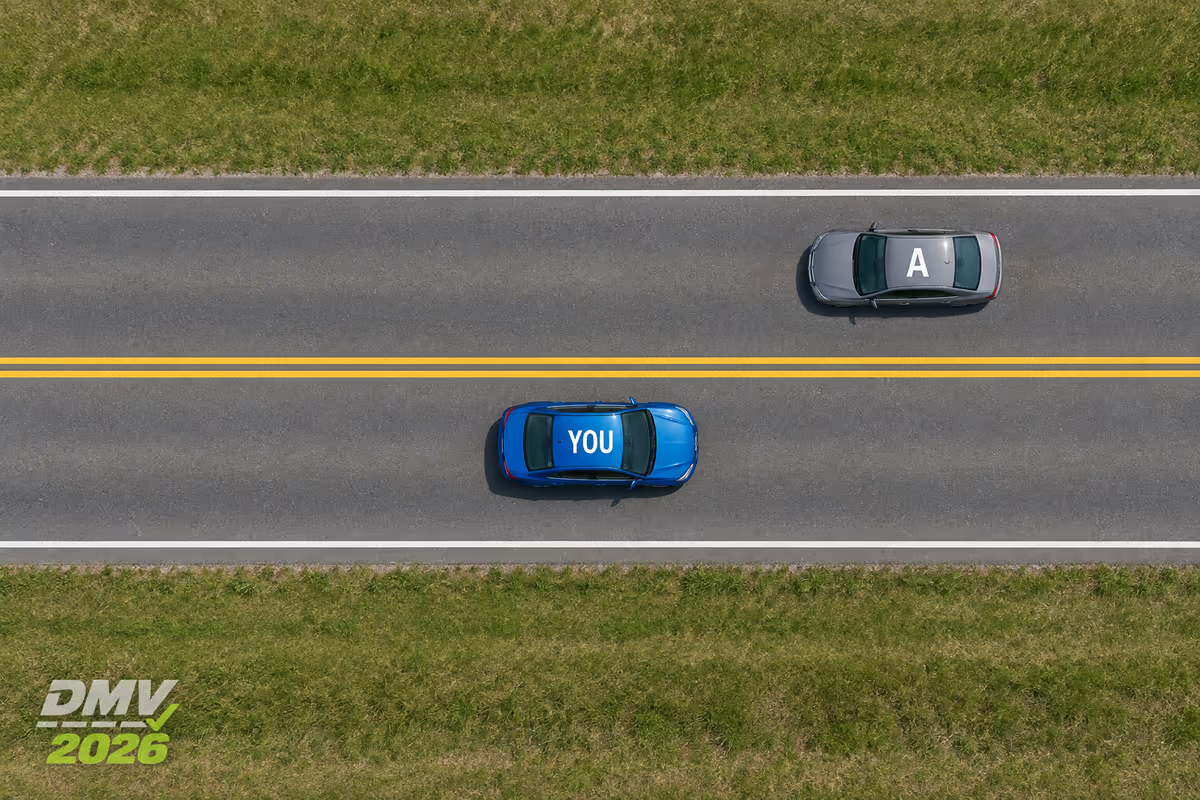
    Two-lane road seen from above with two solid yellow lines side by side down the middle, your car in the lower lane and an oncoming car in the upper lane
    What do these lines mean?
    Show the answer

    The answer is B: No passing in either direction.

    Two solid yellow lines mean neither direction may cross to pass. They are painted where passing is dangerous for everyone, like a busy road or a short view ahead. In most states you may still cross them to turn left into a driveway.

    “C. Two-direction no-passing zone markings consisting of two normal width solid yellow lines where crossing the center line markings for passing is prohibited for traffic traveling in either direction.”

    MUTCD, 11th Edition, page 581
  8. Question 8 of 10 · Distracted and aggressive driving

    What makes something a distraction while you drive?
    Show the answer

    The answer is B: It takes your attention off driving.

    A distraction is anything that takes your attention away from driving, even for a moment. It does not have to take your hands off the wheel or go on for long. One glance at a screen is enough to miss a brake light ahead. Pull over to deal with anything that needs your attention.

    “A distraction is anything that takes your attention away from driving.”

    AAMVA Model Driver’s License Manual, page 9
  9. Question 9 of 10 · Stopping distance and braking

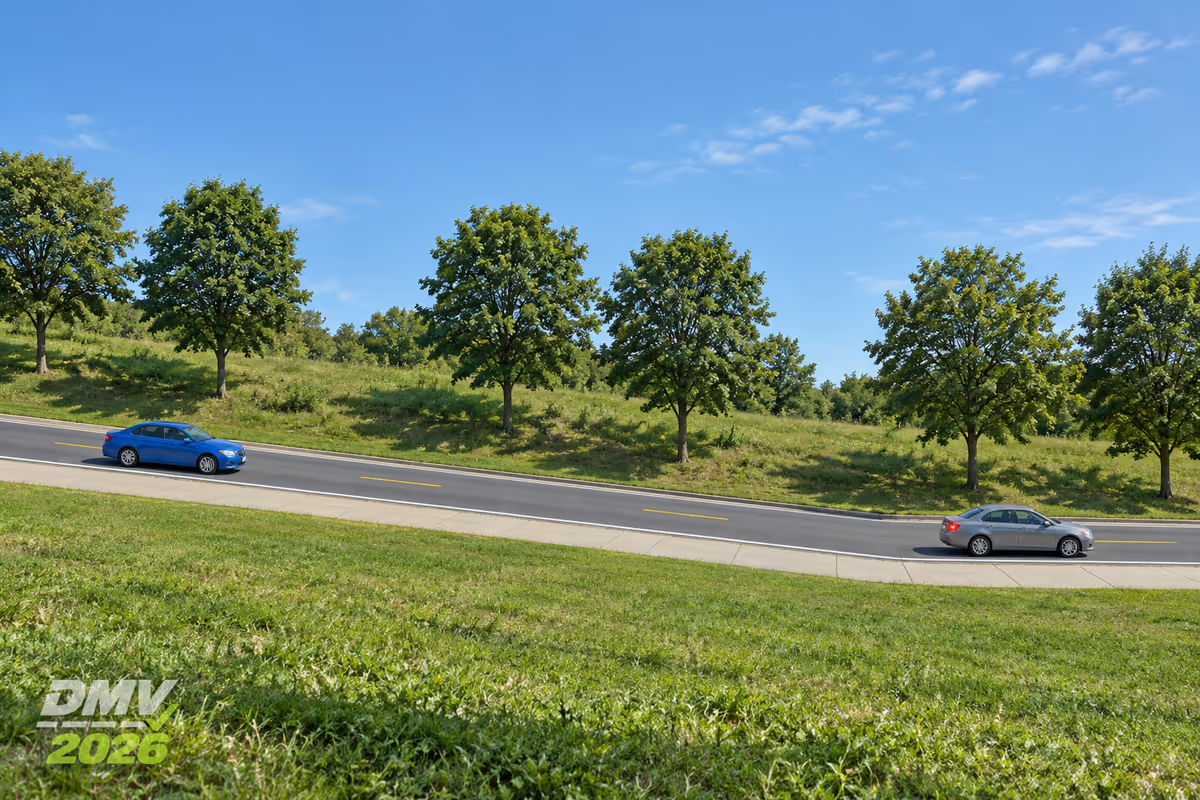
    Side view of a road sloping down from left to right. Your blue car is near the top of the hill, heading down. A grey car has stopped on the level stretch at the bottom with its brake lights on. The road between them is clear
    You must stop at the bottom of this hill. When should you start braking?
    Show the answer

    The answer is A: Sooner than you would on level ground.

    Going downhill, gravity pulls the car on while the brakes work against it. A stop takes more room than on level ground, so start braking sooner and keep more space ahead. The car does not slow by itself on a hill. It speeds up, even with your foot off the gas.

    “You are driving downhill - it is harder for your brakes to slow your vehicle, especially at high speeds.”

    Pennsylvania Driver's Manual, page 40
  10. Question 10 of 10 · Passing

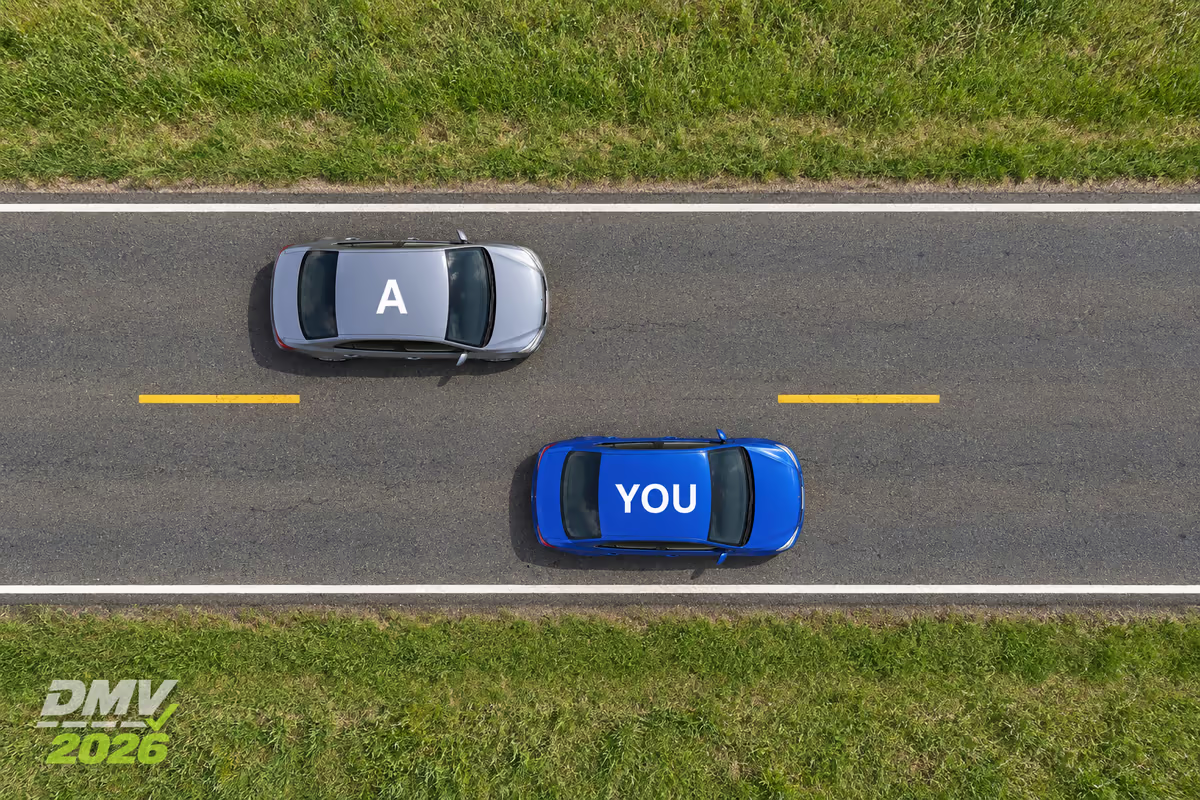
    Straight two-lane road seen from directly above, with a broken yellow center line. Your car is in the lower lane, pointing right. A grey car marked A is in the other lane, pointing the same way and level with the back of your car. The road ahead of both cars is empty
    Car A is passing you. What should you do?
    Show the answer

    The answer is B: Keep your speed and stay in your lane.

    Stay in your lane and keep a steady speed while another car passes you. Speeding up stretches the pass and keeps the other driver out in the oncoming lane longer. Slowing suddenly does not help either, since the driver judged the gap on the speed you were going.

    “Maintain a constant speed to allow the driver to pass you.”

    AAMVA Model Driver’s License Manual, page 28

These 10 questions are from the DMV Champ app’s practice set, last updated October 23, 2026. Spot a mistake in a question? Email us.

How many questions can you miss on the Missouri permit test?

5

You need 20 of the 25 right.

Missouri’s rules say you need 20 of the 25 questions right for a regular Class F license.

“Successful completion of a written examination requires the applicant for a Class F license to correctly answer twenty (20) out of twenty-five (25) questions.”

Missouri Department of Revenue, driver license rules (12 CSR 10-24), page 6

To get an instruction permit, you must pass a vision test, a road sign test and the written test.

“Pass the vision, road sign, and written tests.”

Missouri Driver Guide, page 17

DMV Champ uses the same format for Arkansas, Colorado, Connecticut, Iowa, Kansas, Nebraska, Nevada, North Carolina, North Dakota, South Dakota and Wyoming.

How old do you have to be to get an instruction permit in Missouri?

The youngest you can be is 15.

“Instruction Permit — Eligible Age: 15 This is the first step in Missouri’s Graduated Driver License Program for young drivers.”

Missouri Driver Guide, page 5

How do you take the Missouri permit test?

It’s given by the Missouri State Highway Patrol.

“The MSHP administers the driver examination.”

Missouri Driver Guide, page 20

The guide calls it the written test.

“To test your knowledge of traffic laws, you will need to take a written test of 25 multiple-choice questions.”

Missouri Driver Guide, page 4

The test is closed book, so you can’t look at the guide while you take it.

“The test is NOT an open book test.”

Missouri Driver Guide, page 20

The Highway Patrol or the Department of Revenue can tell you where your nearest testing center is.

“To find the testing center nearest you, contact the MSHP or the Department.”

Missouri Driver Guide, page 20

Test simulator

Practice in the Missouri format

25 questions20 to pass

DMV Champ teaches every question with its explanation, then checks you with 5 simulated tests of 25 questions, graded against the 20-correct passing score. 35 topics in Missouri: the 34 every state tests, plus winter driving, because the Missouri handbook teaches it.

Download on the App Store