West Virginia · Division of Motor Vehicles

West Virginia DMV practice test: 25 questions, 76% to pass

West Virginia’s knowledge test, given by the DMV, has 25 questions, and you need 19 right, or 76%, to pass.

25

questions

19

right to pass

76%

passing score

Timed

length not given

Checked against the West Virginia Driver’s Licensing Handbook (revised July 2026) on October 25, 2026. How we check facts

Practice test

Take a 10-question West Virginia DMV practice test

Pick an answer and check it. Every question comes with the reason behind the right answer and the sentence of an official document it rests on.

To pass here you need 8 of 10, since West Virginia’s test asks for 76%.

  1. Question 1 of 10 · Pavement markings

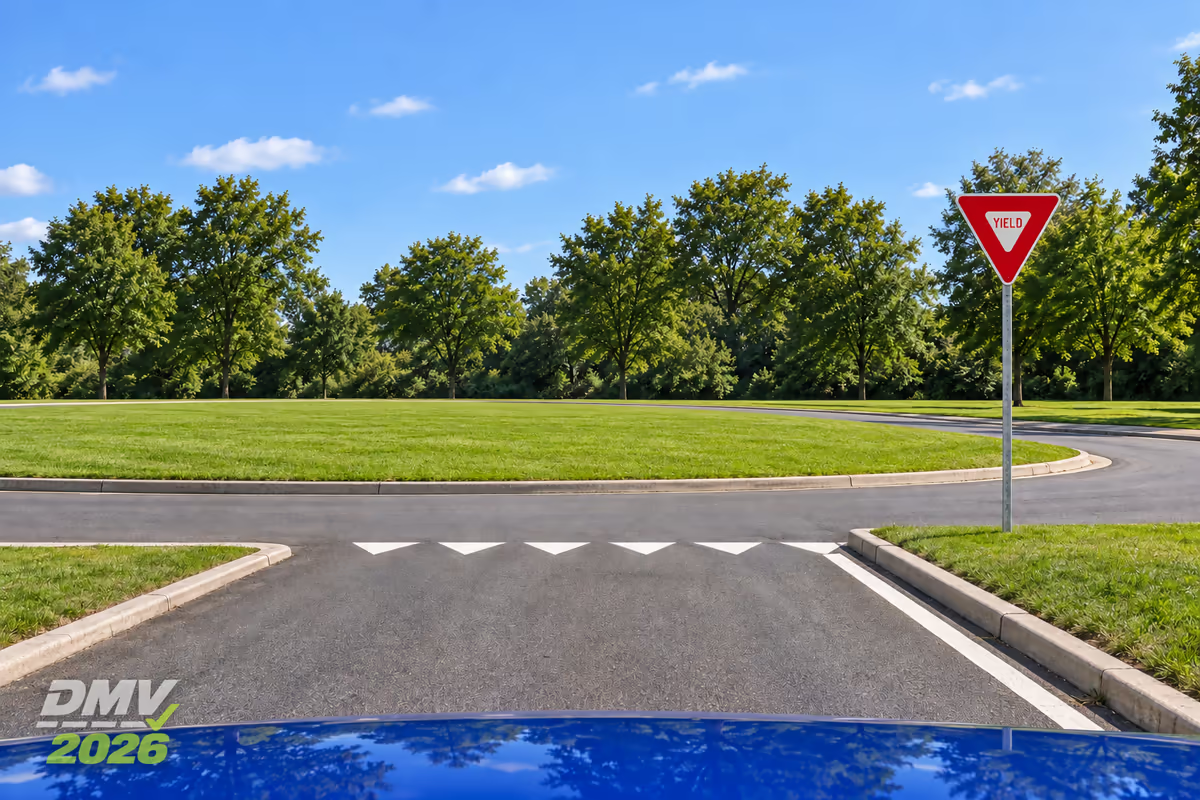
    Your lane from the driver's seat with a row of white triangles painted across it, their points aimed back toward your car
    Nothing is in the circle. Must you stop at this line?
    Show the answer

    The answer is A: No. Slow down and go when clear.

    A yield line is not a stop line. Slow down as you reach the triangles, look left for traffic in the circle, and go when the way is clear. Stop only when something is coming. A stop line is a solid bar, and that one always means a full stop.

    “Except as provided in Section 8C.03, stop lines shall not be used at locations where drivers are required to yield in compliance with a YIELD (R1-2) sign”

    MUTCD, 11th Edition, page 614
  2. Question 2 of 10 · Parking and stopping

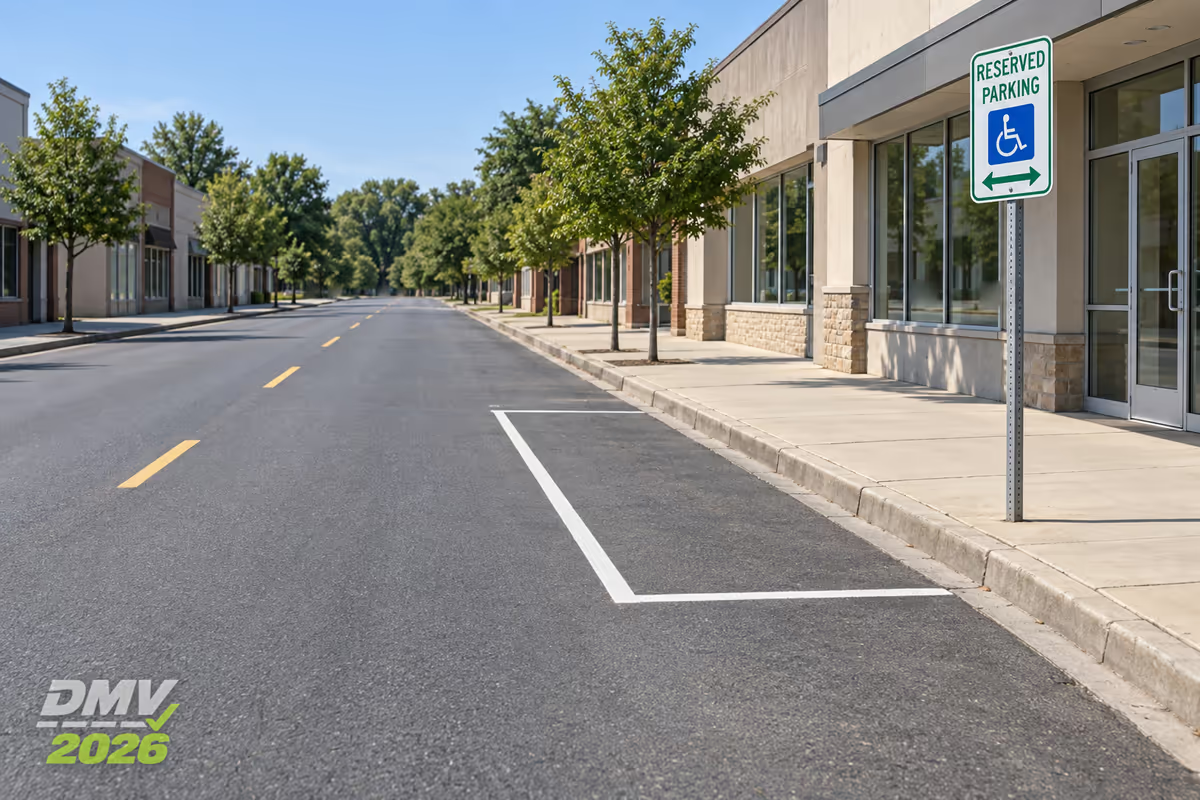
    City street seen from your car with an empty parking space at the right curb in front of a store, and a white sign on a post at the curb reading RESERVED PARKING in green above a blue square with the white wheelchair symbol and a green arrow pointing both ways
    Who may park in a space marked with this sign?
    Show the answer

    The answer is C: A car with a disability placard or plate.

    The space is for a car carrying the person the placard or plate was issued to. It sits close to the door because that person cannot walk far. A placard borrowed from a relative does not count, and neither does a quick stop.

    “Where parking spaces are reserved for persons with disabilities, the Accessible Parking (R7-8) sign (see Drawing D in Figure 2B-25) shall be used to designate the space and shall display the official International Symbol of Accessibility.”

    MUTCD, 11th Edition, page 167
  3. Question 3 of 10 · Motorcycles, trucks and buses

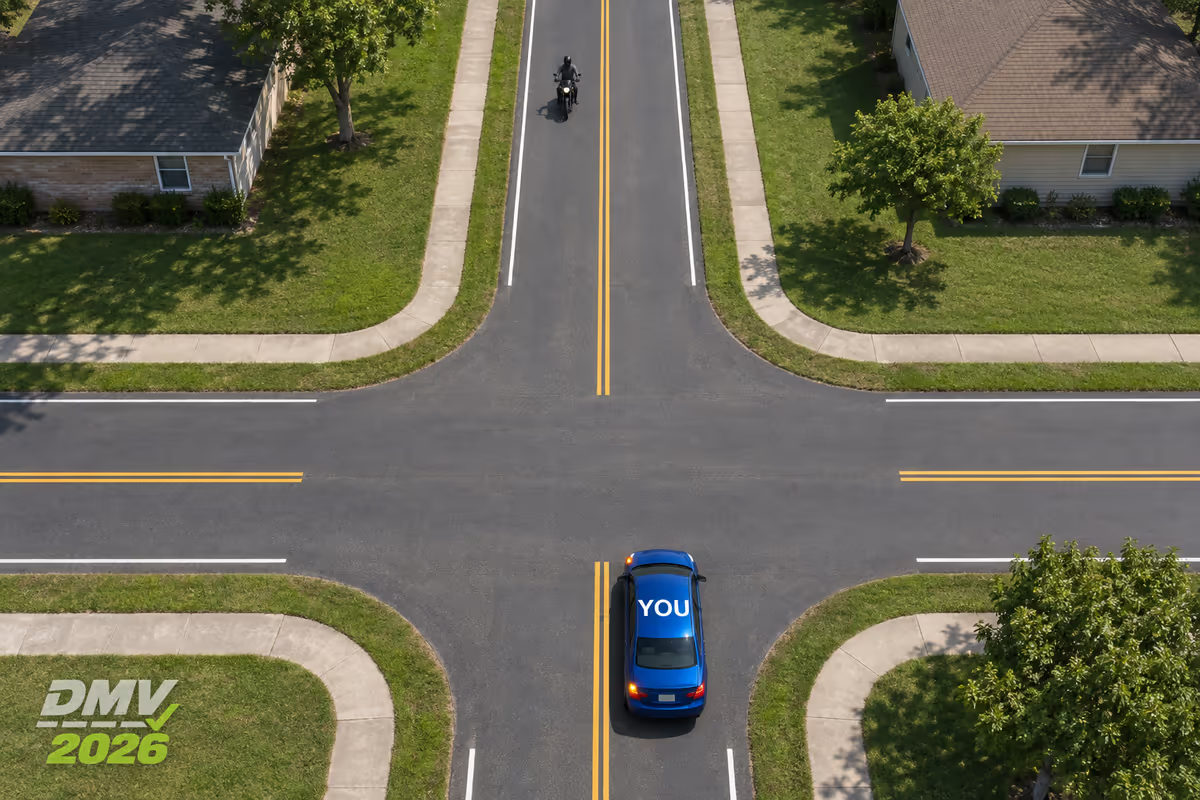
    Intersection seen from above. Your car, marked YOU, is stopped at the bottom approach with its left turn signal on. One motorcycle is coming toward you in the oncoming lane, some way back from the intersection. The rest of the road is empty
    You are waiting to turn left across this motorcycle's path. When do you go?
    Show the answer

    The answer is C: After it has passed.

    A motorcycle is small, so it can look farther away and slower than it really is. Many crashes happen when a driver turns left in front of an oncoming motorcycle. Look twice, and let it pass before you turn.

    “Motorcycles are small and therefore more difficult to see. Be aware that motorcycles can be part of the traffic mix. Always check your mirrors and blind spots for them.”

    AAMVA Model Driver’s License Manual, page 38
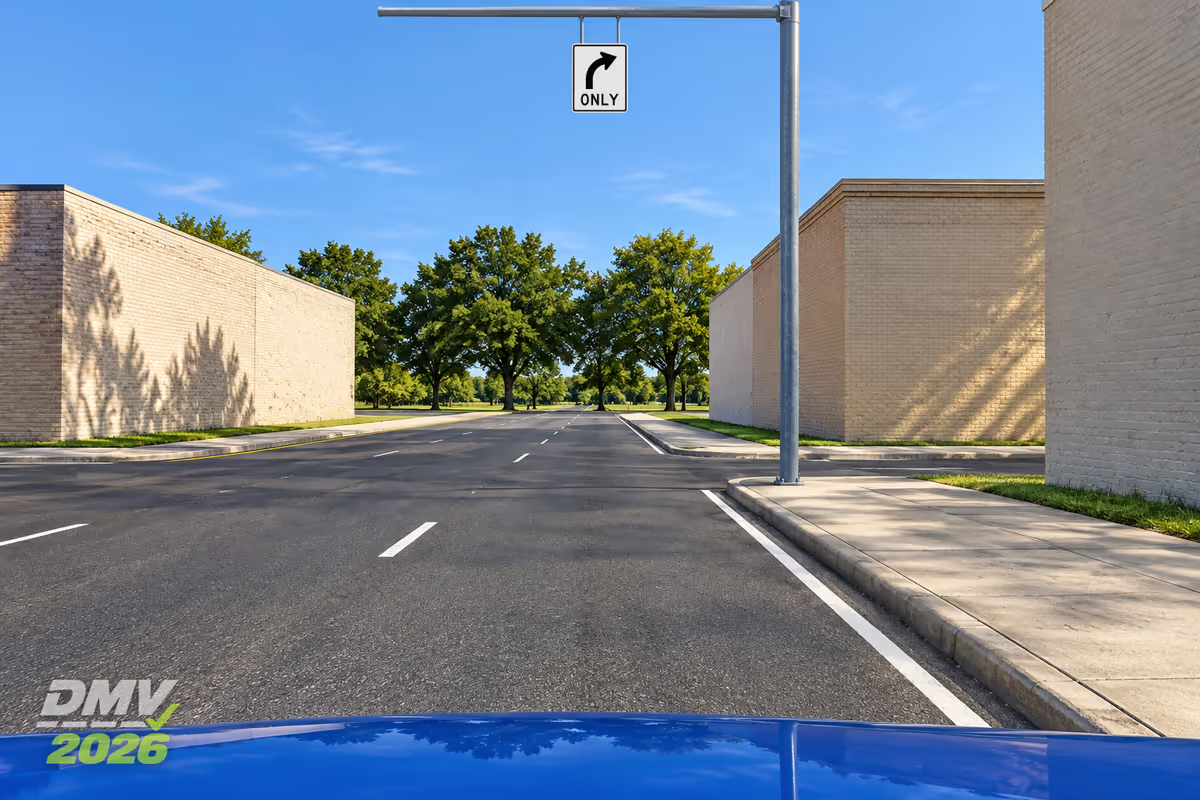
  4. Question 4 of 10 · Regulatory signs

    Three-lane street seen from your car in the right lane, with a white sign hanging over your lane showing a black right-curving arrow above the word ONLY
    You are in the lane under this sign. May you go straight?
    Show the answer

    The answer is B: No. Turn the way the arrow points.

    An arrow over the word ONLY is an order for that lane, not a suggestion. Once you are in it, the arrow is the only way you may leave the corner. Read the lane signs early, while you still have room to move over.

    “Mandatory Movement Lane Control (R3-5, R3-5a, and R3-7) signs (see Figure 2B-4), if used, shall indicate only the single vehicle movement that is required from the lane.”

    MUTCD, 11th Edition, page 133
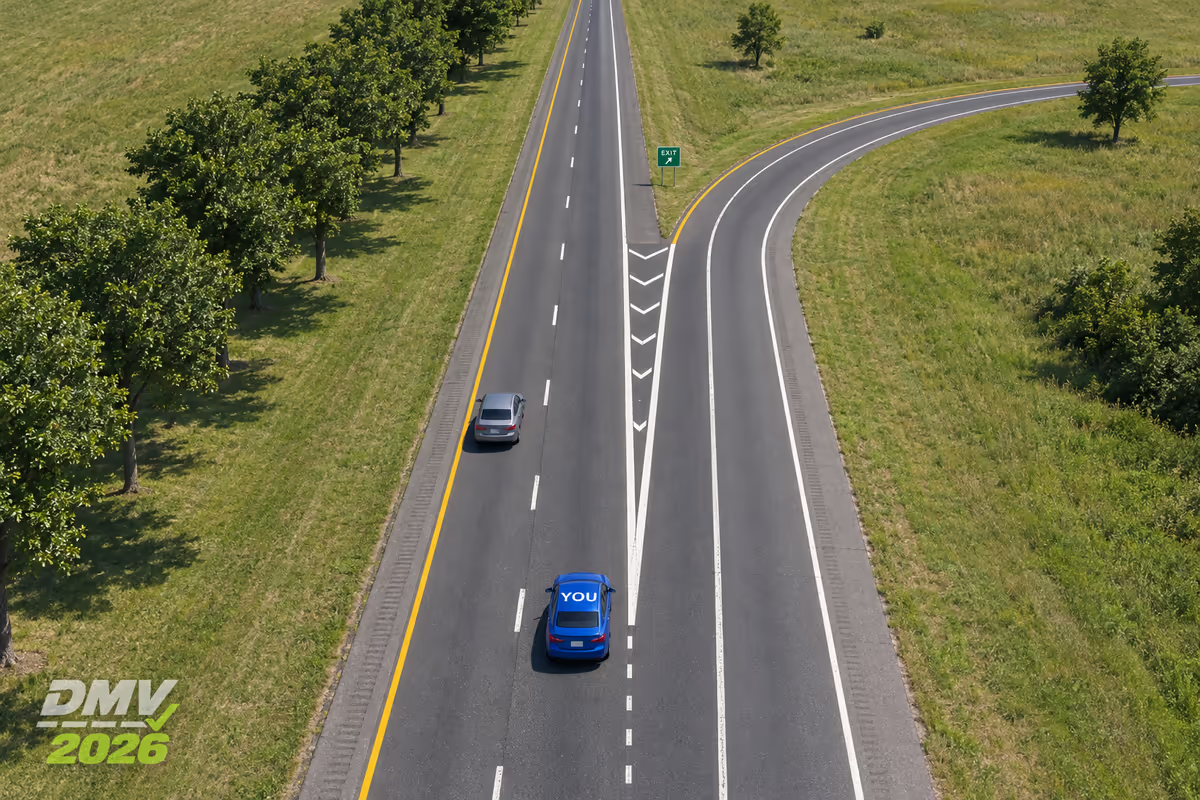
  5. Question 5 of 10 · Highways, merging and exits

    Freeway seen from above where an exit ramp splits off to the right. Between the ramp and the right lane is a long striped triangle edged by two solid white lines, with a green EXIT sign and arrow at its far end. Your car is in the right lane, level with the start of the triangle. One other car is in the left lane ahead
    What is the area between the ramp and the through lanes for?
    Show the answer

    The answer is C: Nothing. Do not drive on it.

    That is the gore area, and no car belongs on it. It separates the ramp from the through lanes, and in some states driving across it is against the law. Do not cut through it to catch the exit, and do not stop in it. A driver who missed the exit may try to cross it and hit you.

    “Do not stop in an exit gore (the triangular area between the through lane and the exit ramp). Another driver may try to cross the gore after missing the exit and strike your vehicle.”

    West Virginia Driver’s Licensing Handbook, page 69
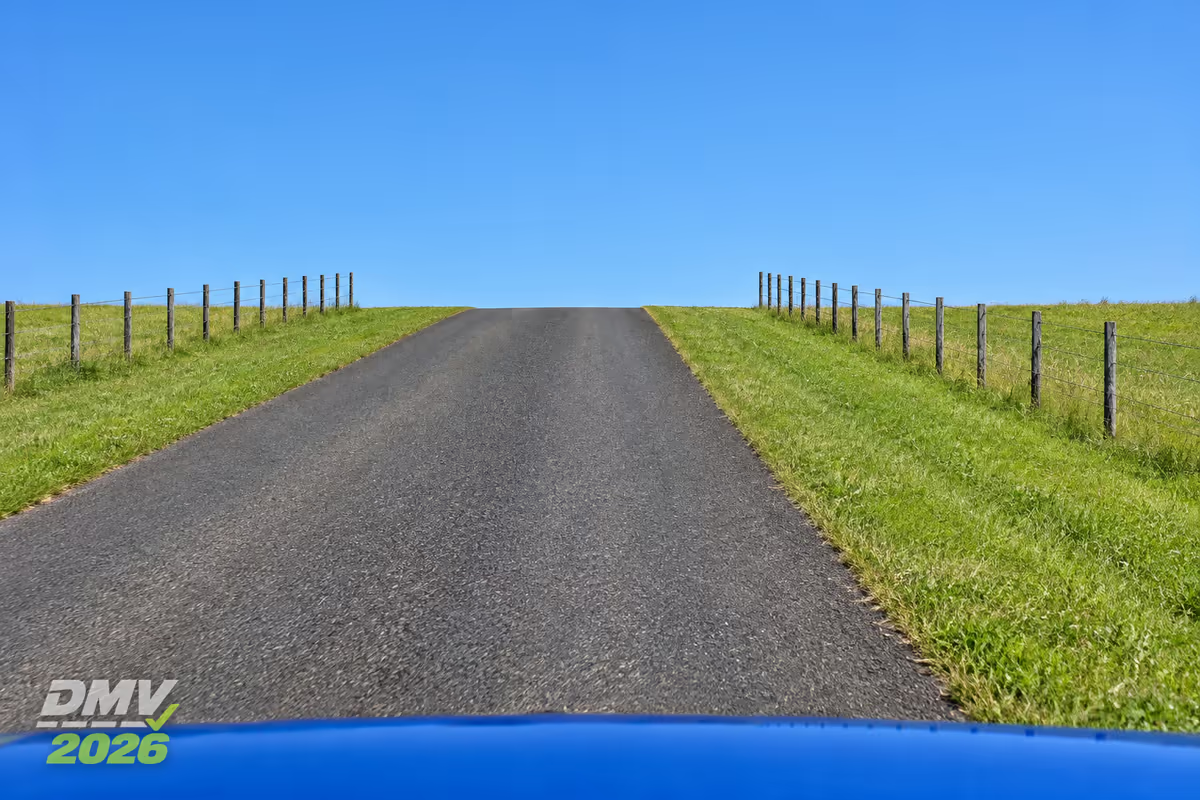
  6. Question 6 of 10 · Curves and hills

    Narrow two-lane country road seen from your car, climbing straight ahead to the top of a hill a short way on. Nothing past the top can be seen but sky
    You are nearing the top of this hill. What should you do?
    Show the answer

    The answer is A: Slow down and keep to the right.

    A hill hides the road beyond its top. A stopped car, or an oncoming car over the line, may be just past it. Slow down so you can stop in the road you can see, and keep to the right. Do not pull left to look over the top, since that is where an oncoming car would be.

    “Areas of reduced vision—Blind corners created by wooded areas, crops growing in fields and steep hills can limit how far you can see. In areas with reduced vision always reduce your speed and be prepared to stop.”

    AAMVA Model Driver’s License Manual, page 43
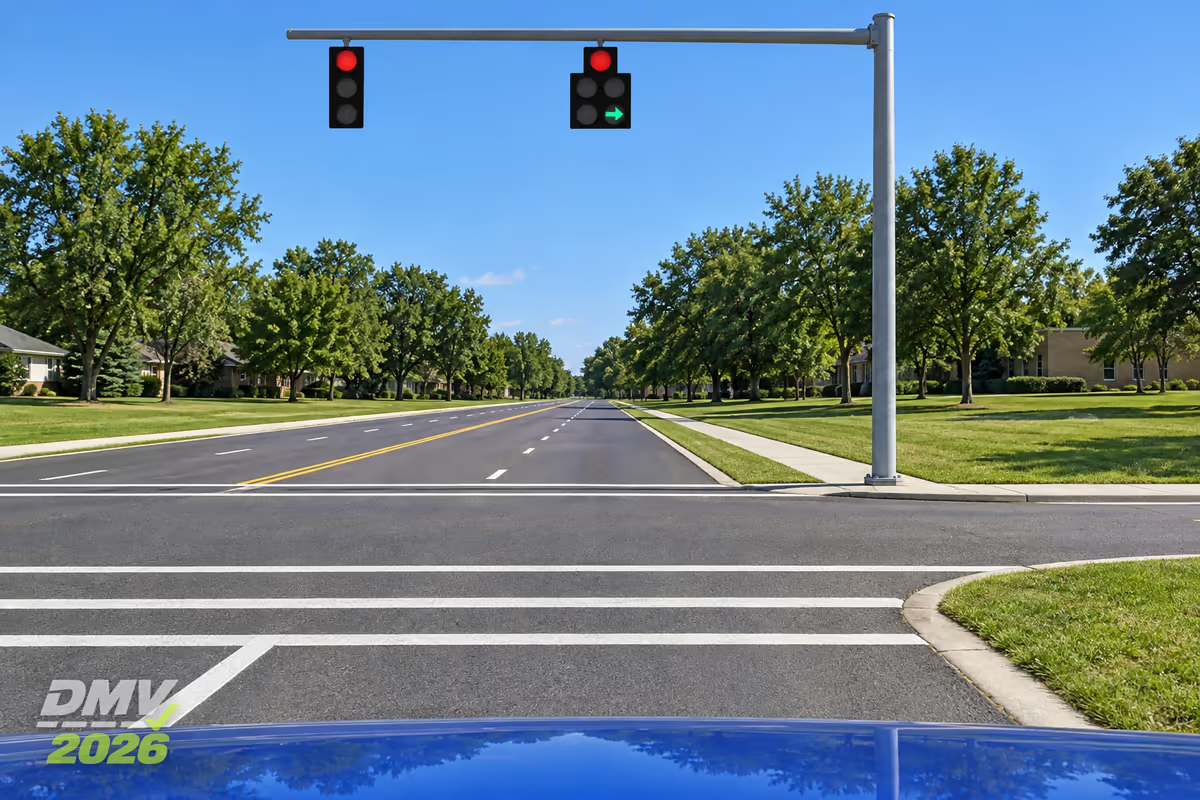
  7. Question 7 of 10 · Traffic signals and arrows

    Intersection seen from your car, with a five-section signal over your lane showing a round red lens lit at the top and, at the bottom right of the same head, a green arrow pointing right lit. The other three lenses are dark. There is a stop line and a crosswalk ahead, no arrow is painted in your lane, and there are no other cars
    The signal ahead shows this. What may you do?
    Show the answer

    The answer is B: Turn right, but not go straight.

    A green arrow beside a red light gives you one move and holds the rest. You may go the way the arrow points, without stopping, and nothing else. The arrow is protected, so the traffic that would cross your path has a red. Anyone walking across still goes first.

    “Vehicular traffic facing a GREEN ARROW signal indication, displayed alone or in combination with another signal indication, is permitted to cautiously enter the intersection only to make the movement indicated by such arrow”

    MUTCD, 11th Edition, page 684
  8. Question 8 of 10 · Fatigue, vision and health

    You turned the radio up and opened the window to stay awake. Is that enough?
    Show the answer

    The answer is A: No. Needing them is a warning sign.

    Needing the radio or the window to stay awake is itself a sign that you are too tired to drive. Noise and cold air help for a few minutes at most, and coffee wears off. The only cure for being tired is sleep. Stop at the next exit or rest area.

    “Watch for the warning signs of fatigue, such as having to turn up the radio or roll down the window to wake yourself up, having trouble keeping your eyes open or drifting from your lane.”

    Kansas Driving Handbook, page 21
  9. Question 9 of 10 · Stopping distance and braking

    If you double your speed, your braking distance grows about ____ times.
    Show the answer

    The answer is C: 4

    Braking distance grows much faster than speed. Double your speed and the brakes need about 4 times the road. Triple it and they need about 9 times. Many drivers guess twice the road, which is far too little.

    “Speed—The faster you are traveling, the more time and distance is needed to stop.”

    AAMVA Model Driver’s License Manual, page 30
  10. Question 10 of 10 · School buses and school zones

    You are following a school bus. Why leave more room than usual?
    Show the answer

    The answer is A: It stops at every railroad crossing.

    A school bus has to stop at every railroad crossing, train or no train. It also stops often to let children on and off. Leave extra room so you have time to stop when it does. Expect the stop even when no train is in sight.

    “There are certain situations when you would need more space in front of your vehicle.”

    AAMVA Model Driver’s License Manual, page 31

These 10 questions are from the DMV Champ app’s practice set, last updated October 23, 2026. Spot a mistake in a question? Email us.

How many questions can you miss on the West Virginia permit test?

6

You need 19 of the 25 right.

The test has 25 questions, and you need 19 right to pass.

“You must answer 19 out of the 25 questions correctly to pass the test.”

West Virginia Driver’s Licensing Handbook, page 34

How old do you have to be to get an instruction permit in West Virginia?

The youngest you can be is 15.

“You must be at least 15 years of age.”

West Virginia Driver’s Licensing Handbook, page 19

The handbook calls it an instruction permit.

“The Level 1 GDL instruction permit allows you to learn how to operate a motor vehicle with a licensed adult driver over the age of 21.”

West Virginia Driver’s Licensing Handbook, page 19

What happens if you fail the West Virginia permit test?

If you fail, you must wait a week before you can take the test again.

“Applicants who fail either the knowledge or road skills test may not be tested twice within a period of one (1) week, in accordance with §17B-2-6, West Virginia State Code.”

West Virginia Driver’s Licensing Handbook, page 36

How do you take the West Virginia permit test?

It’s given by the DMV.

“The vision and knowledge tests are administered by driver examiners at DMV designated locations.”

West Virginia Driver’s Licensing Handbook, page 19

The handbook calls it the knowledge examination.

“The knowledge examination has at least 25 questions based on the basic knowledge, traffic rules, regulations, signs, and markings found in the handbook.”

West Virginia Driver’s Licensing Handbook, page 34

The test has a time limit, and any question you haven’t answered when time runs out counts as wrong.

“There is a time limit on the test and any questions not answered in the prescribed time will be considered incorrect.”

West Virginia Driver’s Licensing Handbook, page 34

You can take the written test online.

“Applicants may take the written test Online.”

West Virginia Driver’s Licensing Handbook, page 19

If reading is hard for you, you can take an audio version of the test with headphones.

“Audio versions of the knowledge examination are available for the reading impaired. The test is administered with headphones.”

West Virginia Driver’s Licensing Handbook, page 34

The DMV may let you use a translator.

“At the Division’s discretion, the applicant may use a translator.”

West Virginia DMV, driver’s license exam rules (91 CSR 4)

Every testing location uses automated testing.

“Automated testing is given at all locations.”

West Virginia Driver’s Licensing Handbook, page 34

Test simulator

Practice in the West Virginia format

25 questions19 to pass

DMV Champ teaches every question with its explanation, then checks you with 5 simulated tests of 25 questions, graded against the 19-correct passing score. 36 topics in West Virginia: the 34 every state tests, plus winter driving and flooding, because the West Virginia handbook teaches them.

Download on the App Store