New Mexico

New Mexico permit practice test

DMV Champ’s simulated tests for New Mexico use 25 questions, with 18 right to pass.

25 (DMV Champ’s figure, not confirmed by an official source)

questions

18 (DMV Champ’s figure, not confirmed by an official source)

right to pass

72% (DMV Champ’s figure, not confirmed by an official source)

passing score

* The figures DMV Champ’s simulated tests use, not confirmed by an official source.

Checked against the New Mexico Driver Manual on October 25, 2026. How we check facts

Practice test

Take a 10-question New Mexico permit practice test

Pick an answer and check it. Every question comes with the reason behind the right answer and the sentence of an official document it rests on.

To pass here you need 8 of 10, the 72% DMV Champ’s simulated tests use.

  1. Question 1 of 10 · Guide and service signs

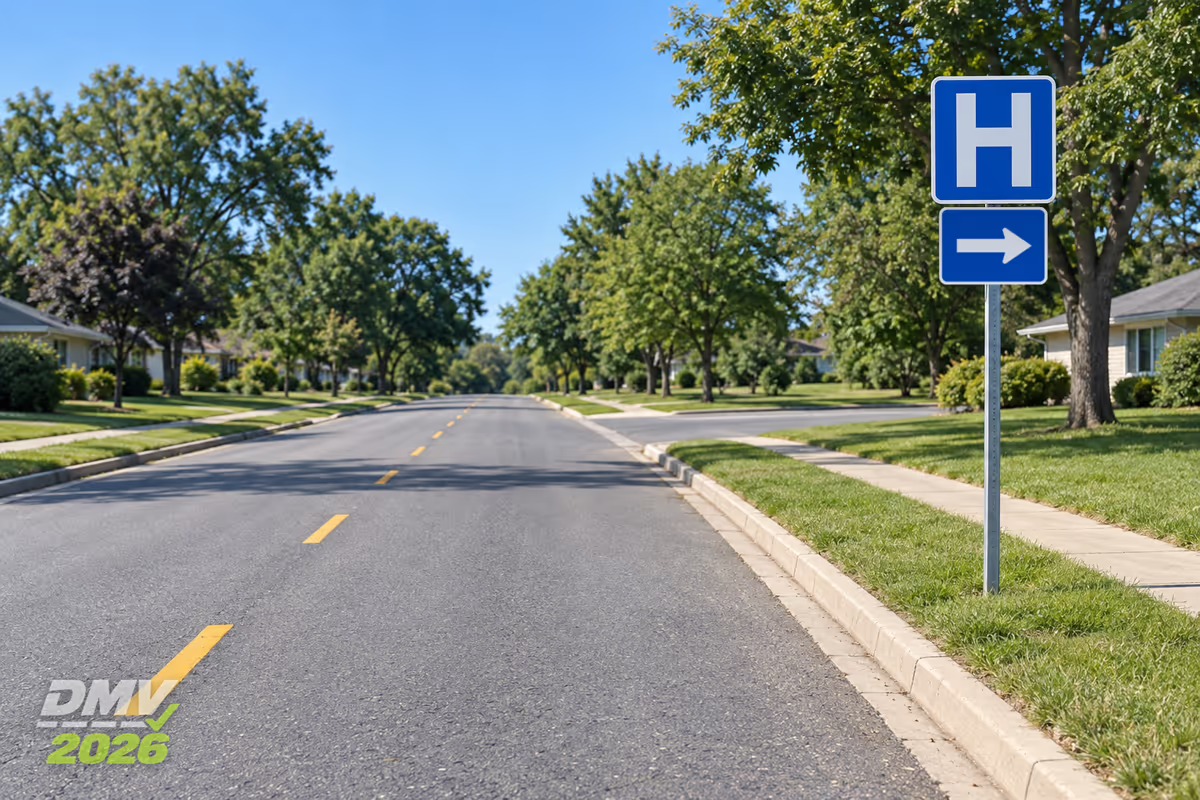
    Blue square sign with a white letter H, with a small blue plaque under it carrying a white arrow pointing right, on a post beside a two-lane town road
    What does this sign point you to?
    Show the answer

    The answer is B: A hospital.

    A white H on blue means a hospital, and the sign is posted only for one that is open day and night. If someone in the car is hurt, follow the H. The arrow or the distance on the sign shows the way in.

    “Use of the Hospital (D9-2) sign or the HOSPITAL (D9-13aP) plaque (see Figure 2I-1) shall be limited to facilities that operate 24 hours per day, 7 days per week.”

    MUTCD, 11th Edition, page 516
  2. Question 2 of 10 · Turn signals, horn and lights

    A broken-down car on the shoulder should have its ____ on.
    Show the answer

    The answer is C: hazard lights

    Hazard lights, the four-way flashers, tell every driver that your car is stopped and in trouble. Get the car as far off the road as you can, then turn them on. A turn signal says you are about to move, which is the wrong message from a car that cannot.

    “Turn on your emergency flashers to show your vehicle is disabled.”

    AAMVA Model Driver’s License Manual, page 35
  3. Question 3 of 10 · Stopping distance and braking

    Which part of a stop can paying attention make shorter?
    Show the answer

    The answer is C: The part before you brake

    An alert driver sees a hazard sooner and gets a foot on the brake sooner. The car then covers less road before the brakes come on. Once they are on, your speed, your tires, your brakes and the road decide the rest. Being tired or distracted stretches the first part.

    “Perception time, reaction distance and braking distance are affected by weather, visibility, and your mental and physical condition. Braking distance is also affected by how fast your vehicle is traveling, the condition of your brakes and tires, and the pavement condition.”

    Virginia Driver's Manual, page 17
  4. Question 4 of 10 · Traffic signals and arrows

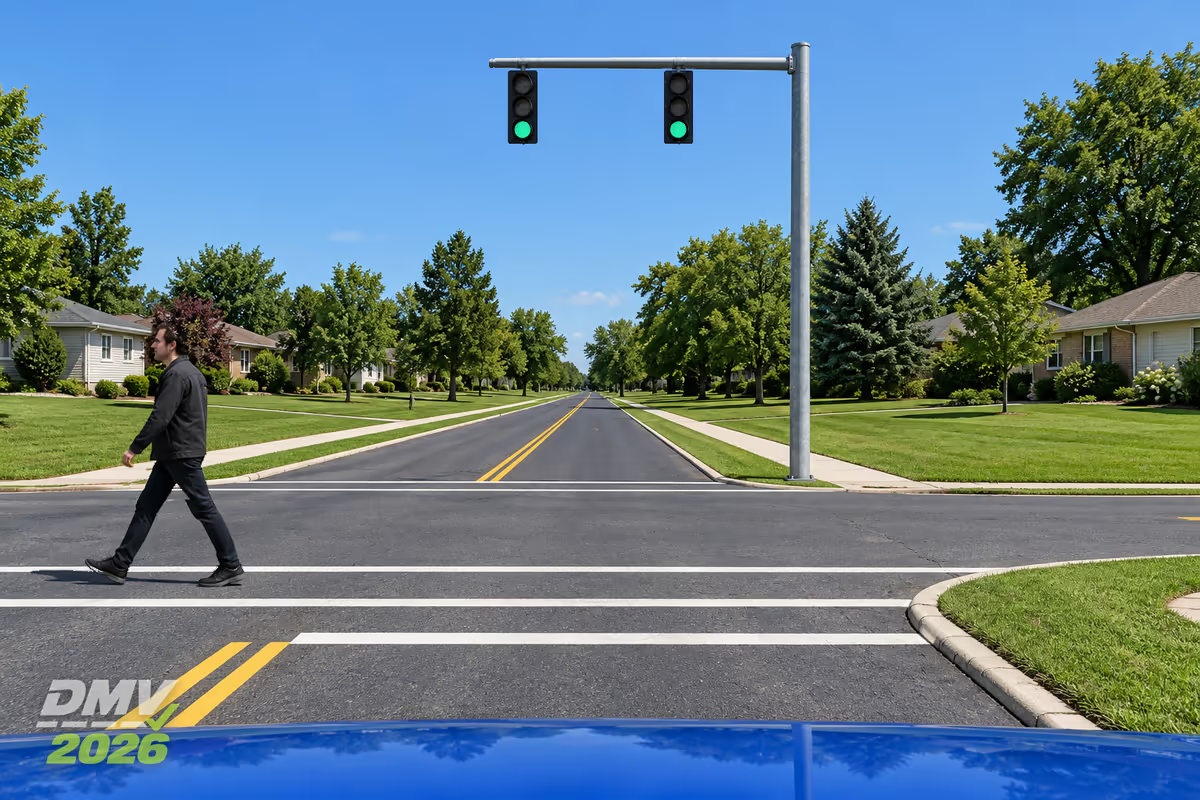
    Street seen from your car, stopped at the line with the signal over the intersection showing green. One person is walking across the crosswalk in front of you, two thirds of the way across and not yet at the far curb. There are no other cars
    You have a green light. Someone is still crossing in front of you. What do you do?
    Show the answer

    The answer is B: Wait until they are across.

    A green light does not cancel a person's right to finish crossing. Anyone already in the crosswalk goes first, green or not. Wait until they reach the curb. Edging forward only frightens people and gains you nothing.

    “You must yield the right of way to all pedestrians in the intersection even if the traffic light is green.”

    AAMVA Model Driver’s License Manual, page 36
  5. Question 5 of 10 · Passing

    You have passed a truck. What tells you it is safe to move back in front of it?
    Show the answer

    The answer is A: Its whole front shows in your rearview mirror.

    Move back only when the whole front of the truck shows in your rearview mirror, then signal and ease over. A truck is long, so this takes further than you expect. Cut in early and you leave the truck no room to slow down.

    “Continue to pass until the complete front of the passed vehicle is visible in your rearview mirror.”

    AAMVA Model Driver’s License Manual, page 28
  6. Question 6 of 10 · Pedestrians and bicyclists

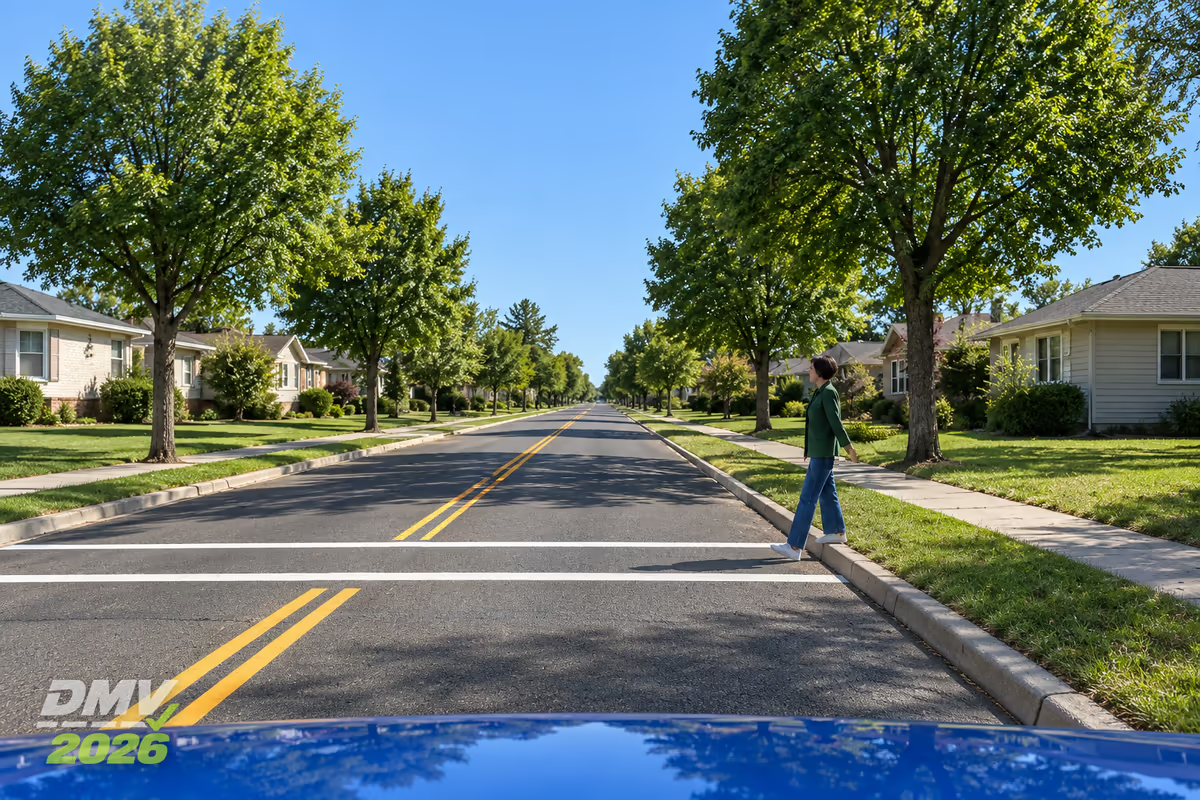
    Quiet street seen from your car. Two white lines are painted across the road ahead, forming a crosswalk. A person at the right-hand curb is stepping off the curb into the crosswalk. There are no signs, signals or other traffic
    A person starts across here. What must you do?
    Show the answer

    The answer is B: Let them finish crossing before you go.

    A person in a crosswalk has the right of way, painted or not. Slow down, stop if you need to, and wait until they are out of your path. Do not creep forward or tap the horn to hurry them. A person on foot has no protection if you get it wrong.

    “Pedestrians are difficult to see and it is difficult to determine their intentions.”

    AAMVA Model Driver’s License Manual, page 36
  7. Question 7 of 10 · Pavement markings

    A solid white line runs along the right edge of the road. What does it mark?
    Show the answer

    The answer is A: The edge of the road.

    The white edge line shows where the road ends. In rain, fog and darkness it is often the easiest line to see, so use it to hold your place. Beyond it is the shoulder, not a lane.

    “right edge line pavement markings, if used, shall consist of a normal width solid white line to delineate the right-hand edge of the roadway.”

    MUTCD, 11th Edition, page 603
  8. Question 8 of 10 · Licensing, insurance and penalties

    You cause a crash. What does your liability insurance pay for?
    Show the answer

    The answer is B: The harm you did to other people.

    Liability insurance pays for injuries and damage you cause to other people and their property when a crash is your fault. It does not fix your own car. That is collision coverage, which the law does not require. Each state sets its own minimum amounts, and most states make you carry at least those.

    “Liability and property damage are the most important type of automobile insurance you should have. It protects you against financial loss when bodily injury or property damage occurs.”

    Vermont Driver's License Manual, page 68
  9. Question 9 of 10 · Rain, fog and slick roads

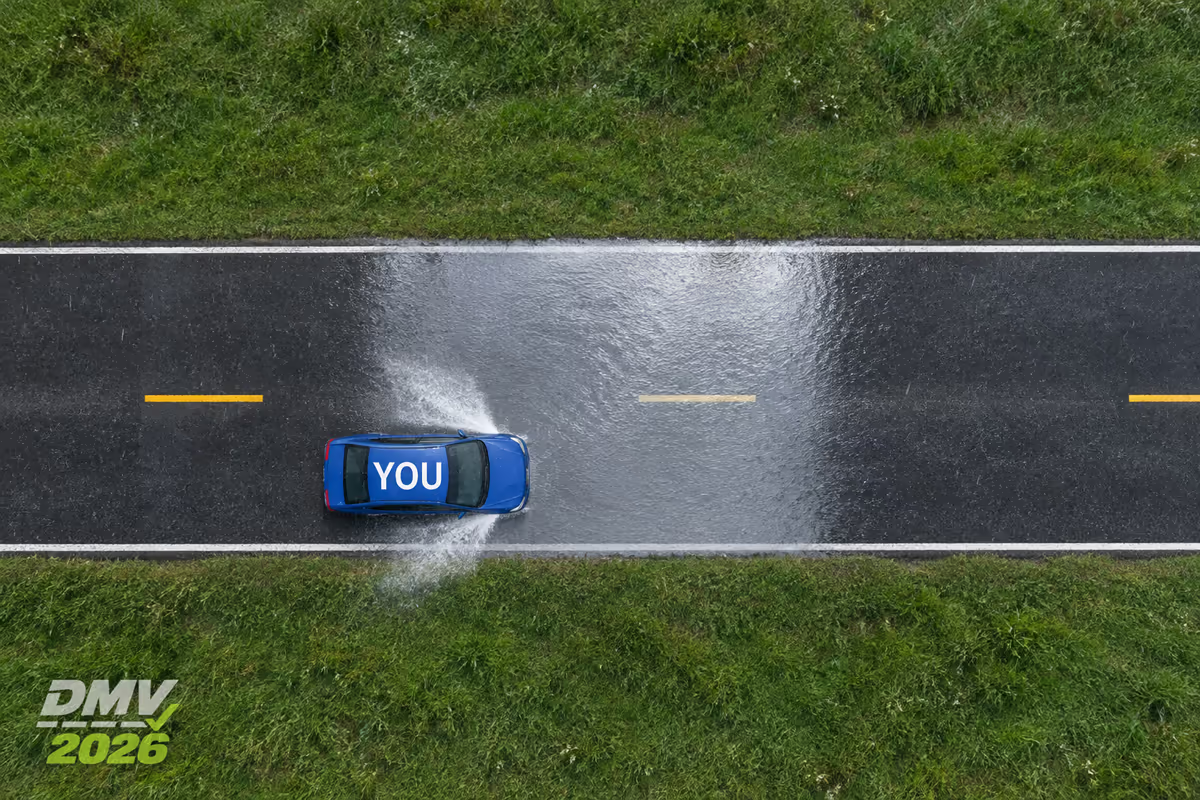
    Road seen from directly above in rain. A wide sheet of shallow water lies across both lanes. Your car, marked YOU, has driven straight into it in the lower lane, with spray thrown out from its front tires
    What is happening to this car?
    Show the answer

    The answer is A: It is hydroplaning.

    Hydroplaning is the tires riding up on a film of water, like water skis. The faster you go, the less the tread can push the water out of the way, until the tire floats. A tire on water cannot steer or brake, and this can start well under highway speed.

    “Hydroplaning occurs when the steering tires start to ride up on any pooled water, similar to the action of water skis. The best way to avoid traction loss from hydroplaning is to slow down in the rain or when the road is wet with pooled water or water puddles.”

    AAMVA Model Driver’s License Manual, page 30
  10. Question 10 of 10 · Right-of-way

    Two drivers stop at an all-way stop at the same time. The one on the ____ goes first.
    Show the answer

    The answer is B: right

    When two drivers reach an all-way stop together, the driver on the left yields to the driver on the right. If one of you stopped first, that driver goes first instead. Being on the main road counts for nothing at an all-way stop, since every road there has a stop sign.

    “You should yield the right of way to”

    AAMVA Model Driver’s License Manual, page 19

These 10 questions are from the DMV Champ app’s practice set, last updated October 23, 2026. Spot a mistake in a question? Email us.

How many questions can you miss on the New Mexico permit test?

On DMV Champ’s 25-question simulated test, you can miss 7.

Those figures aren’t confirmed by an official source.

You need a score of at least 70% to pass the written test.

“All class D and M written test scores must be 70% or better to pass.”

New Mexico MVD, road and written test requirements

How old do you have to be to get an instructional permit in New Mexico?

The youngest you can be is 15.

“The minimum age for an instructional permit is 15 years of age.”

New Mexico Driver Manual, page 4

The manual calls it an instructional permit.

“To obtain an instructional permit you must be at least 15 years of age and pass the knowledge test and vision test.”

New Mexico Driver Manual, page 4

How do you take the New Mexico permit test?

You can take the test in English, Spanish, Tagalog, Italian, German, French, Vietnamese or Chinese.

“Knowledge exams are available in English, Spanish, Tagalog, Italian, German, French, Vietnamese, and Chinese.”

New Mexico MVD, road and written test requirements

Test simulator

Practice in the New Mexico format

25 questions18 to pass

DMV Champ teaches every question with its explanation, then checks you with 5 simulated tests of 25 questions, graded against the 18-correct passing score. 35 topics in New Mexico: the 34 every state tests, plus winter driving, because the New Mexico handbook teaches it.

Download on the App Store