Kentucky · State Police

Kentucky permit practice test: 80% to pass

Kentucky’s knowledge test is given by the Kentucky State Police, and you need 80% to pass. DMV Champ’s simulated tests use 40 questions.

40 (DMV Champ’s figure, not confirmed by an official source)

questions

32 (DMV Champ’s figure, not confirmed by an official source)

right to pass

80%

passing score

* The figures DMV Champ’s simulated tests use, not confirmed by an official source.

Checked against the Kentucky Driver Manual on October 25, 2026. How we check facts

Practice test

Take a 10-question Kentucky permit practice test

Pick an answer and check it. Every question comes with the reason behind the right answer and the sentence of an official document it rests on.

To pass here you need 8 of 10, since Kentucky’s test asks for 80%.

  1. Question 1 of 10 · Traffic signals and arrows

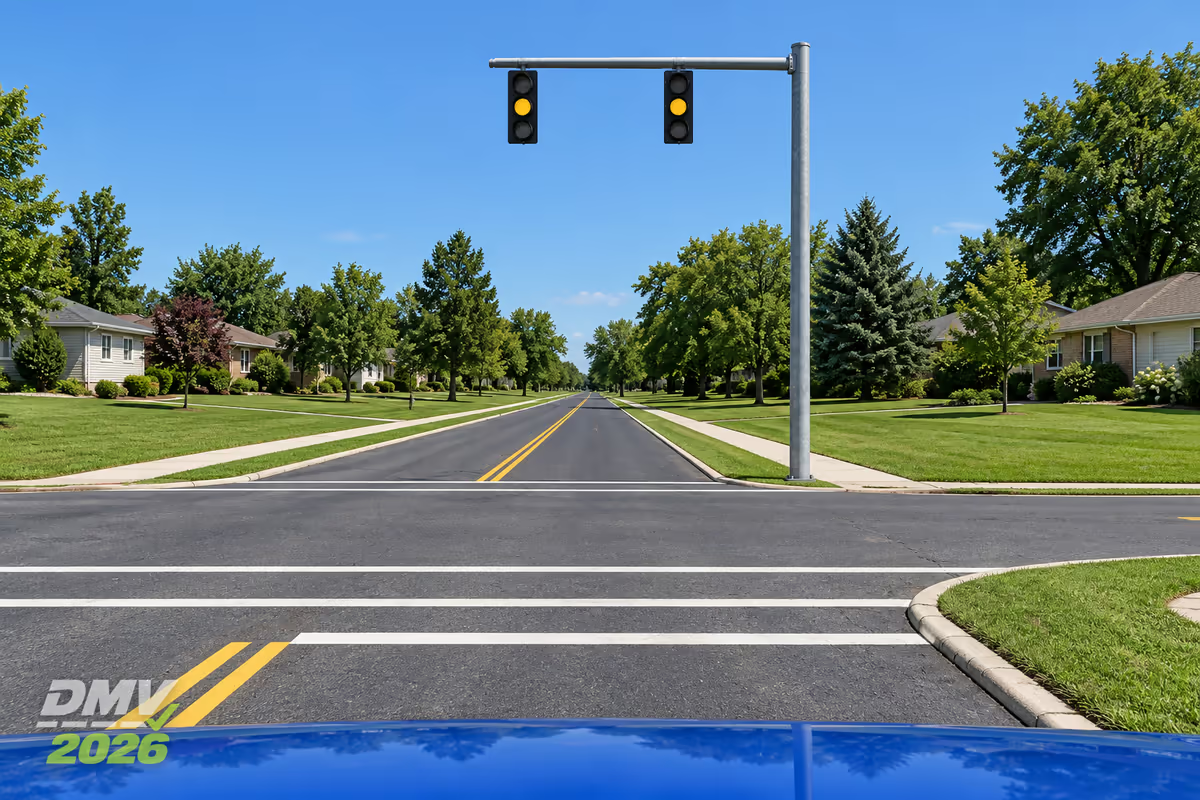
    Street seen from your car, with a traffic signal hanging over the intersection ahead. The signal has three round lenses one above the other, and the middle one is lit yellow while the other two are dark. There is a stop line and a crosswalk across your lane, and no other cars
    The yellow light comes on when you are too close to stop smoothly. What now?
    Show the answer

    The answer is B: Keep going at your speed.

    A yellow light asks you to stop only if you can do it without a sudden, hard stop. If you are too close, keep going at the speed you are doing and clear the intersection. Braking hard can put the car behind you into your trunk, or leave you stopped on the crosswalk.

    “If you cannot stop safely, cautiously cross the intersection.”

    California Driver's Handbook, page 39
  2. Question 2 of 10 · Turns and U-turns

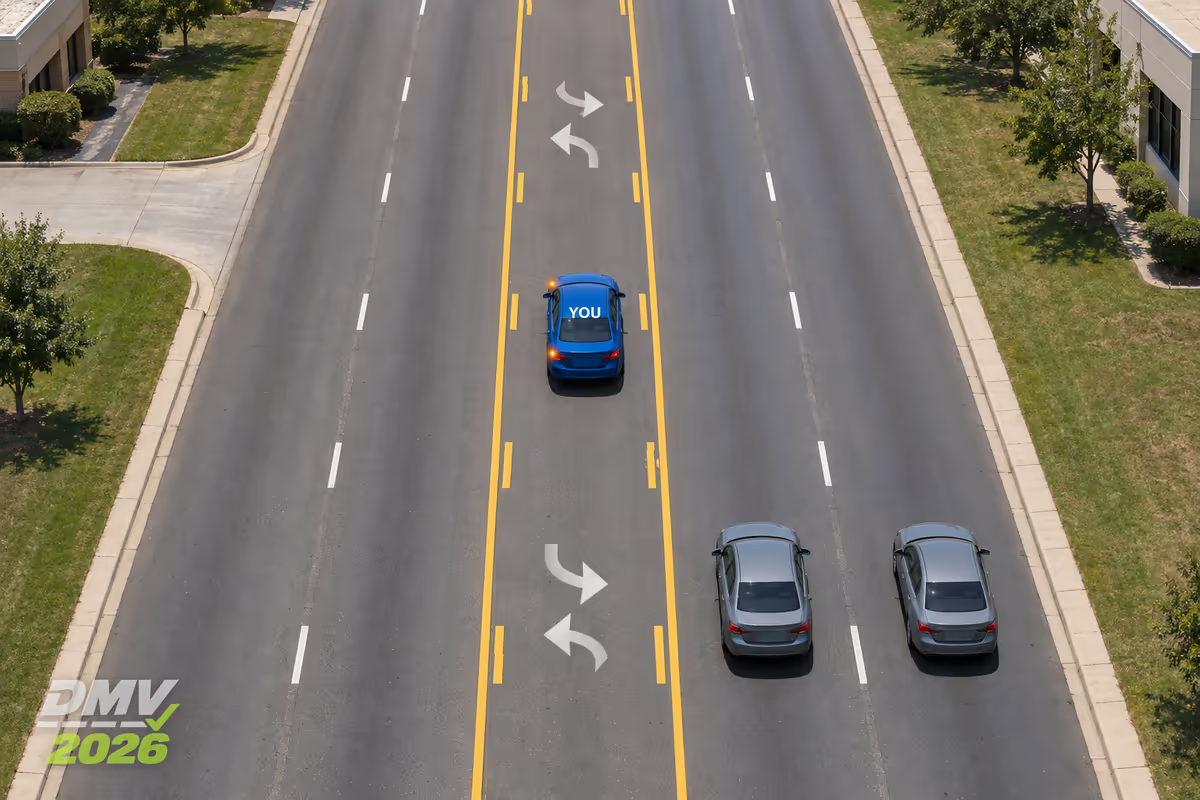
    Street seen from above with two lanes each way and a center lane between them, marked by yellow lines and painted with left-turn arrows pointing both ways. Your car waits in the center lane with its left signal on, just before a driveway on the left. Two grey cars are in the lanes going your way; the oncoming lanes and the rest of the center lane are empty
    You are in the middle lane, waiting to turn left. Who else may use it?
    Show the answer

    The answer is B: A driver from the other way, turning left.

    Drivers from both directions share the center lane to turn left. Look for a car coming toward you in it before you pull in. Nobody may drive along it or pass in it. Signal, enter it shortly before your turn, and wait there for a gap.

    “Shared Center Lane Left Turn Only—This sign tells you where a lane is reserved for the use of left turning vehicles from either direction and is not to be used for through traffic or passing other vehicles.”

    AAMVA Model Driver’s License Manual, page 22
  3. Question 3 of 10 · Flooding and high water

    The flood water has drained off the road. Is it safe to drive at normal speed?
    Show the answer

    The answer is C: No. The road may give way under you.

    A road weakens under flood water. The ground beneath it can be washed out while the surface still looks whole. Then the pavement can collapse under the weight of a car. Drive slowly the first time over a road that was under water, even when it looks the same as before.

    “Roads weaken under floodwater and drivers should proceed cautiously after waters have receded since the road may collapse under the vehicle’s weight.”

    Texas Driver Handbook, page 56
  4. Question 4 of 10 · Warning signs

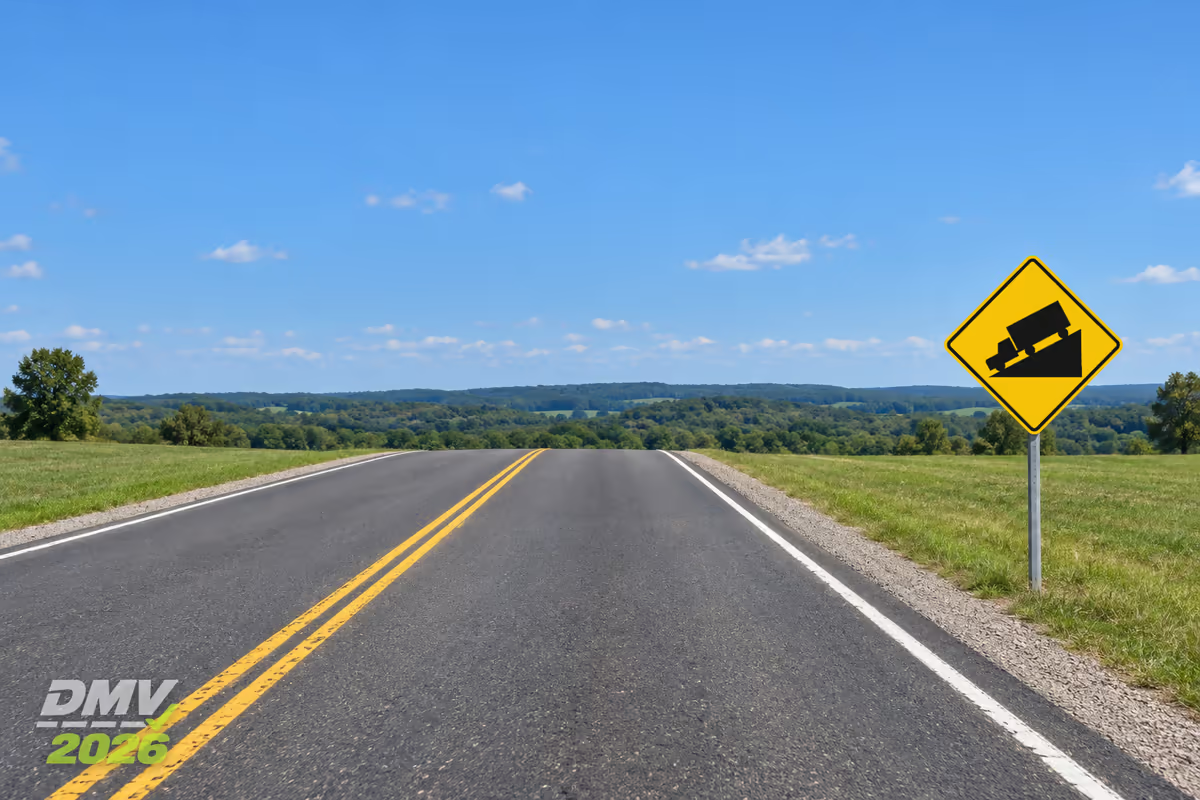
    Yellow diamond sign on a post at the right of a two-lane road, showing a black truck heading down a slope. The road behind it crests and drops out of sight toward hills. No vehicles
    This sign means
    Show the answer

    The answer is A: a steep downhill grade ahead.

    A truck on a slope is the hill sign. It stands before a long or steep downgrade, often with a plaque giving the grade in percent. Slow down before you start down, not partway down. A USE LOW GEAR plaque under it means a lower gear will help hold your speed.

    “The Hill (W7-1) sign (see Figure 2C-5) should be used in advance of a downgrade where the length, percent of grade, horizontal curvature, and/or other physical features require special precautions on the part of road users.”

    MUTCD, 11th Edition, page 208
  5. Question 5 of 10 · Right-of-way

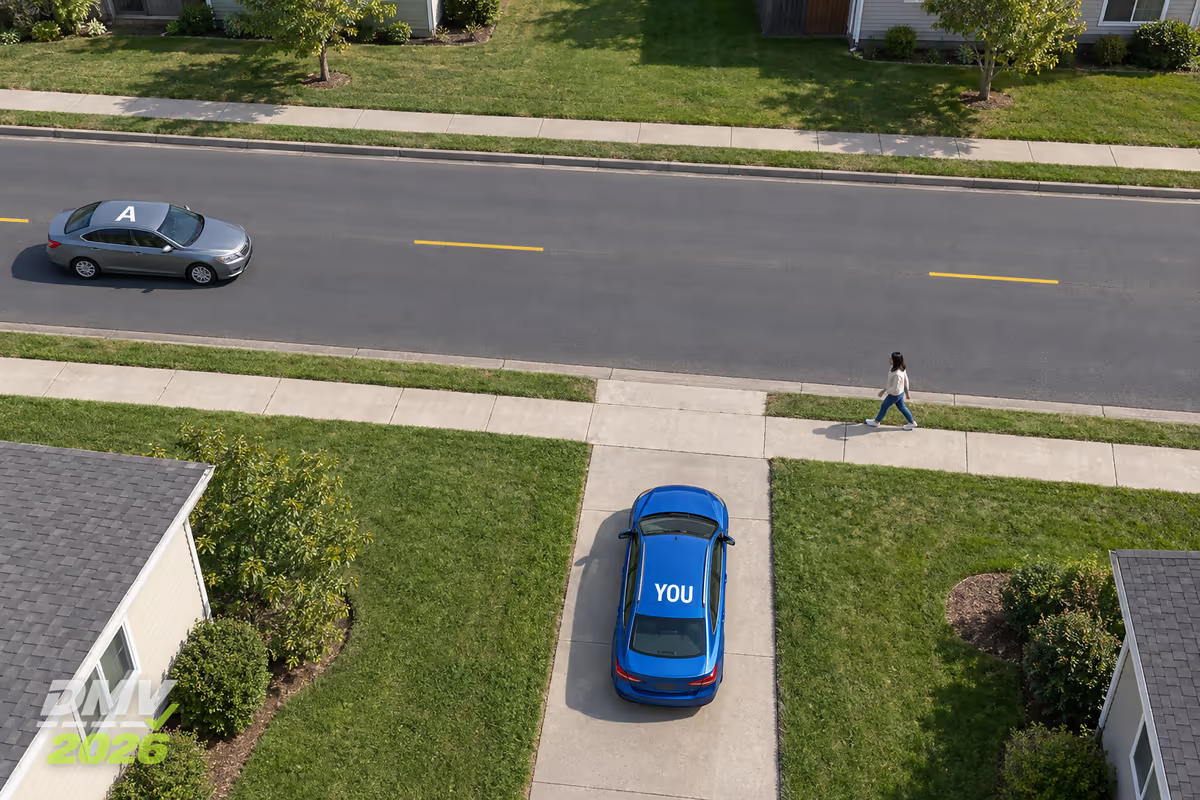
    Driveway seen from above. Your car is in the driveway, facing a street, stopped before the sidewalk. A person is walking along the sidewalk toward your car, and a car marked A is coming along the street from your left
    Who goes first here?
    Show the answer

    The answer is B: The person on the sidewalk.

    Coming out of a driveway, you yield to everything else. Stop before the sidewalk and let the person pass. Then move up far enough to see the street and wait for a gap in traffic. Car A goes before you, but the person on the sidewalk goes before both of you.

    “drivers on a public highway if you are entering the highway from a driveway or a private road;”

    AAMVA Model Driver’s License Manual, page 19
  6. Question 6 of 10 · Motorcycles, trucks and buses

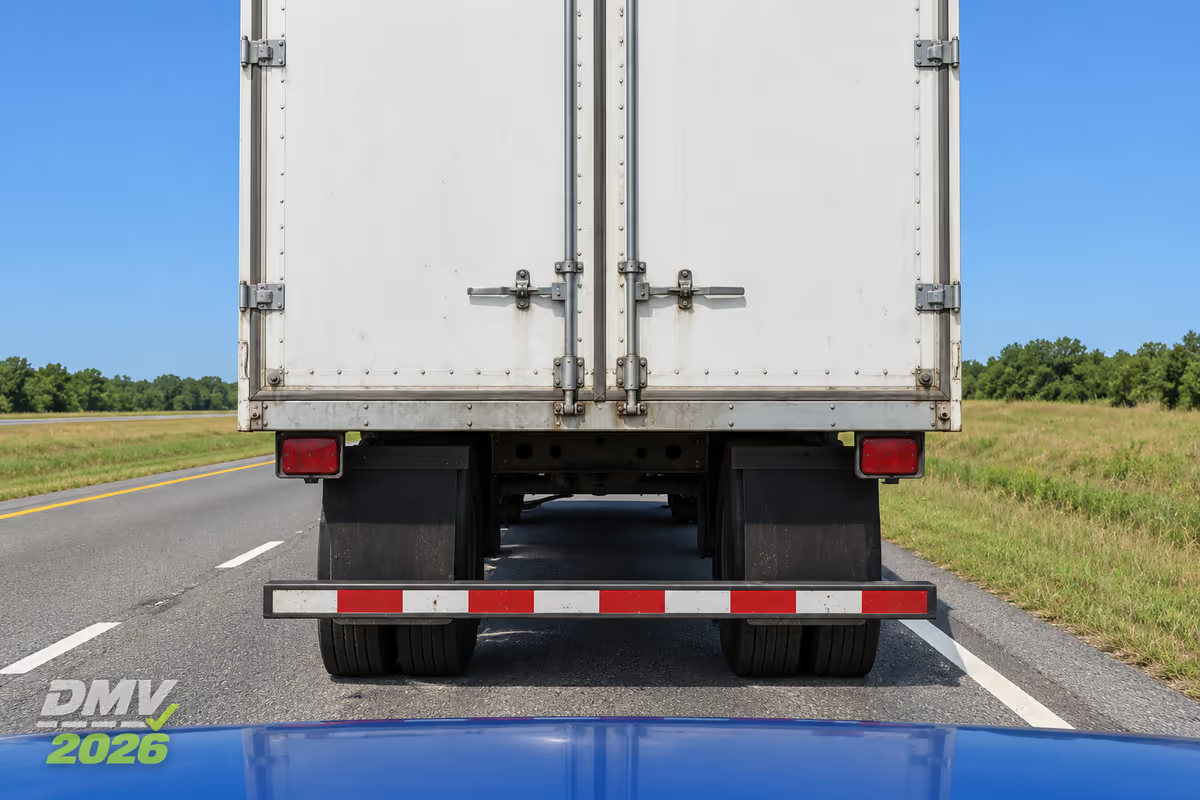
    View from your car very close behind a large white trailer, which fills most of the view. Only the trailer's rear doors, bumper and wheels can be seen, and nothing of the road ahead of it
    Behind a truck, stay far enough back to see its ____.
    Show the answer

    The answer is A: side mirrors

    If you cannot see a truck's side mirrors, its driver cannot see you. The blind spot behind a truck reaches back a long way, up to 200 feet. This close, you cannot see the road ahead of it either. Drop back until both mirrors come into view.

    “Unlike cars, large vehicles have huge blind spots directly behind them that extend up to 200 feet. If you are too close, the large vehicle cannot see your car, and you cannot see what is ahead of you.”

    AAMVA Model Driver’s License Manual, page 39
  7. Question 7 of 10 · Pavement markings

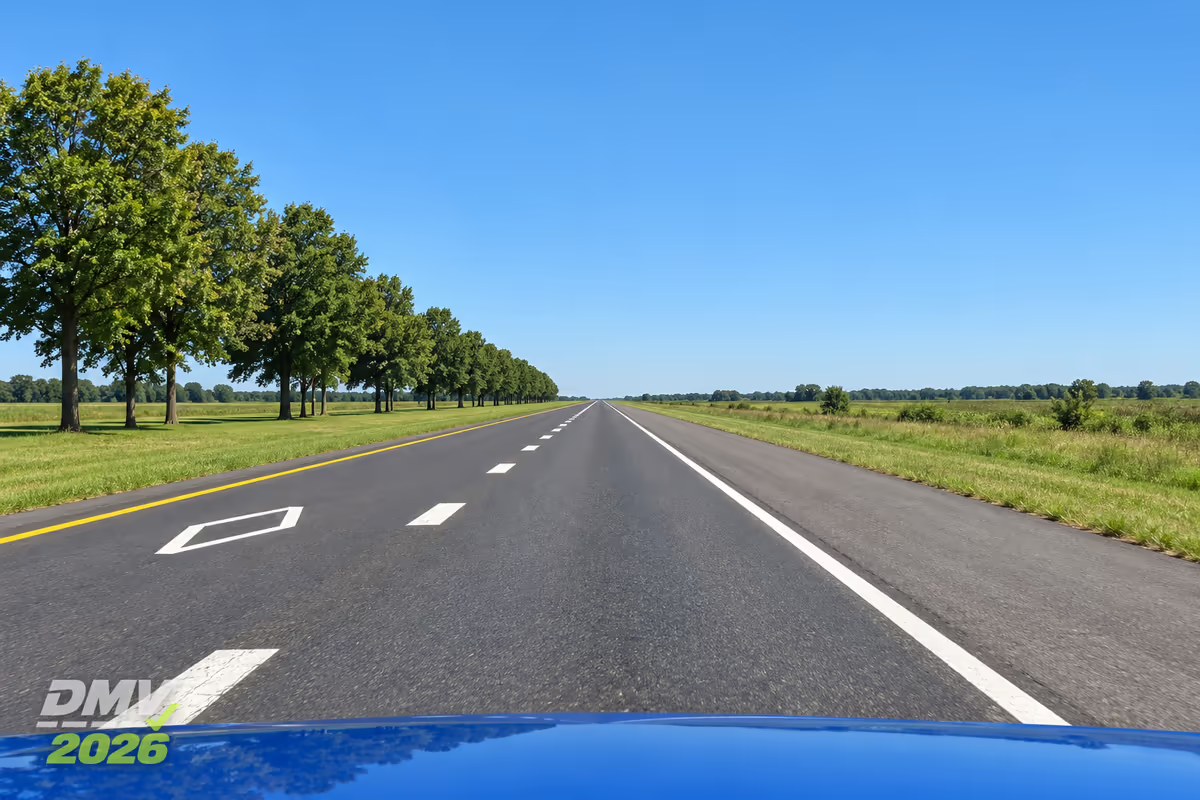
    Highway from the driver's seat, your car in the right lane, and a white diamond painted on the pavement of the lane to your left
    What does the diamond painted in the lane mean?
    Show the answer

    The answer is A: The lane is reserved for certain vehicles.

    A diamond marks a reserved lane. A sign nearby says who may use it, usually carpools, buses or bicycles, and during which hours. Read the sign before you move into the lane.

    “Diamond Symbol: This symbol indicates the lane is reserved lanes for buses, HOV (High-Occupancy Vehicles) like car-pools and van-pools, bicycles or other special vehicles. You cannot enter and use these lanes unless your vehicle complies with”

    New York State Driver's Manual and Practice Tests, page 33
  8. Question 8 of 10 · Fatigue, vision and health

    A new medicine's label says it may cause drowsiness. May you drive after taking it?
    Show the answer

    The answer is C: Not until you know how it affects you.

    A drowsiness warning means the medicine can make you slow and sleepy at the wheel, and you may not feel it coming. Find out how it affects you somewhere other than the driver's seat. If you are not sure, ask your doctor or pharmacist. A smaller dose is still a dose, and a short trip is still driving.

    “Check the labels of your medications and be aware if they cause drowsiness.”

    AAMVA Model Driver’s License Manual, page 9
  9. Question 9 of 10 · Night driving and headlights

    May you wear sunglasses at night to cut headlight glare?
    Show the answer

    The answer is C: No. They cut the light you need.

    Take sunglasses and tinted lenses off after dark. They cut down the light you need to see the road, even when oncoming headlights bother you. The same goes for overcast days. For glare, look toward the right edge of the road instead.

    “Do not wear sunglasses or colored lenses when driving at night or on overcast days. Tinted or colored lenses reduce your vision.”

    AAMVA Model Driver’s License Manual, page 42
  10. Question 10 of 10 · Turn signals, horn and lights

    To warn the driver behind you before an unexpected stop, you should
    Show the answer

    The answer is B: tap the brake pedal a few times.

    Your brake lights are what your car says to the driver behind you. A few light taps flash them before you really slow, which catches a driver whose eyes have wandered. Then slow as smoothly as you can so the gap closes gently. The horn says nothing about stopping.

    “Signal when reducing speeds—Brake lights let other roadway users know that the vehicle in front is slowing down.”

    AAMVA Model Driver’s License Manual, page 32

These 10 questions are from the DMV Champ app’s practice set, last updated October 23, 2026. Spot a mistake in a question? Email us.

How many questions can you miss on the Kentucky permit test?

20% of them, since you need 80%.

On DMV Champ’s 40-question simulated test, you can miss 8.

The number of questions isn’t confirmed by an official source.

You need a score of at least 80% to pass.

“Applicants must make a minimum score of 80% to pass this test.”

Kentucky Driver Manual, page 19

DMV Champ uses the same format for Louisiana, Minnesota and Washington.

How old do you have to be to get an instruction permit in Kentucky?

The youngest you can be is 15.

“Drivers must be at least 15 years of age to take the vision and written knowledge tests and apply for a permit.”

Kentucky Driver Manual, page 13

The manual calls it an instruction permit.

“For all other license classes, the next step is to secure an instruction permit.”

Kentucky Driver Manual, page 12

How do you take the Kentucky permit test?

It’s given by the Kentucky State Police.

“First, Kentucky State Police will administer a vision-screening test to determine if you meet minimum visual requirements and a written knowledge test of the information contained in the corresponding manual (Driver, Motorcycle, or CDL).”

Kentucky Driver Manual, page 12

The manual calls it the written test.

“The written test is based on the type of license for which the applicant has applied.”

Kentucky Driver Manual, page 18

The Kentucky State Police give the test at offices across the state, by appointment only.

“The Kentucky State Police offers testing services at mulitple offices regionally located across the state. All testing is conducted by appointment only.”

Kentucky Driver Manual, page 21

The written test also comes in 26 other languages, including Spanish, Arabic, Chinese and Vietnamese.

“The written test is available in the following languages:”

Kentucky Driver Manual, page 19

Every testing office has tablets that read the test aloud in English and several other languages, with no special appointment needed.

“All testing offices are equipped with tablet devices that will present the test audibly in English and several foreign languages. A special appointment is not needed to utilize this feature.”

Kentucky Driver Manual, page 19

If you can’t read English, you can take the test orally, but you must answer the road sign questions on your own.

“Tests can be given orally for applicants who cannot read the English language. However, the signs portion of the test must be answered by applicants from their own knowledge and understanding.”

Kentucky Driver Manual, page 19

Test simulator

Practice in the Kentucky format

40 questions32 to pass

DMV Champ teaches every question with its explanation, then checks you with 5 simulated tests of 40 questions, graded against the 32-correct passing score. 36 topics in Kentucky: the 34 every state tests, plus winter driving and flooding, because the Kentucky handbook teaches them.

Download on the App Store