
Kansas · Department of Revenue, Division of Vehicles

Kansas permit practice test: 25 questions, 80% to pass

Kansas’s knowledge test, given by the Kansas Department of Revenue, has 25 questions, and you need 20 right, or 80%, to pass.

25

questions

20

right to pass

80%

passing score

None

time limit

Checked against the Kansas Driving Handbook (revised February 2022) on October 25, 2026. How we check facts

Practice test

Take a 10-question Kansas permit practice test

Pick an answer and check it. Every question comes with the reason behind the right answer and the sentence of an official document it rests on.

To pass here you need 8 of 10, since Kansas’s test asks for 80%.

  1. Question 1 of 10 · Traffic signals and arrows

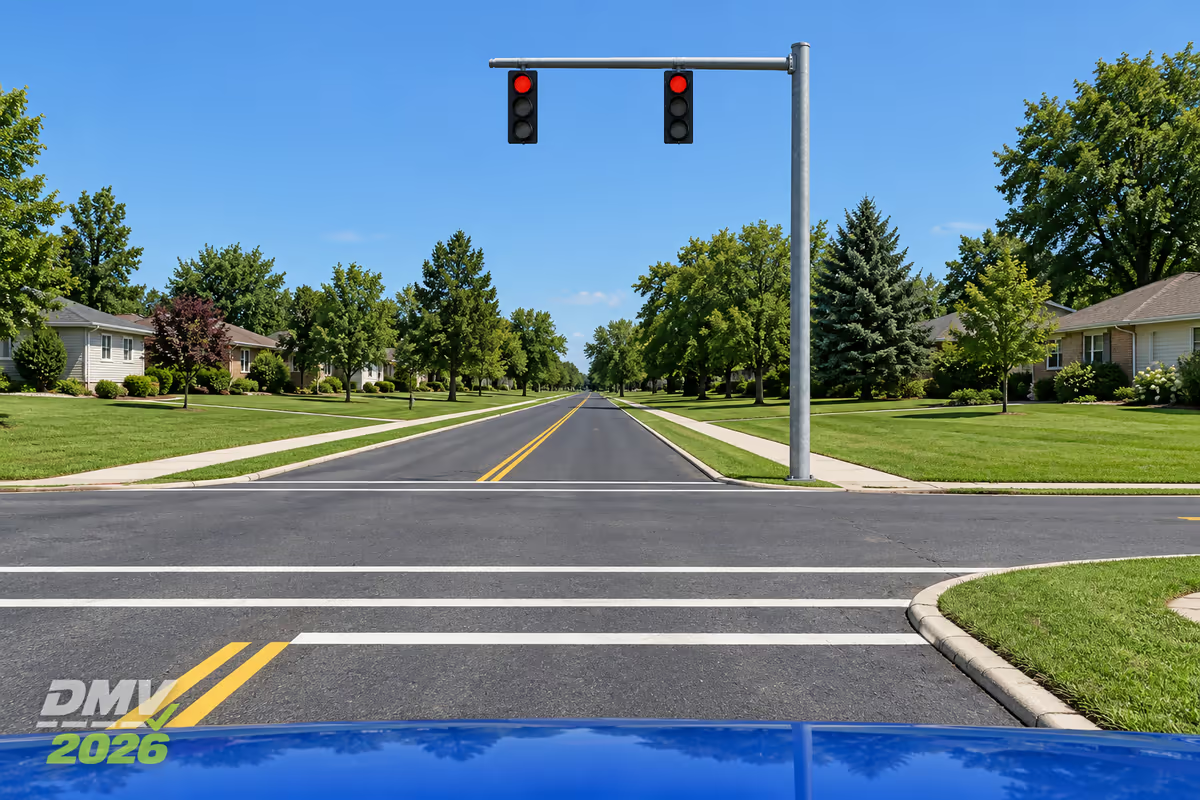
    Street seen from your car, with a traffic signal hanging over the intersection ahead. The signal has three round lenses one above the other, and the top one is lit red while the other two are dark. There is a stop line and a crosswalk across your lane, and no other cars
    What does this light tell you to do?
    Show the answer

    The answer is C: Stop and wait for green.

    A steady red light means stop and stay stopped until your light changes. Stop behind the stop line, or before the crosswalk if there is no line. A flashing red is the one that works like a stop sign. A steady red does not.

    “Vehicular traffic facing a steady CIRCULAR RED signal indication, unless entering the intersection to make another movement permitted by another signal indication, shall stop at a clearly marked stop line; but if there is no stop line, traffic shall stop before entering the crosswalk on the near side of the intersection; or if there is no crosswalk, then before entering the intersection; and shall remain stopped until a signal indication to proceed is displayed”

    MUTCD, 11th Edition, page 685
  2. Question 2 of 10 · Speed limits

    You turn onto a street with no speed limit sign. What sets your speed?
    Show the answer

    The answer is B: Your state's limit for streets.

    Every state sets a limit for each kind of road, for the places where no sign is posted. It is lower on a street in town than on an open highway. The numbers differ from state to state, so learn the ones in your own handbook. A missing sign never means there is no limit.

    “In general, the maximum speed limits applicable to rural and urban roads are established: A. Statutorily – a maximum speed limit applicable to a particular class of road, such as freeways or city streets, that is established by State law; or B. As speed zones – based on engineering studies.”

    MUTCD, 11th Edition, page 125
  3. Question 3 of 10 · Flooding and high water

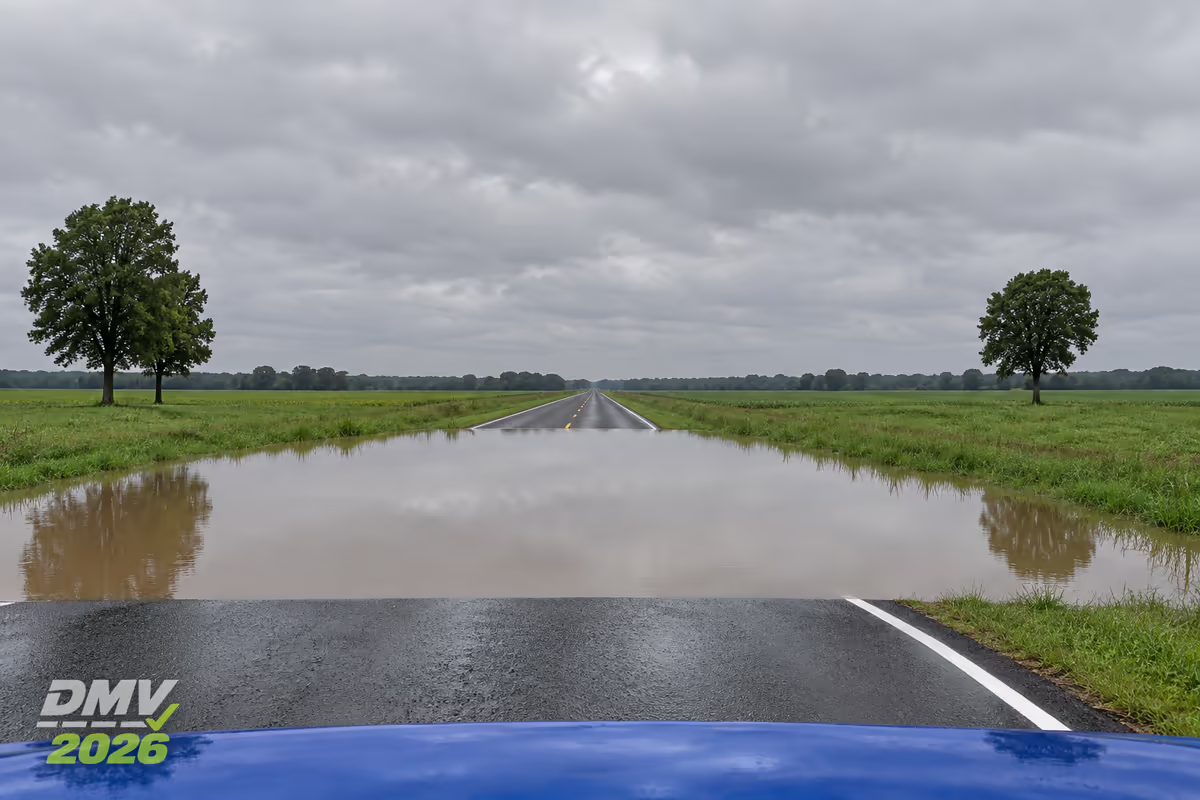
    View through the windshield of a straight two-lane road after rain. A short way ahead the road disappears under a flat sheet of brown water that fills it from edge to edge, and the road comes back out of the water in the distance. The water is still and nothing shows how deep it is
    Can you tell how deep this water is from the driver's seat?
    Show the answer

    The answer is A: No. The road under it is hidden.

    You cannot judge the depth of flood water by looking at it. The surface looks the same over a shallow puddle and over a hole where the road used to be. The water may also hide a dip or a washout. Looking harder tells you nothing, so turn around.

    “It may not be possible to determine the depth of the flood by looking.”

    California Driver's Handbook, page 69
  4. Question 4 of 10 · Warning signs

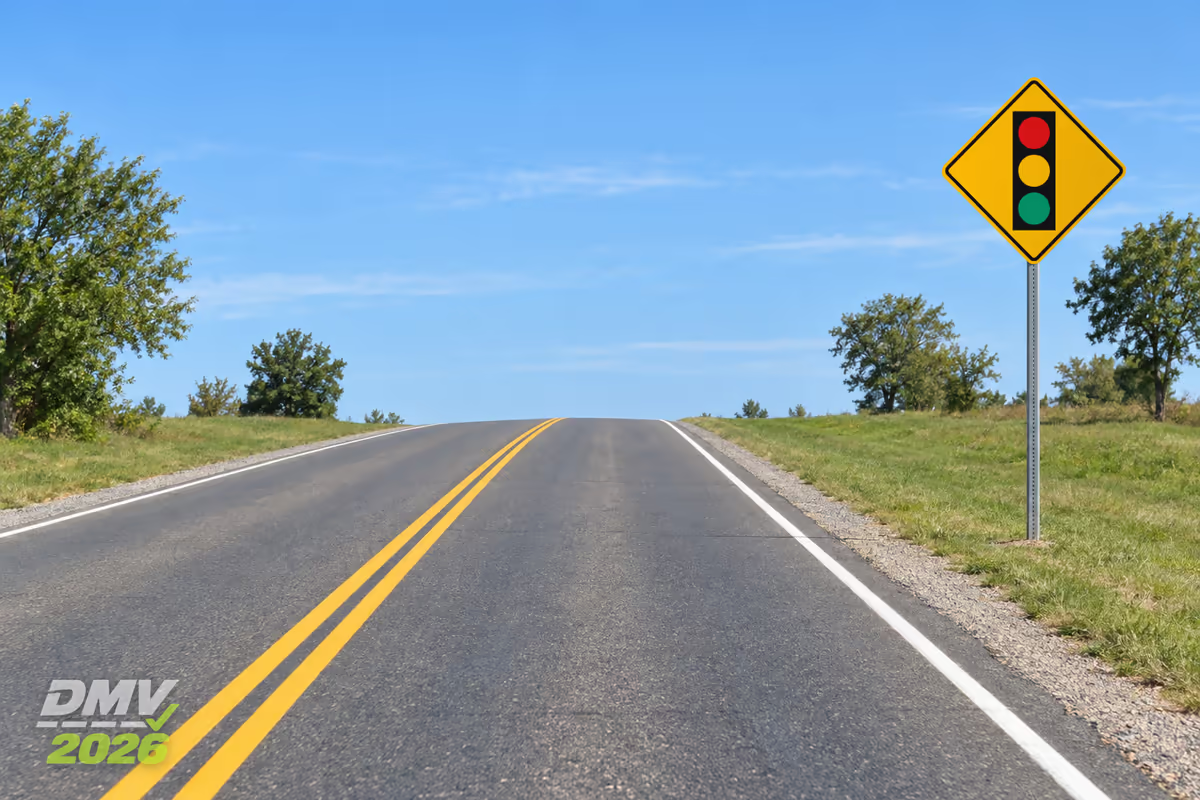
    Yellow diamond sign on a post at the right of a two-lane road, showing a black traffic signal with red, yellow and green lamps. The road behind it rises over a hill and nothing beyond the crest is visible. No vehicles
    What does this sign tell you to get ready for?
    Show the answer

    The answer is C: A traffic signal ahead.

    A signal on a yellow diamond is the signal ahead sign. It is posted where you cannot see the signal from far enough back. The light may already be red when it comes into view, so slow down and be ready to stop.

    “The Stop Ahead (W3-1), Yield Ahead (W3-2), and Signal Ahead (W3-3) Advance Traffic Control signs (see Figure 2C-8) shall be installed on an approach to a primary traffic control device that is not visible for a sufficient distance to permit the road user to respond to the device”

    MUTCD, 11th Edition, page 218
  5. Question 5 of 10 · Highways, merging and exits

    You have been on a straight, empty highway for an hour. What keeps you alert?
    Show the answer

    The answer is C: Keep your eyes moving and read the signs.

    A long, unchanging road brings on highway hypnosis: you stare at one spot and stop taking in what is around you. Shift your eyes from near to far and side to side, and read the signs as they come. If you feel sleepy, none of that fixes it. Pull off at the next exit or rest area.

    “Fatigue is physical or mental tiredness that can be caused by physical or mental strain, repetitive tasks, illness, or lack of sleep.”

    AAMVA Model Driver’s License Manual, page 9
  6. Question 6 of 10 · Emergencies and crashes

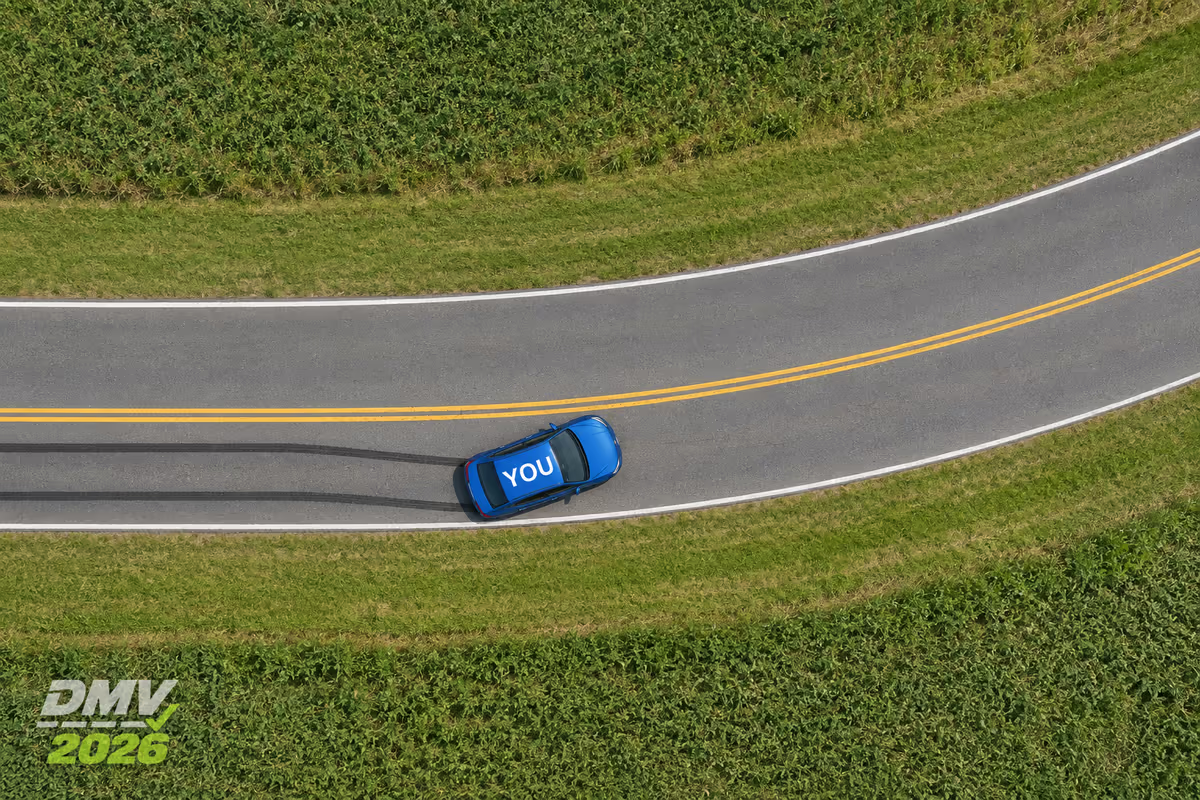
    Curving road seen from above with your car partway round the bend, its rear end sliding out toward the outside of the curve, the car at an angle across its lane and tire marks on the road behind its rear wheels
    In a skid, look and steer ____.
    Show the answer

    The answer is C: where you want the car to go

    Your hands follow your eyes, so the car goes where you look. Stare at the tree you fear and you will steer into it. Look at the open road instead and steer gently that way, feet off both pedals. Some handbooks call this steering into the skid, and it is the same move.

    “In traction loss, with ESP you should steer the vehicle toward the direction you are looking and avoid abrupt steering.”

    Kansas Driving Handbook, page 62
  7. Question 7 of 10 · Work zones and flaggers

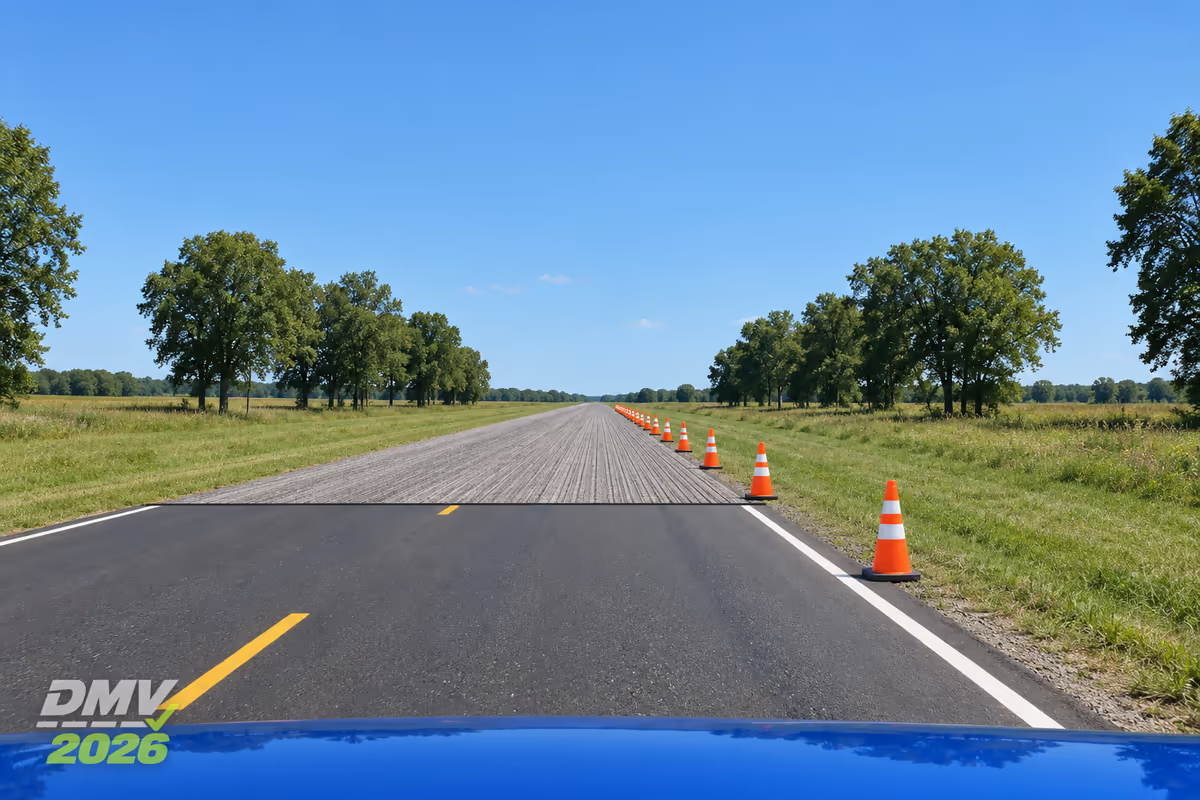
    Two-lane road seen from your car inside a work zone, orange cones along the right edge. A few car lengths ahead the smooth dark pavement ends at a straight edge and the road surface becomes rough, lighter grey and grooved along its length, with a small step down at the edge
    What should you expect when you drive onto this surface?
    Show the answer

    The answer is B: Less grip and a rough ride.

    The top layer of the road has been ground off. The surface is rough and gives your tires less grip, and it is hardest on a motorcycle. Slow down before you reach it. Expect the same from loose gravel and steel plates in a work zone.

    “The narrower lanes and rough pavement can create a hazardous condition.”

    AAMVA Model Driver’s License Manual, page 43
  8. Question 8 of 10 · Distracted and aggressive driving

    The car behind is tailgating you and flashing its lights. Should you tap your brakes?
    Show the answer

    The answer is C: No. Let the car go past.

    A tailgater is a problem to get rid of, not to teach a lesson to. Braking in front of a car that close starts a rear-end crash, and speeding up only brings the race to you. Ease off a little and let the car past at the first chance. Do not answer the aggression.

    “Do not challenge them by speeding up or attempting to hold-your-own in your path of travel.”

    Kansas Driving Handbook, page 19
  9. Question 9 of 10 · Following distance and space

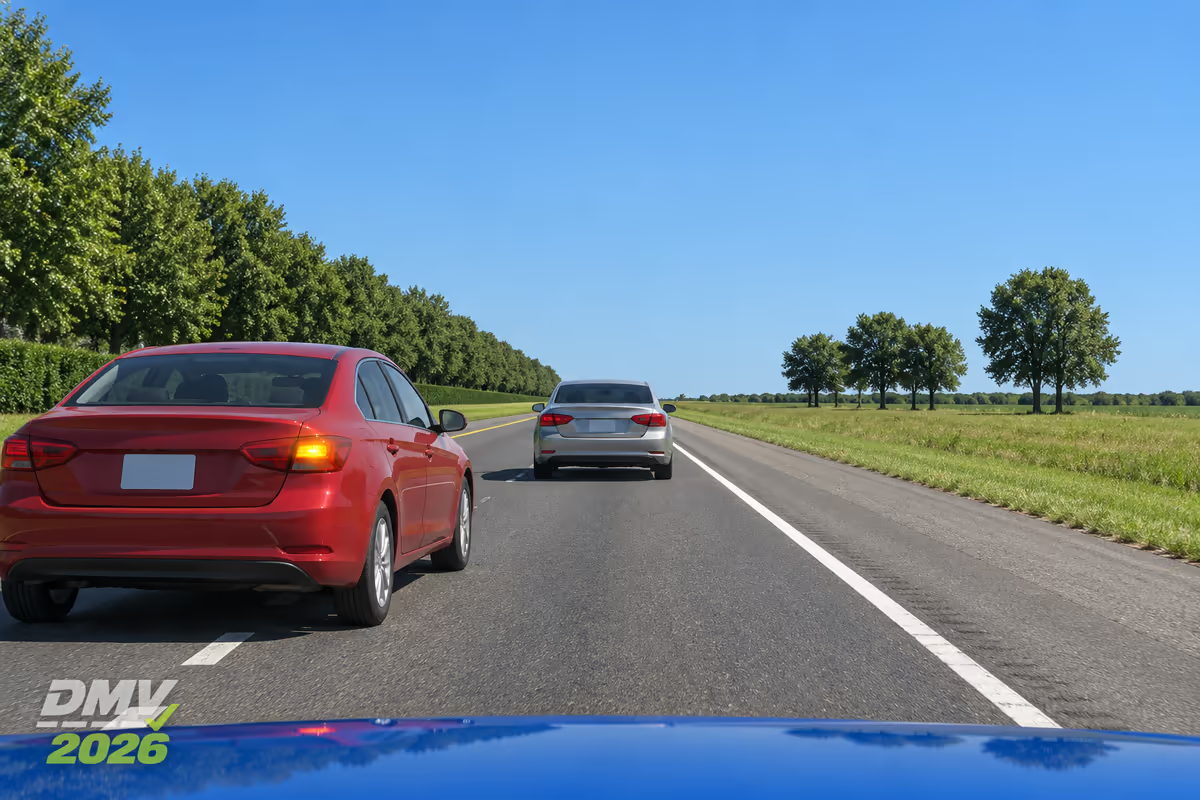
    View through your windshield of a two-lane highway. A grey car is ahead in your lane, and a red car from the lane on the left is angled into the space between you and it, close in front of you, with its right turn signal on. Your hood is at the bottom of the picture
    This car has moved into your gap. What should you do?
    Show the answer

    The answer is A: Ease off the gas and drop back.

    The space ahead of you was your room to stop, and it is gone. Take your foot off the gas until the gap opens back up to your count. Closing up to keep others out leaves you with no room at all. That is the very thing the gap was there to prevent.

    “Someone may crowd your lane position, try to change lanes, and pull into your lane space. Increase or reduce your vehicle speed to stay clear of the other vehicle that may be trying to enter your lane space.”

    Kansas Driving Handbook, page 64
  10. Question 10 of 10 · Emergency vehicles and the Move Over law

    Emergency vehicles use flashing lights and a siren to ____.
    Show the answer

    The answer is C: clear a path through traffic

    Flashing lights and a siren mean the vehicle is on its way to an emergency and needs the road. Every other driver makes room for it by pulling to the right and stopping. The lights are not a warning about the road ahead, and they are never an invitation to follow.

    “Immediately drive to the right and stop until the emergency vehicles have passed. NEVER follow such vehicles.”

    Kansas Driving Handbook, page 18

These 10 questions are from the DMV Champ app’s practice set, last updated October 23, 2026. Spot a mistake in a question? Email us.

How many questions can you miss on the Kansas permit test?

5

You need 20 of the 25 right.

The test has 25 multiple choice questions, including questions on traffic signs and pavement markings.

“The knowledge test consists of 25 multiple choice questions that are important to the safe operation of a motor vehicle, including traffic signs, pavement markings and Kansas laws and driving practices.”

Kansas Driving Handbook, page 94

You need a score of 80% to pass.

“You must score an 80% to pass the knowledge test.”

Kansas Driving Handbook, page 94

DMV Champ uses the same format for Arkansas, Colorado, Connecticut, Iowa, Missouri, Nebraska, Nevada, North Carolina, North Dakota, South Dakota and Wyoming.

How old do you have to be to get an instruction permit in Kansas?

The youngest you can be is 14.

“Instruction Permits • Class C or M Instruction Permit: 14 years of age or older”

Kansas Driving Handbook, page 9

What happens if you fail the Kansas permit test?

You get 4 tries to pass, and after a 4th fail you wait 6 months before you start again.

“You are given 4 opportunities to pass the knowledge exam. If you fail to pass the 4th time, you will be required to wait 6 months from the most recent failed exam before starting the process again.”

Kansas Driving Handbook, page 94

How do you take the Kansas permit test?

It’s given by the Kansas Department of Revenue.

“The Kansas Department of Revenue offers Kansans the ability to complete their non-commercial knowledge exam online, bring in their passing results, and eliminate the in-office knowledge exam.”

Kansas Driving Handbook, page 9

The test has no time limit, and it usually takes 15 to 20 minutes.

“The test is not timed, but generally takes 15 to 20 minutes to finish.”

Kansas Driving Handbook, page 94

You can take the test at a full-service driver’s license center, through an approved driver’s education course, or online.

“To take the knowledge exam, you may go to any Full-Service Driver License Center, complete an approved driver’s education course, or complete the written exam online at https://ks.knowtodrive.com/.”

Kansas Driving Handbook, page 94

Not every driver’s license station gives the test, so check online before you go.

“Please use the following link to determine if the station you plan to visit will be able to administer the knowledge test, https://www.ksrevenue.gov/dovlicenses.html.”

Kansas Driving Handbook, page 94

Test simulator

Practice in the Kansas format

25 questions20 to pass

DMV Champ teaches every question with its explanation, then checks you with 5 simulated tests of 25 questions, graded against the 20-correct passing score. 36 topics in Kansas: the 34 every state tests, plus winter driving and flooding, because the Kansas handbook teaches them.

Download on the App Store