New York · Department of Motor Vehicles

New York DMV practice test: 20 questions, 70% to pass

New York’s knowledge test, given by the DMV, has 20 questions, and you need 14 right, or 70%, to pass.

20

questions

14

right to pass

70%

passing score

Checked against the New York State Driver’s Manual on October 25, 2026. How we check facts

Practice test

Take a 10-question New York DMV practice test

Pick an answer and check it. Every question comes with the reason behind the right answer and the sentence of an official document it rests on.

To pass here you need 7 of 10, since New York’s test asks for 70%.

  1. Question 1 of 10 · Pavement markings

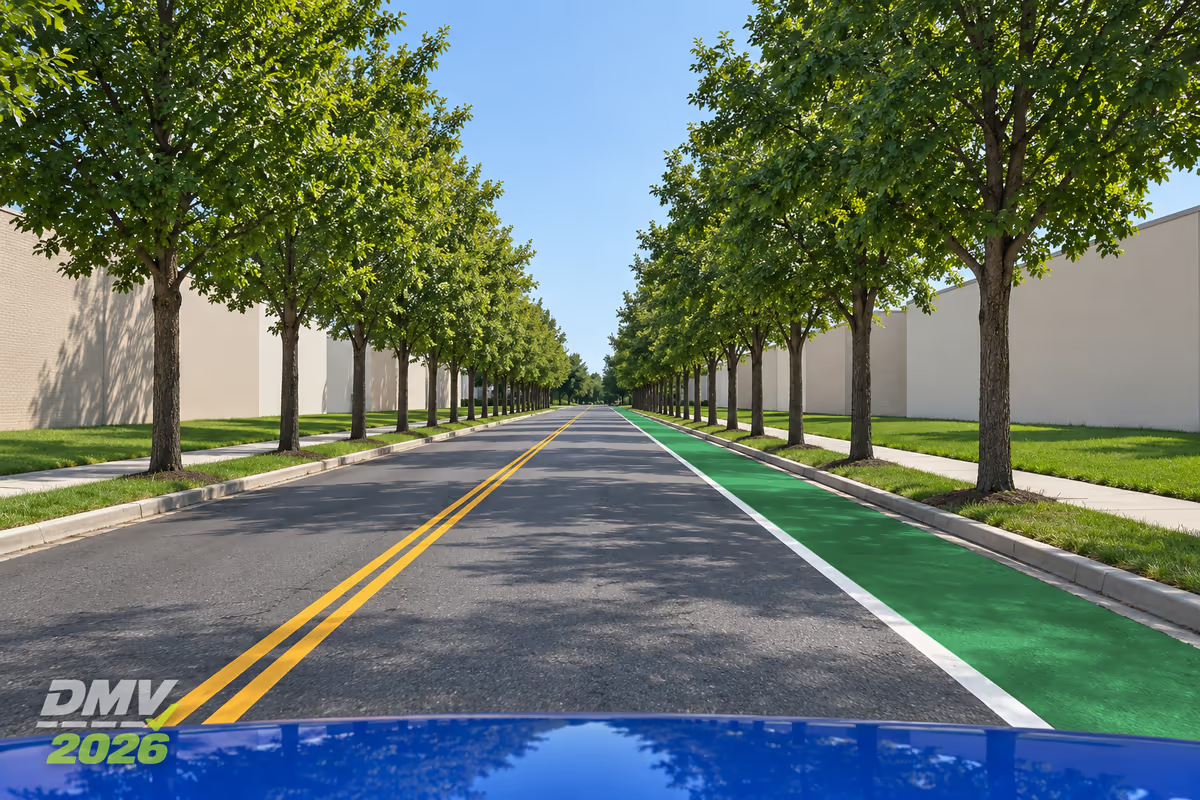
    Street from the driver's seat, your car in the traffic lane, and along the right edge a narrow lane painted bright green inside a solid white line
    What is the colored pavement on the right for?
    Show the answer

    The answer is B: Bicycles ride or cross there.

    Green paint marks a bicycle lane or a place where bicycles and cars cross, like the start of a right-turn lane. It is there to make riders easier to see. Slow down, look for a rider and yield before you cross it.

    “Green-colored pavement is used to enhance the conspicuity of locations where bicyclists are expected to operate, and areas where bicyclists and other traffic might have potentially conflicting, weaving, or crossing movements.”

    MUTCD, 11th Edition, page 666
  2. Question 2 of 10 · Roundabouts and intersections

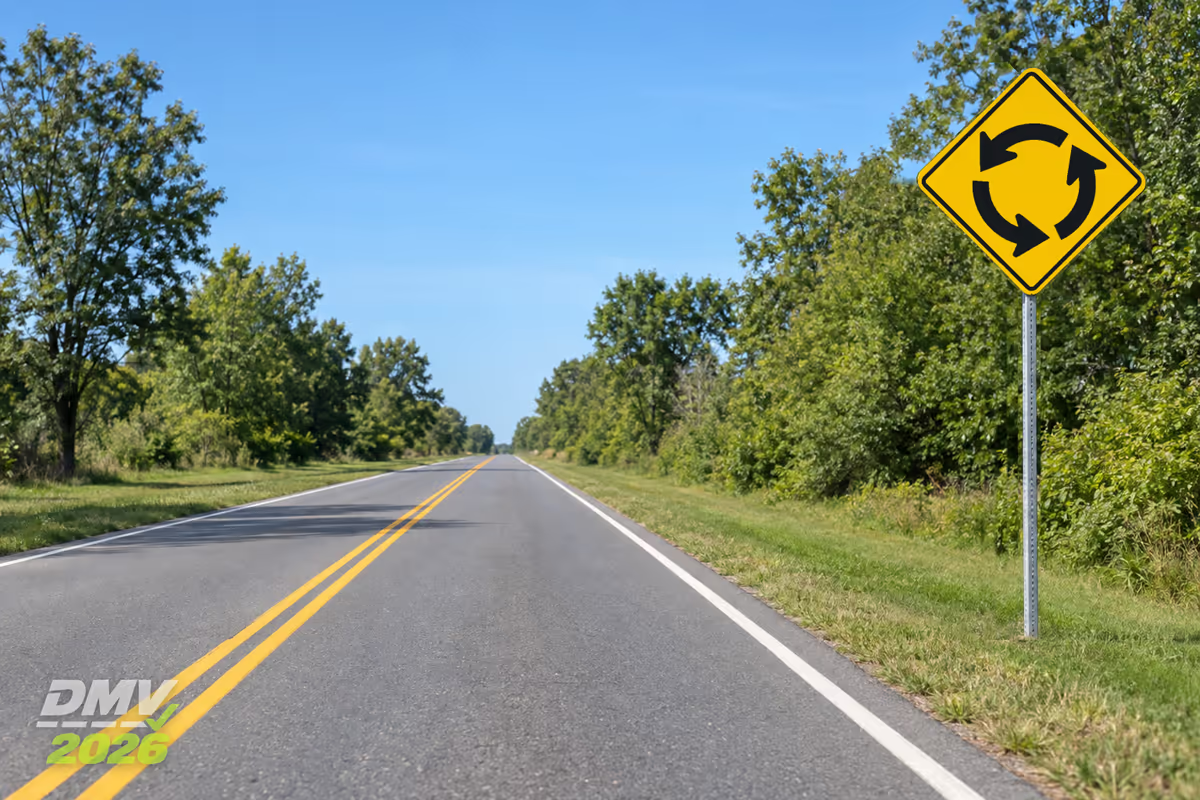
    Yellow diamond sign on a post at the right of the road, showing three black arrows chasing one another counterclockwise around a circle
    What is this sign warning you about?
    Show the answer

    The answer is A: A roundabout ahead.

    This warning sign stands before a roundabout. Slow down when you see it, because you will have to yield to traffic already in the circle before you can enter. The arrows show the way around: to the right, counterclockwise.

    “The Circular Intersection (W2-6) sign (see Figure 2C-10) may be installed in advance of a circular intersection”

    MUTCD, 11th Edition, page 221
  3. Question 3 of 10 · Slow-moving and farm vehicles

    Cars have lined up behind your slow vehicle on a two-lane road. What should you do?
    Show the answer

    The answer is A: Pull off and let them by.

    A line of cars behind a slow vehicle leads to risky passing. Pull off at the first safe spot, let them by, then pull back on. Many states require this once a line of cars builds up behind you, and some post turnouts for it.

    “A SLOW VEHICLES WITH XX OR MORE FOLLOWING VEHICLES MUST USE TURN-OUT (R4-12) sign (see Figure 2B-10) may be installed in advance of a turn-out area to inform drivers who are driving so slow that they have accumulated a specific number of vehicles behind them that they are required by the traffic laws of that State to use the turn-out to allow the vehicles following them to pass.”

    MUTCD, 11th Edition, page 147
  4. Question 4 of 10 · Warning signs

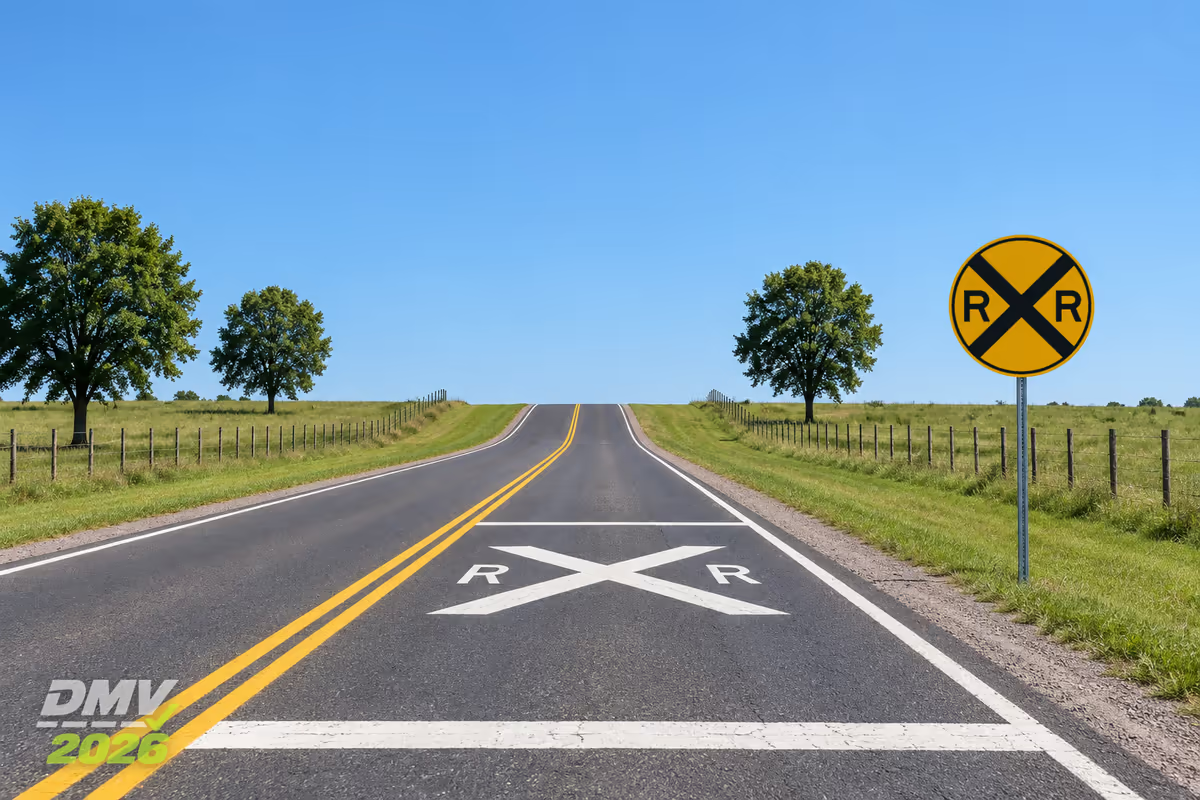
    Round yellow sign on a post at the right of a two-lane road, with a black X and the letters R and R. The same X and letters are painted across your lane. The road runs straight between fields and over a rise, with no tracks in sight. No vehicles
    You cannot see the tracks yet. When do you start to slow down?
    Show the answer

    The answer is A: When you reach this sign.

    This sign warns of a railroad crossing ahead. Start slowing down when you reach it. It is placed far enough before the crossing to give you room to stop if a train is coming. Do not wait until you see the tracks or hear a train.

    “A round yellow warning sign with an “X” symbol and black “RR” letters is placed along the road before a highway-railroad grade crossing. The sign cautions you to slow down, look and listen for a train or railroad vehicle, and be prepared to stop if a train is approaching.”

    AAMVA Model Driver’s License Manual, page 21
  5. Question 5 of 10 · Right-of-way

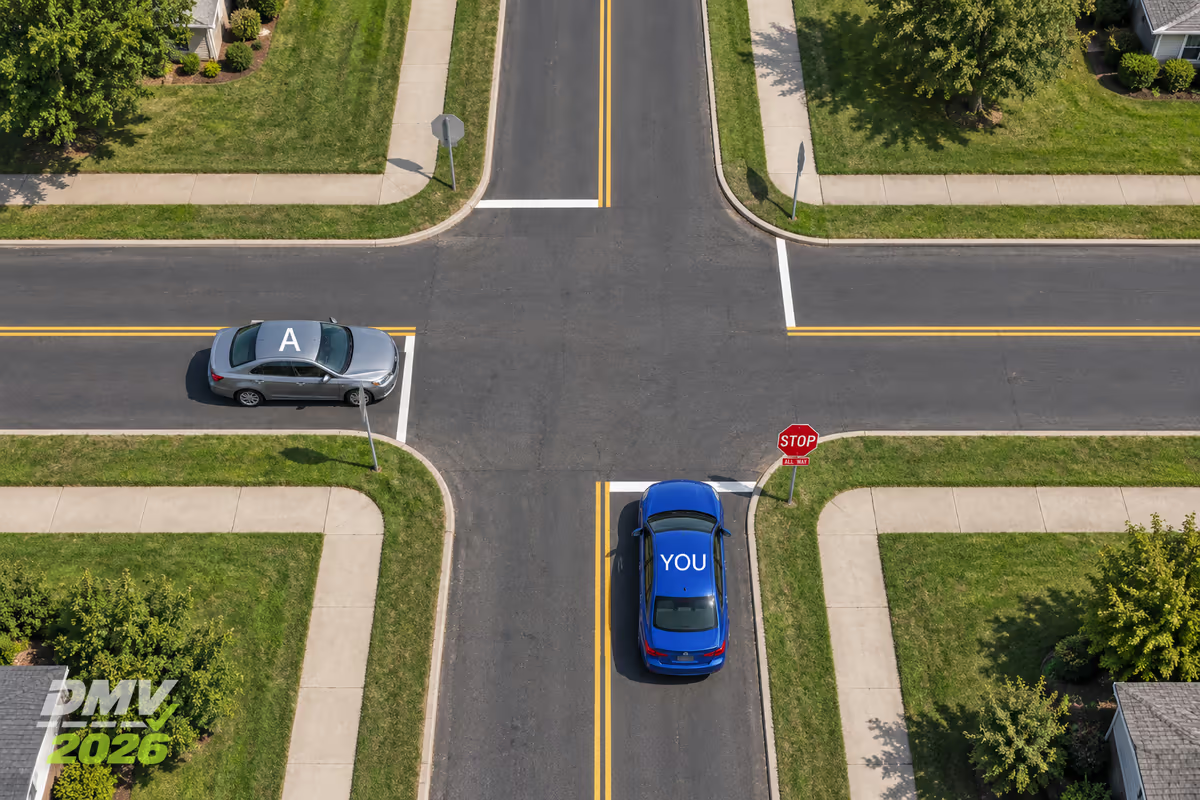
    Intersection seen from above with a stop sign on all four corners. Your car has stopped at the bottom approach, and a car marked A has stopped at the approach to your left. The other two approaches are empty
    You and car A stopped at the same time. Who goes first?
    Show the answer

    The answer is C: You. Car A is on your left.

    At an all-way stop, two drivers who stop together yield to the right. Car A is on your left, so the turn is yours. Look at car A before you move anyway. Some drivers do not know the rule, and being right does not prevent a crash.

    “the driver on your right at a four-way intersection controlled by stop signs if both of you arrive at the intersection at the same time;”

    AAMVA Model Driver’s License Manual, page 19
  6. Question 6 of 10 · Before you drive

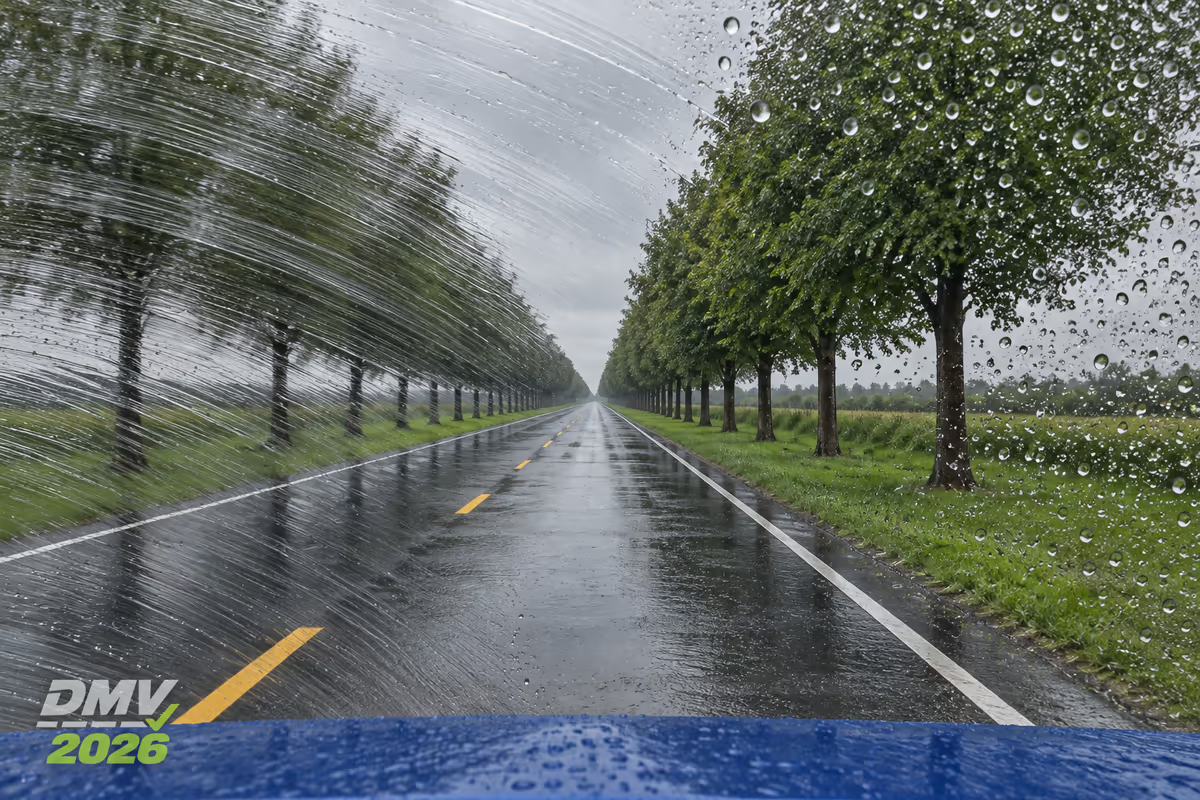
    View through the windshield from the driver's seat after a wipe. A wide hazy smeared arc covers the glass in front of the driver, and the empty road ahead is blurred behind it
    Your wipers leave a smear like this on every sweep. What fixes it?
    Show the answer

    The answer is A: Replacing the blades.

    Worn wiper blades smear and streak the glass instead of clearing it. Replace them as soon as they stop clearing the windshield. Washer fluid washes off dirt, but it cannot fix a worn blade, so keep the fluid topped up and the blades fresh.

    “If wiper blades aren't keeping the windshield clean, replace them.”

    Iowa Driver's License Manual, page 24
  7. Question 7 of 10 · Traffic signals and arrows

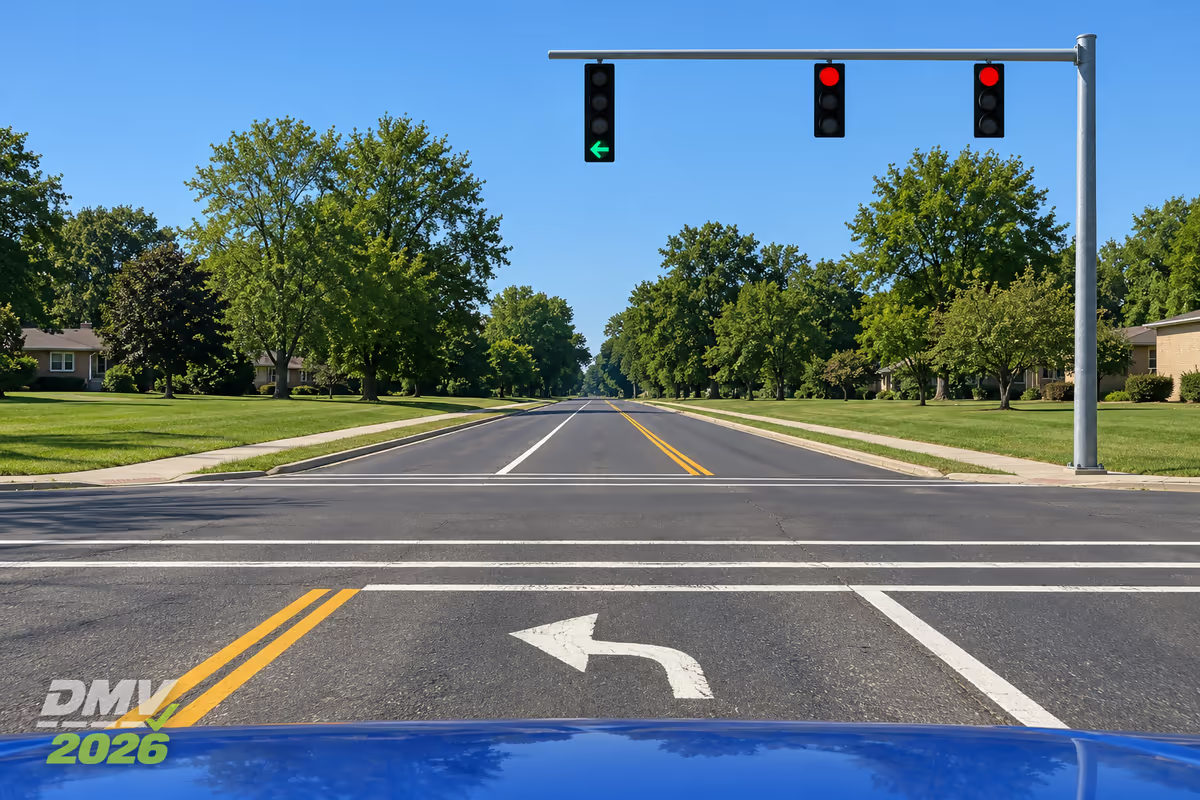
    Left-turn lane seen from your car, with a four-section signal over it whose sections are all arrows. The three upper sections are dark and the bottom section is lit as a green arrow pointing left. The intersection ahead and the oncoming lanes are empty
    What does this signal mean?
    Show the answer

    The answer is B: Turn left now. Oncoming traffic has a red.

    A green arrow is a protected turn. The traffic that could cross your path has a red light, so the turn is yours. You still look before you move, and anyone already in the crosswalk still goes first. The arrow holds cars. It does not hold people.

    “Vehicular traffic facing a GREEN ARROW signal indication, displayed alone or in combination with another signal indication, is permitted to cautiously enter the intersection only to make the movement indicated by such arrow”

    MUTCD, 11th Edition, page 684
  8. Question 8 of 10 · Fatigue, vision and health

    You have a bad cold and have just worked all night. Should you drive home?
    Show the answer

    The answer is A: No. Rest first or get a ride.

    Illness and a night without sleep each leave you with less attention than driving needs, and together they leave you less still. Your body wants to sleep in the early morning whatever you did overnight. Nobody checks this for you. You decide whether you are fit to drive today.

    “Fatigue is physical or mental tiredness that can be caused by physical or mental strain, repetitive tasks, illness, or lack of sleep.”

    AAMVA Model Driver’s License Manual, page 9
  9. Question 9 of 10 · Looking ahead, mirrors and backing up

    Your car has a backup camera. May you back up by watching only the screen?
    Show the answer

    The answer is B: No. Look back as well.

    A backup camera is one more check, not a replacement for looking. Its view is limited, and it does not give you the full picture behind you. Keep turning to look through the rear window, and use your mirrors too.

    “Your mirrors do not show the area directly behind your vehicle and a back-up camera provides a limited view so do not depend solely on your mirrors or a back-up camera while backing.”

    Maine Driver's License Manual, page 46
  10. Question 10 of 10 · Turn signals, horn and lights

    The road looks empty. Do you still signal before you change lanes?
    Show the answer

    The answer is B: Yes. Signal every time.

    Signal every time you turn, change lanes or merge, even when you see nobody. The car you did not see is the dangerous one. It may be in your blind spot or coming up fast behind you. Signaling only when it seems to matter is how the habit breaks down.

    “You should use a turn signal when changing lanes, turning left or right, or when merging into traffic.”

    AAMVA Model Driver’s License Manual, page 32

These 10 questions are from the DMV Champ app’s practice set, last updated October 23, 2026. Spot a mistake in a question? Email us.

How many questions can you miss on the New York permit test?

6

You need 14 of the 20 right.

The test has 20 questions, and you need at least 14 right, including 2 of the 4 road sign questions.

“To pass the written test, you must correctly answer at least 14 of the 20 questions asked, but you must correctly answer two of the four questions about road signs.”

New York State Driver’s Manual, page 10

How old do you have to be to get a learner permit in New York?

The youngest you can be is 16.

“Students who are at least age 16 can bring their receipt and completed forms to any state or county motor vehicle office to apply for a learner permit.”

New York State Driver’s Manual, page 11

The manual calls it a learner permit.

“When you pass the vision and written tests and pay your fees, your learner permit will be issued and you can start to learn to drive.”

New York State Driver’s Manual, page 11

What happens if you fail the New York permit test?

If you fail the online test at your school, you can take it again online as many times as the school allows.

“Students who fail the test can take it again online as many times as the school allows.”

New York State Driver’s Manual, page 11

How do you take the New York permit test?

It’s given by the DMV, which also runs an online version at participating high schools for students from 15 years and 11 months.

“Before you apply for a learner permit, students who are at least age 15 and 11 months can take the written test through the DMV Online Knowledge Test Application (OKTA) program. The test is given at participating high schools across New York State.”

New York DMV, online Driver’s Manual, chapter 1

The manual calls it the written test.

“To pass the written test, you must correctly answer at least 14 of the 20 questions asked, but you must correctly answer two of the four questions about road signs.”

New York State Driver’s Manual, page 10

The test comes in several languages, and you take it on a touch screen or on paper.

“Class D knowledge tests are offered in multiple languages and can be taken via touch screen test stations or on paper.”

New York State Driver’s Manual, page 10

Test simulator

Practice in the New York format

20 questions14 to pass

DMV Champ teaches every question with its explanation, then checks you with 5 simulated tests of 20 questions, graded against the 14-correct passing score. 35 topics in New York: the 34 every state tests, plus winter driving, because the New York handbook teaches it.

Download on the App Store