Iowa · Department of Transportation

Iowa DOT practice test: 25 questions, 80% to pass

Iowa’s knowledge test, given by the Iowa DOT or your county treasurer’s office, has 25 questions, and you need 20 right, or 80%, to pass.

25

questions

20

right to pass

80%

passing score

Checked against the Iowa Driver’s License Manual (July 23, 2026 edition) on October 25, 2026. How we check facts

Practice test

Take a 10-question Iowa DOT practice test

Pick an answer and check it. Every question comes with the reason behind the right answer and the sentence of an official document it rests on.

To pass here you need 8 of 10, since Iowa’s test asks for 80%.

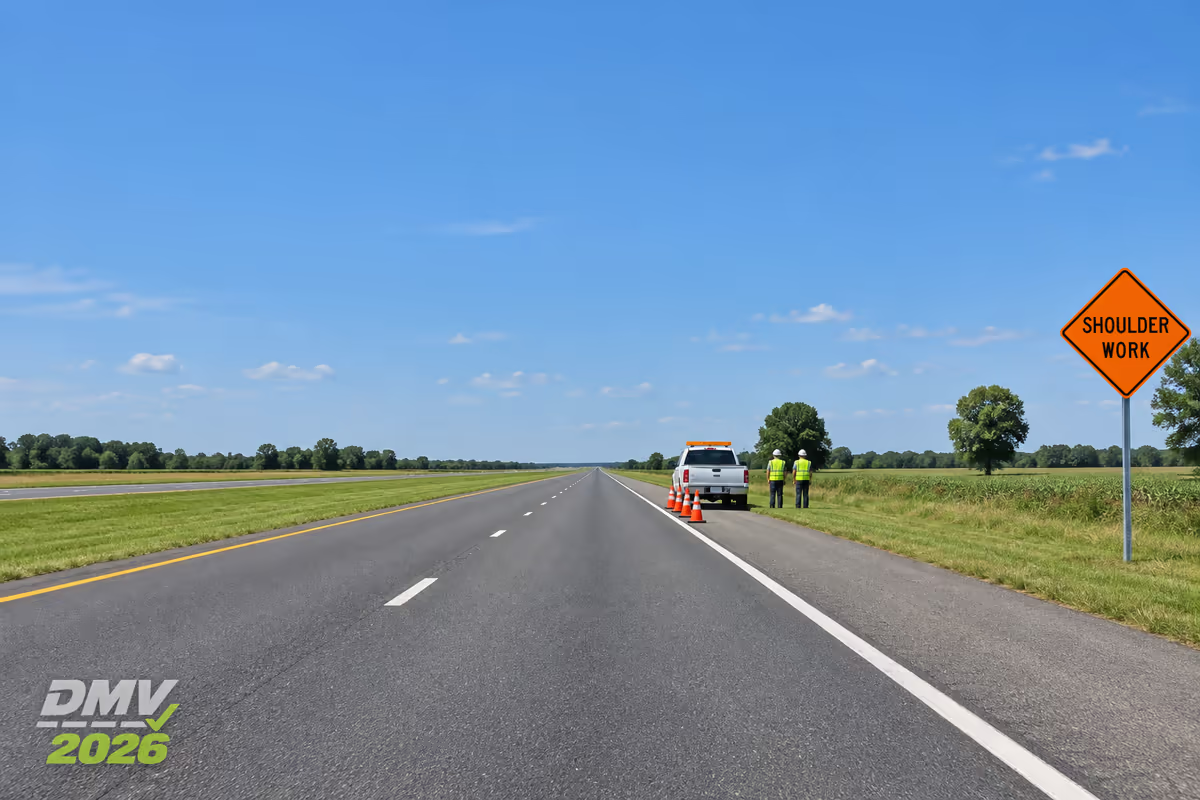
  1. Question 1 of 10 · Work zones and flaggers

    Orange diamond sign with the words SHOULDER WORK in black
    You are in the lane next to the shoulder. What should you do?
    Show the answer

    The answer is B: Slow down and give the shoulder room.

    People are working on the shoulder, close enough that a car passing at speed is a danger to them. The lanes stay open, so there is nothing to stop for. Move to the next lane if you can. Where you cannot, slow down and leave as much room as the road allows.

    “Shoulder Work signs (see Figure 6H-1) warn of maintenance, reconstruction, or utility operations on the highway shoulder where the roadway is unobstructed.”

    MUTCD, 11th Edition, page 848
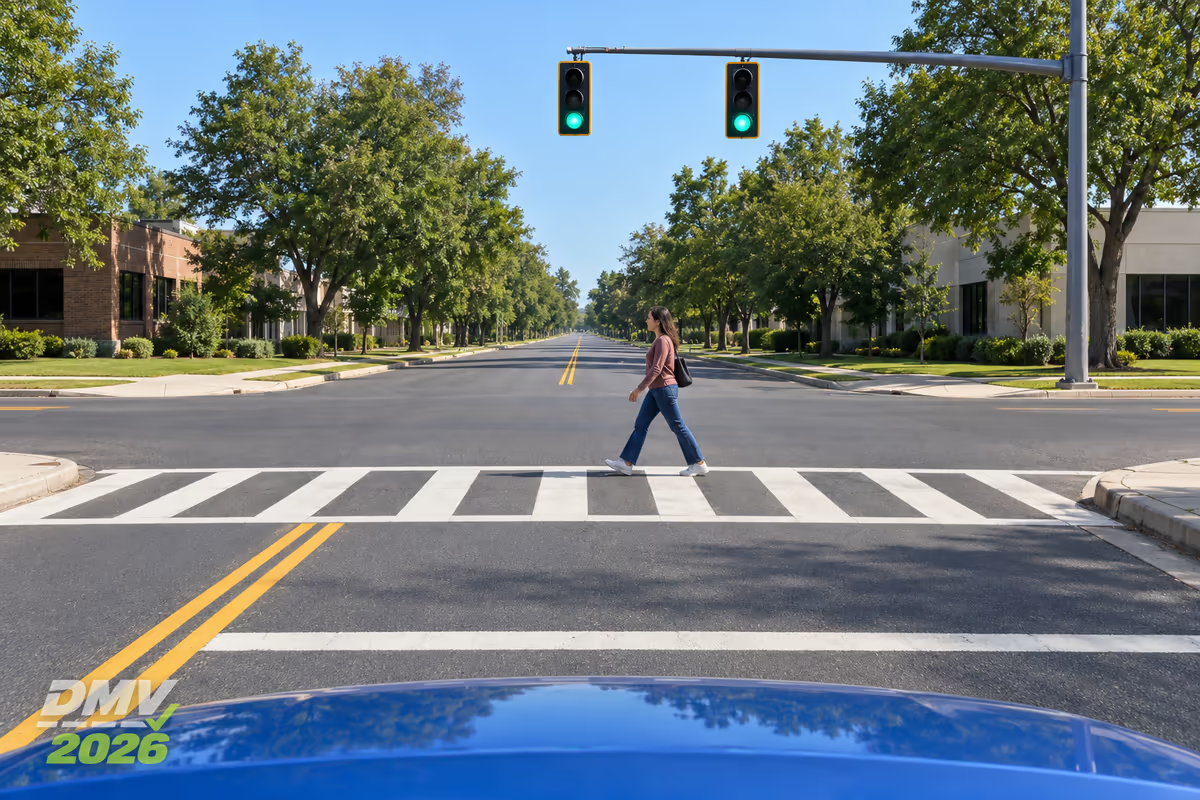
  2. Question 2 of 10 · Right-of-way

    View from your car stopped at a traffic light that shows green. A person is in the crosswalk ahead of you, about halfway across
    Your light has just changed. May you go?
    Show the answer

    The answer is A: No. Wait for the person to finish crossing.

    A green light means you may go when the intersection is clear. A person still in the crosswalk has the right of way, even on your green. Wait until they are out of your path, then go. The light tells you when you may move, not that the way is clear.

    “You must yield the right of way to all pedestrians in the intersection even if the traffic light is green.”

    AAMVA Model Driver’s License Manual, page 36
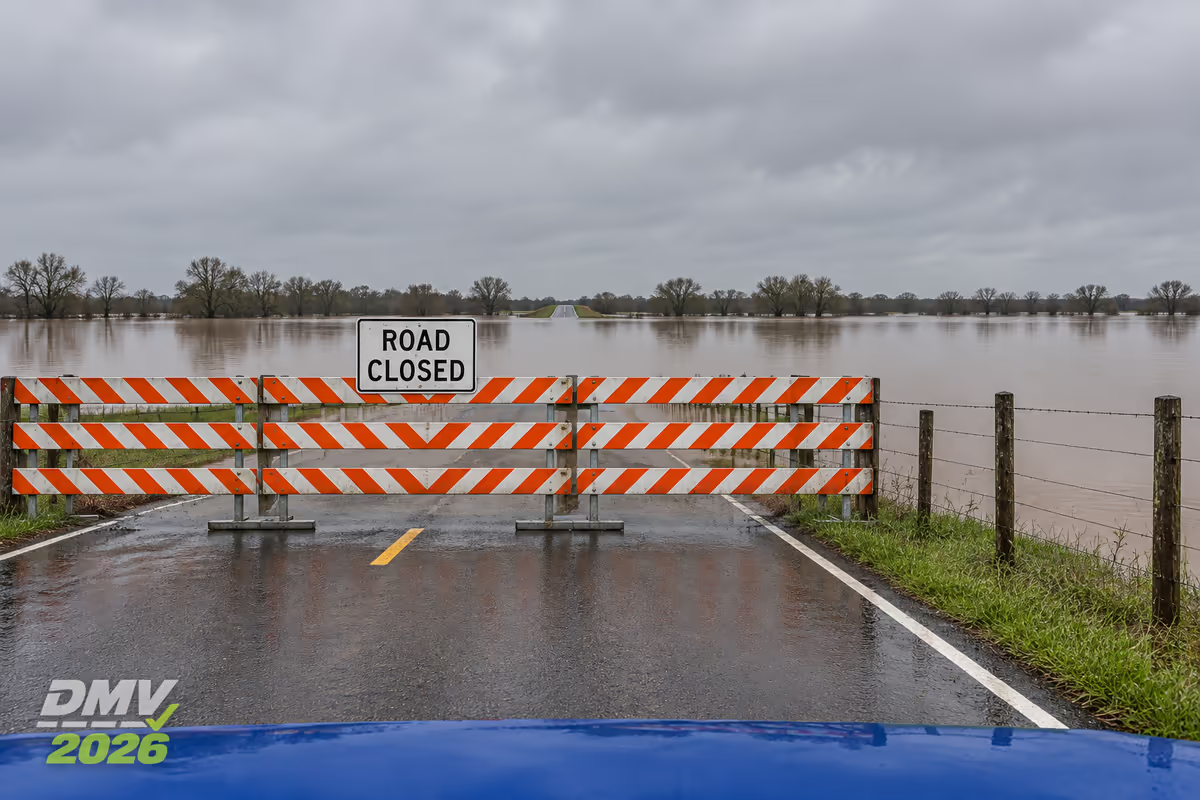
  3. Question 3 of 10 · Flooding and high water

    View through the windshield of a two-lane road after rain. A row of orange and white striped barricades with a ROAD CLOSED sign stands across the whole road ahead, its ends against the fences on both sides. Beyond it the road slopes down under a sheet of brown water and comes back out in the distance
    The water behind the barricade looks shallow. May you go around it?
    Show the answer

    The answer is A: No. Find another road.

    A barricade on a flooded road means someone has checked the road and closed it. The road may be washed away, or there may be debris or a power line in the water. In many states driving around a flood barricade is against the law as well as unsafe.

    “If a flooded road is blocked off by safety barricades, do not drive around them. The barricades are there because it is unsafe for vehicles. There may be debris or power lines in the water or the road may have been washed away.”

    What Every Driver Must Know, page 77
  4. Question 4 of 10 · Pavement markings

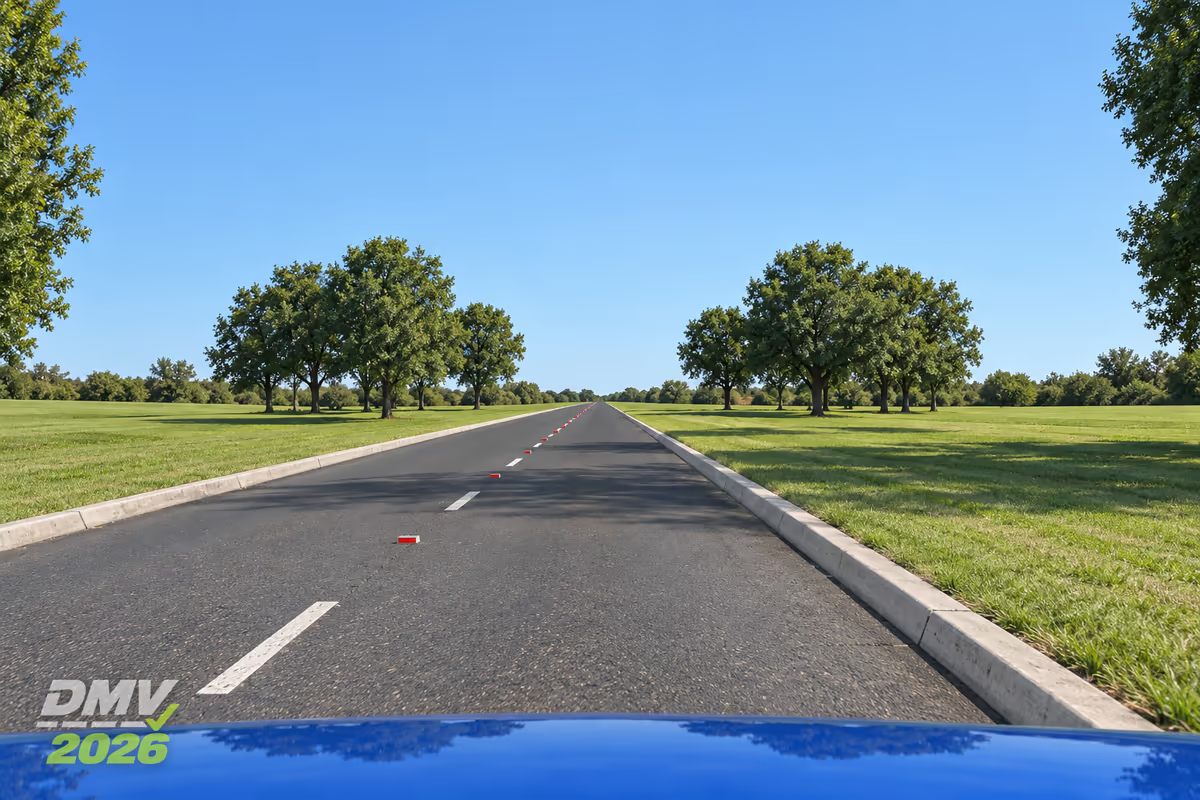
    Lane from the driver's seat with a line of raised markers along the lane line, every face turned toward you showing red; daylight, plain road, no other traffic
    You see these in the road ahead. What are they telling you?
    Show the answer

    The answer is C: You are going the wrong way.

    Raised reflectors show red only to a driver going the wrong way. Drivers going the right way see white or yellow on the same markers. Red reflectors mean stop and turn around as soon as it is safe.

    “When used, red raised pavement markers or delineators shall delineate”

    MUTCD, 11th Edition, page 579
  5. Question 5 of 10 · School buses and school zones

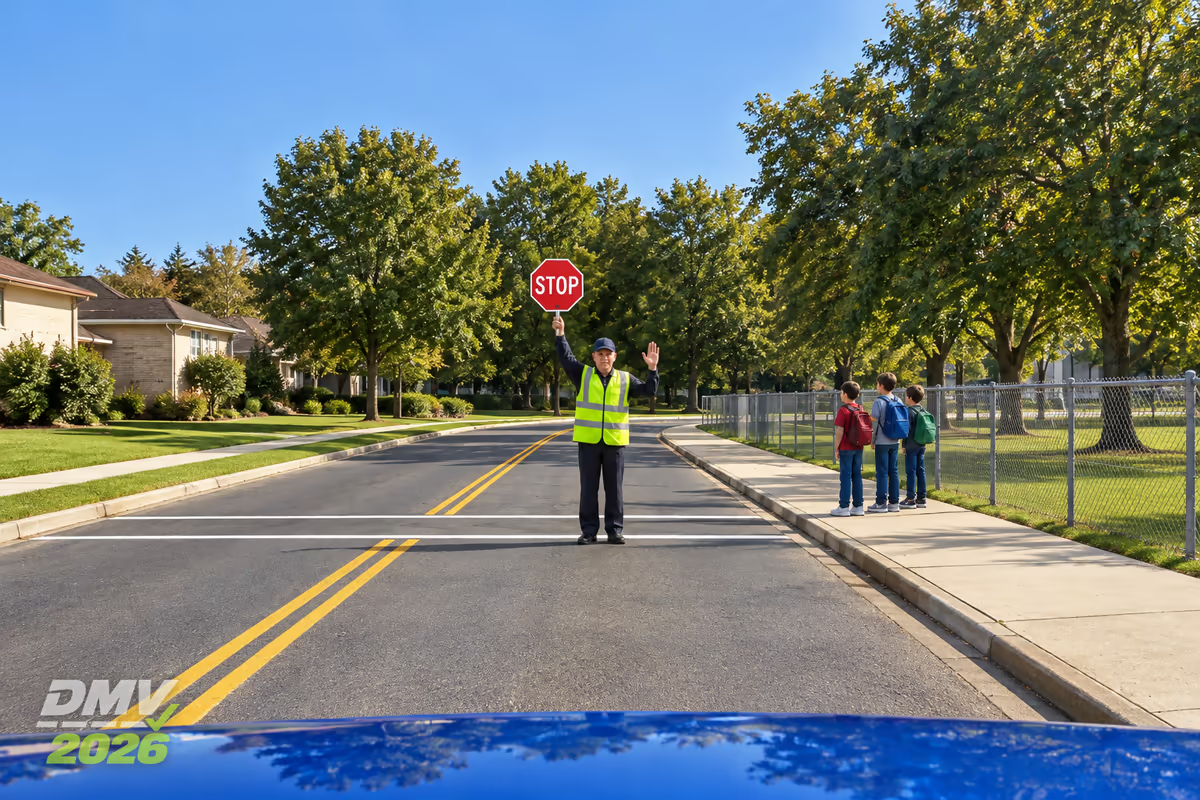
    Street seen from behind the wheel at a crosswalk. A crossing guard in a bright yellow-green vest stands in your lane holding up a red STOP paddle, with one hand raised. Three children wait on the sidewalk to the right. The crosswalk is empty
    The guard has stepped out like this. No one is crossing yet. What do you do?
    Show the answer

    The answer is A: Stop and wait until the guard waves you on.

    A crossing guard directs traffic at a school crossing, and you obey the guard as you would a police officer. The guard steps out to make a gap before the children cross. That is why the road looks empty when you are told to stop. Stay stopped until the guard lowers the paddle and waves you through.

    “Traffic control devices include traffic signals, signs, pavement markings, and directions provided by law enforcement, highway personnel, and school crossing guards.”

    AAMVA Model Driver’s License Manual, page 19
  6. Question 6 of 10 · Pedestrians and bicyclists

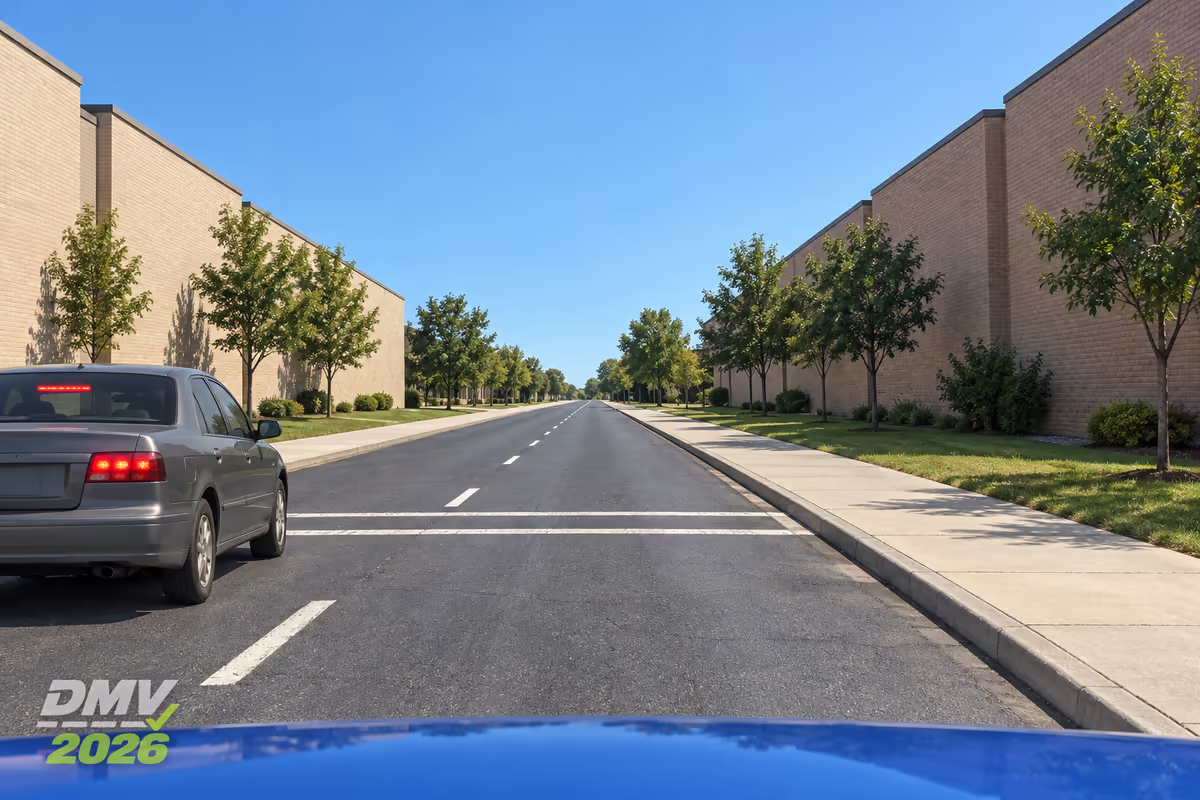
    One-way street with two lanes, seen from your car in the right-hand lane. A grey car in the left-hand lane has stopped just before a crosswalk that crosses both lanes. Your lane and the crosswalk in front of it look clear
    The car in the next lane has stopped at the crosswalk. What do you do?
    Show the answer

    The answer is B: Stop behind the crosswalk too.

    Never pass a car that has stopped at a crosswalk. It may be waiting for a person you cannot see, and its body hides the crosswalk from you. Stop too, and go only once you can see that the crosswalk is clear.

    “When driving next to parked or stopped vehicles, pedestrians can walk out between these vehicles. Slow down and do not pass until you are sure there are no pedestrians crossing in front of it.”

    AAMVA Model Driver’s License Manual, page 36
  7. Question 7 of 10 · Warning signs

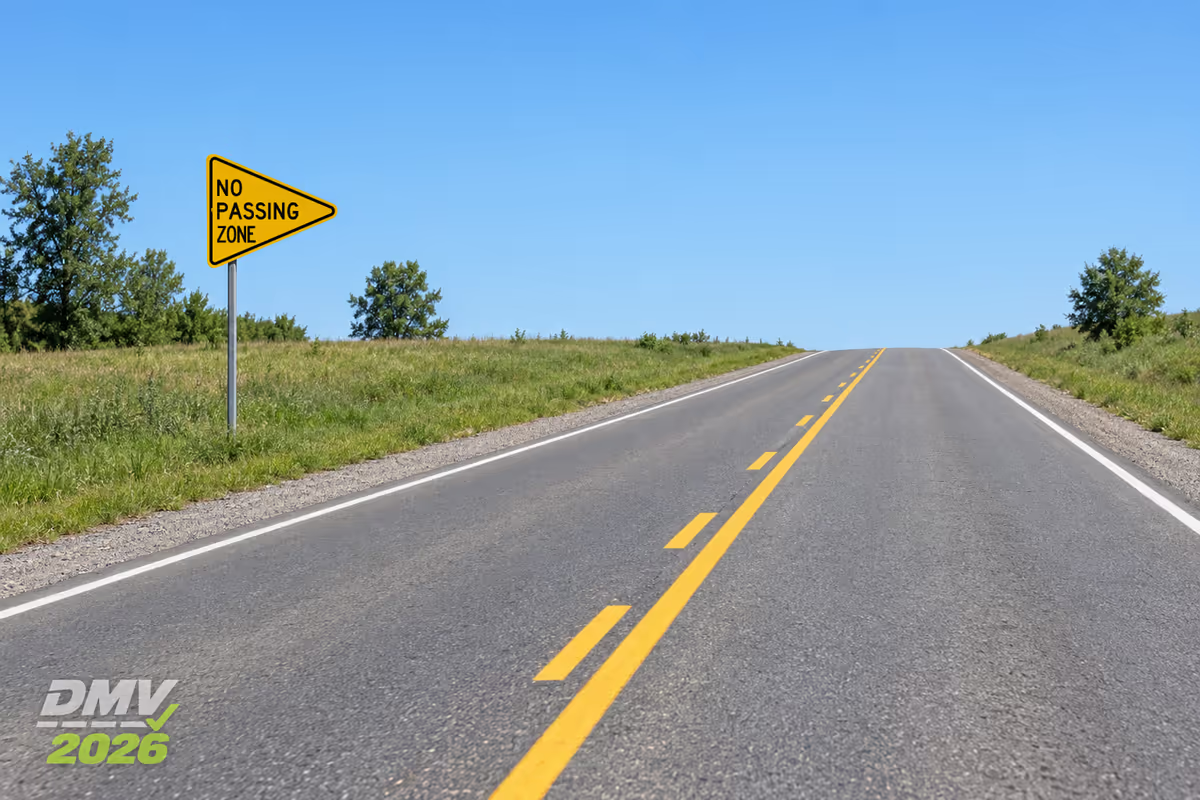
    Yellow pennant-shaped sign pointing right on a post at the left side of a two-lane road, with the words NO PASSING ZONE in black. The road rises toward a crest ahead, with a solid yellow line on your side of the center. No vehicles
    This sign stands on the left side of the road. What does it mark?
    Show the answer

    The answer is C: The start of a no-passing zone.

    The pennant is posted on the left side of the road where a no-passing zone starts. The zone is marked by a solid yellow line on your side. Stay in your lane until the zone ends. The zone usually ends with no sign. The line on your side turns broken again.

    “When used, the NO PASSING ZONE sign shall be installed on the left-hand side of the roadway at the beginning of no-passing zones identified by pavement markings or DO NOT PASS signs or both (see Sections 2B.36 and 3B.03).”

    MUTCD, 11th Edition, page 231
  8. Question 8 of 10 · Licensing, insurance and penalties

    You move to a new address. What do you have to do about your license?
    Show the answer

    The answer is A: Report it within your state's deadline.

    Your license has to show who you are and where you live. Report a new name or a new address to your state's licensing agency. Each state sets a deadline, often a few weeks. If you move to another state, you apply for its license within the time it allows. You hand in the old one, since you may hold only one license at a time.

    “If you have changed your name or address, you must report the change to the Department of Motor Vehicles within 30 days.”

    Vermont Driver's License Manual, page 25
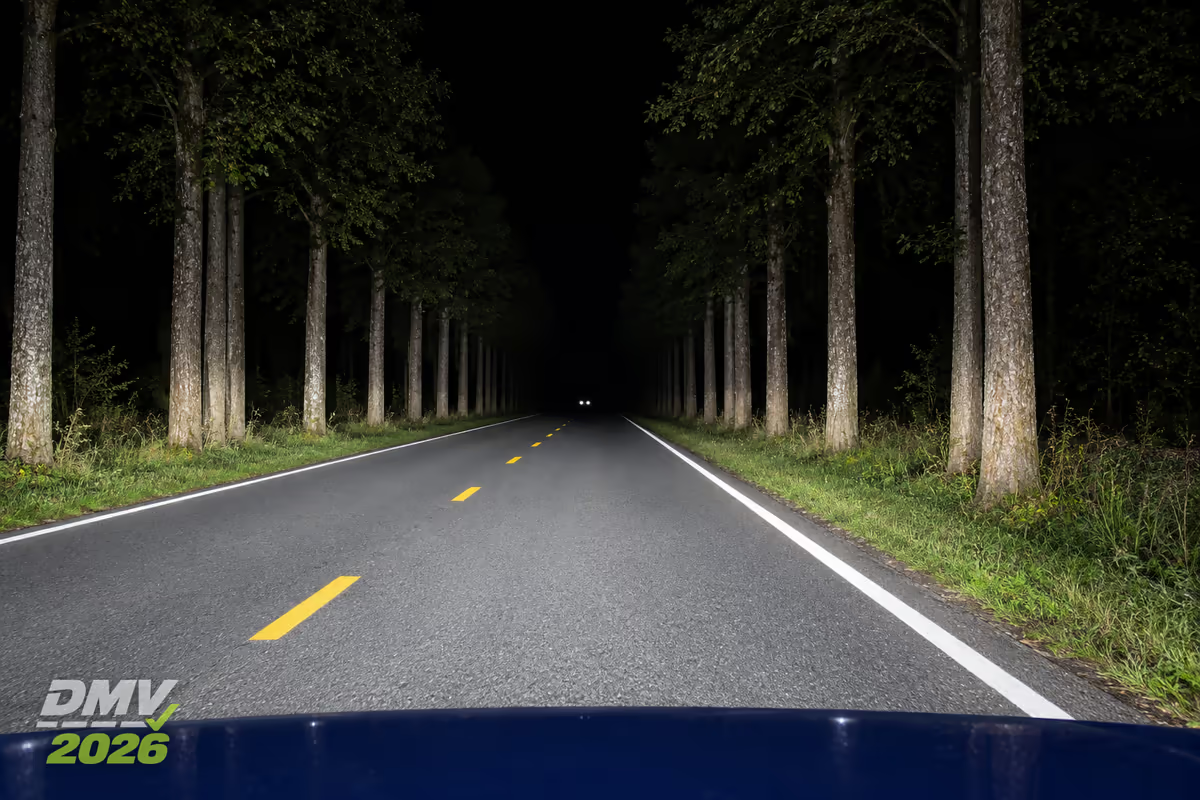
  9. Question 9 of 10 · Night driving and headlights

    Night view through your windshield of a two-lane country road. Your headlights light the road far ahead, and a pair of small headlights is coming toward you in the other lane a long way off
    Your high beams are on. When do you dim them for this car?
    Show the answer

    The answer is C: Well before you meet it.

    Dim your high beams as soon as you see a car coming toward you, well before the two of you meet. Most states set a distance, so switch early rather than late. Do not wait for the other driver to go first. If neither of you dims, both of you may be blinded.

    “Dim your high beams for approaching traffic.”

    AAMVA Model Driver’s License Manual, page 42
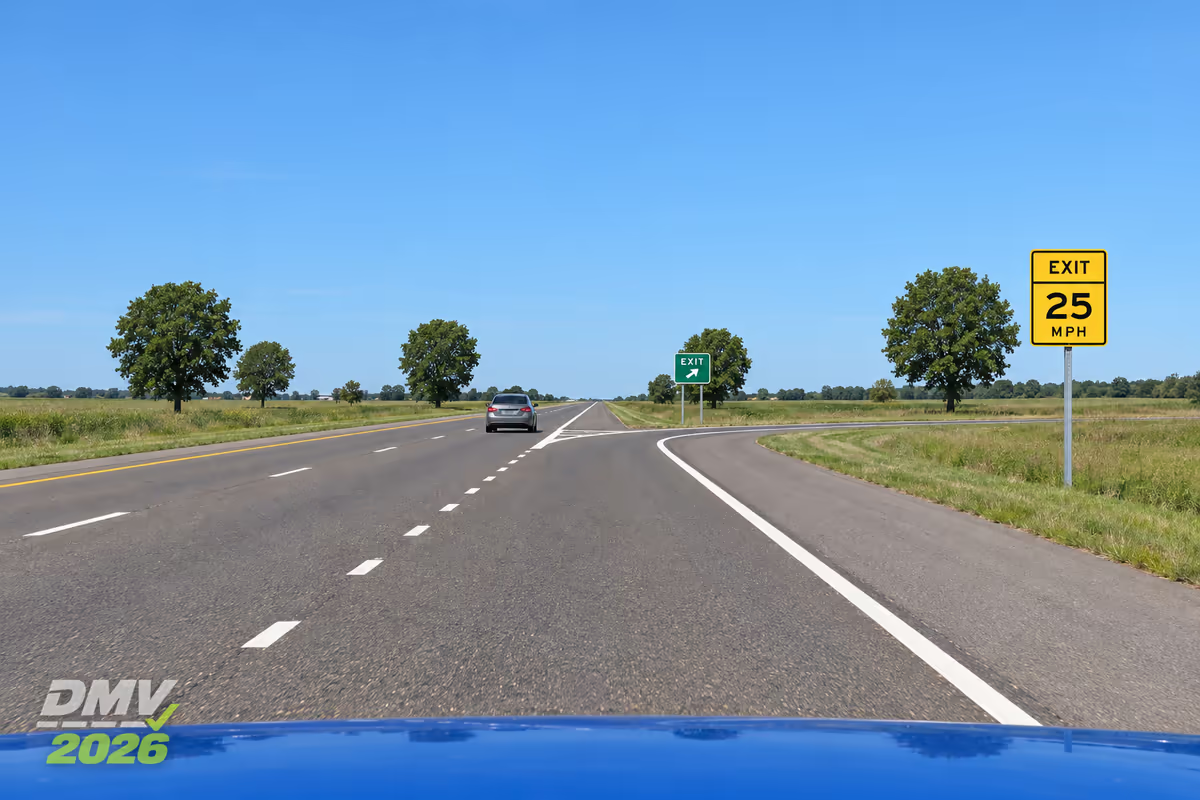
  10. Question 10 of 10 · Highways, merging and exits

    View through the windshield from the exit lane beside the freeway. Ahead, the exit ramp leaves the freeway and bends sharply to the right. A yellow sign at the right reads EXIT 25 MPH, and a small green EXIT sign stands where the ramp leaves. The freeway lanes run on at the left
    What speed do you take this ramp at?
    Show the answer

    The answer is A: The speed posted for the ramp.

    A ramp has its own posted speed, and it is set for the curve. It is much lower than the highway's because the ramp bends you off a fast road onto a slower one. Carry highway speed into it and you may not get around the bend. Slow down before the curve, not in it.

    “Check the posted speed for the deceleration lane.”

    AAMVA Model Driver’s License Manual, page 28

These 10 questions are from the DMV Champ app’s practice set, last updated October 23, 2026. Spot a mistake in a question? Email us.

How many questions can you miss on the Iowa permit test?

5

You need 20 of the 25 right.

Iowa DOT’s page on commercial license tests lists the Iowa operator test as 25 questions, and you can miss up to 5.

“Iowa operator (if applicable) (25/5)”

Iowa DOT, CDL testing page

DMV Champ uses the same format for Arkansas, Colorado, Connecticut, Kansas, Missouri, Nebraska, Nevada, North Carolina, North Dakota, South Dakota and Wyoming.

What happens if you fail the Iowa permit test?

If you fail, the examiner decides whether you can take the test again.

“An applicant who fails a knowledge test may repeat the test at the discretion of the examiner.”

Iowa Administrative Code, license examination rules (761 IAC 604), page 3

How do you take the Iowa permit test?

It’s given at Iowa driver’s license stations and county treasurer’s offices.

“This practice test generates 25 questions, randomly chosen from a larger group of sample questions that includes questions from the real knowledge test given at any Iowa driver’s license station or county treasurer’s office.”

Iowa DOT, practice test page

To take the real test, you schedule an appointment.

“Take our practice knowledge test online at iowadot.gov/mvd/driverslicense/manuals-and-practice-tests then schedule an appointment to take the test for real.”

Iowa Driver’s License Manual, page 65

Iowa DOT’s website explains how to take the test at home or at school, which it calls Skip the Trip.

“Taking your knowledge test at home or school (Skip the Trip)”

Iowa Driver’s License Manual, page 5

If you can’t read or understand the written test, you can ask for an oral test, given by an examiner or a machine.

“An applicant who is unable to read or understand a written test may request an oral test. The oral test may be administered by an examiner or by an automated testing device.”

Iowa Administrative Code, license examination rules (761 IAC 604), page 3

Test simulator

Practice in the Iowa format

25 questions20 to pass

DMV Champ teaches every question with its explanation, then checks you with 5 simulated tests of 25 questions, graded against the 20-correct passing score. 36 topics in Iowa: the 34 every state tests, plus winter driving and flooding, because the Iowa handbook teaches them.

Download on the App Store